Nuclear War Now! Productions VI
2026-01-20
by Niklas Göransson
Collaborations with Sabbat and Revenge anchored Nuclear War Now! deeper into the Japanese and Canadian undergrounds. Elaborate formats and exhaustive labour converged across scenes that shared little geography, but a common severity.
YOSUKE KONISHI: I’d been writing to Gezol for years, mostly to buy rare seven-inches and CDs. Getting hold of SABBAT releases in the US used to be difficult – especially those early ‘90s Evil Records titles printed in small quantities. As a collector, I was hell-bent on owning every possible variant.
From the eponymous 1985 EP until SABBAT’s fifth full-length a decade later, the Japanese thrashers self-released almost everything through Evil Records, run by bassist and vocalist Gezol. This changed in ‘98, when German label Iron Pegasus reissued their second album, “Evoke” (1992), as one of its very first titles.
Over the following years, Iron Pegasus issued a string of SABBAT releases – both archival and new. While making the music more widely available, it also turned the band’s catalogue into a collector’s rabbit hole of micro-variations, alternate pressings, and region-specific editions.
YOSUKE: Gezol released special Japanese versions with hand-copied obi strips, which added another layer of appeal. So, our initial contact revolved entirely around me ordering stuff. Once Nuclear War Now! was up and running, I reached out to see if we could work together.
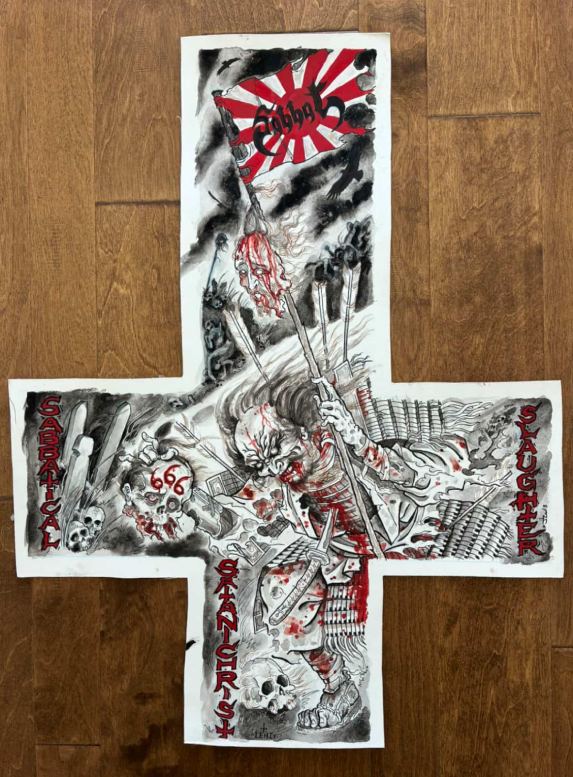
Since the Die Hard model was conceived and pioneered by Iron Pegasus, Yosuke had to bring out the proverbial big guns to impress Gezol. He proposed a triple six-inch vinyl edition housed in a foldout cover shaped like an inverted cross.
YOSUKE: At that stage, I was just throwing out ideas – I had no clue whether any of it would even be logistically possible. After calling a few different vinyl factories and asking around, I learned there’s only one plant in the US capable of pressing the six-inch format.
The SABBAT vinyl ended up being manufactured at Erika Records in Los Angeles, which is still operational today.
YOSUKE: To make those weird sizes, they basically press seven-inches with oversized runoff grooves and then stamp them into whatever shape is needed. It’s a stupid novelty, really, but at least the unusual presentation brought attention to SABBAT and made for a fun project to work on.
With the vinyl sorted, Yosuke turned his attention to packaging. Looking for someone capable of producing elaborate die-cut sleeves, he came across ThingMakers – a small Seattle company specialising in odd-format album jackets and similar custom materials.
YOSUKE: ThingMakers must’ve been the most aggressively DIY outfit I ever worked with. It’s unfortunate he’s no longer around, but there’s a reason for that: this guy was a terrible businessman, couldn’t meet deadlines, and regularly ran out of materials, forcing him to improvise.
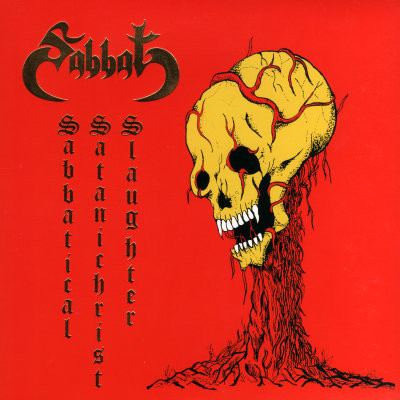
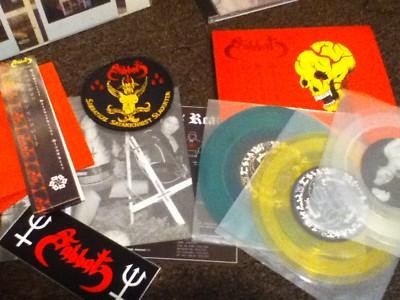
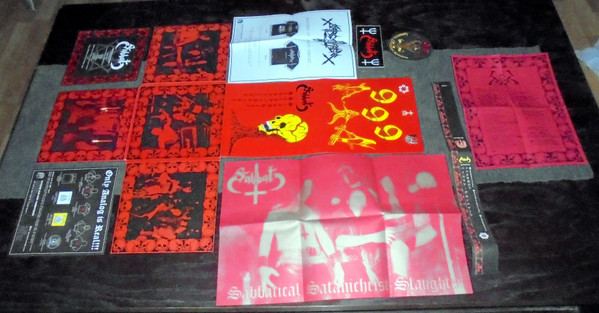
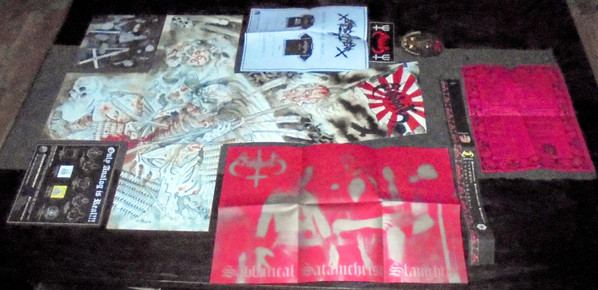
Few releases in the early N.W.N! catalogue embody Yosuke’s dual obsessions – handcrafted analogue presentation and Japanese underground heritage – as fully as “Sabbatical Satanichrist Slaughter”. Issued as a triple six-inch vinyl box set with an inverted-cross foldout standing seventy centimetres (28″) tall when opened, each record contains two tracks sourced from live recordings spanning 1986 to 2002.
In addition to its novelty format and ambitious packaging, this release also marked the first of many collaborations between Nuclear War Now! and Jef Whitehead. The LEVIATHAN frontman and his co-worker Tim Lehi handled all artwork.
YOSUKE: By then, Jef had already tattooed the N.W.N! logo on my left arm. The SABBAT piece I commissioned takes the form of a traditional Japanese woodcut – but with an added black metal twist. The idea of a satanic samurai didn’t really make sense to Gezol, but he found the culture clash amusing.
This sounds like an expensive, technically demanding release for a young label – which naturally raises questions about demand. I checked SABBAT’s Metal Archives page and nearly developed carpal tunnel syndrome just scrolling through their discography; even today, the band seems to release a live album every time they set foot on stage.
YOSUKE: Japanese grindcore bands tend to have gigantic discographies, so it’s not unique to SABBAT. I actually think this has more to do with Heavy Metal Super Star. If you remember a ‘zine called F.E.T.U. – Far East Thrash Union – the owner, Yohta, later started H.M.S.S.
When H.M.S.S. launched in 1999, the acronym stood for ‘Heavy Metal Super Star’. Since 2008, it apparently means ‘Hyper Mach Speed Saucer’.
YOSUKE: H.M.S.S. initially focused almost entirely on live recordings by SABBAT, then branched out to other Japanese acts like ABIGAIL and UNHOLY GRAVE. Later on, a few European bands such as SATANIC WARMASTER released material through the label.
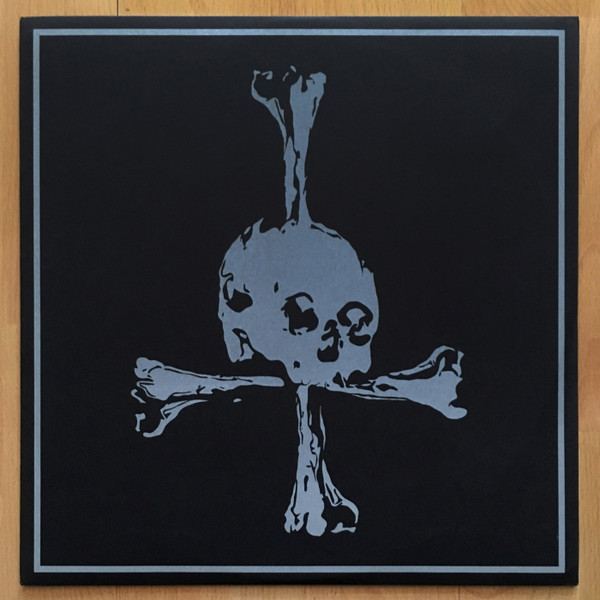
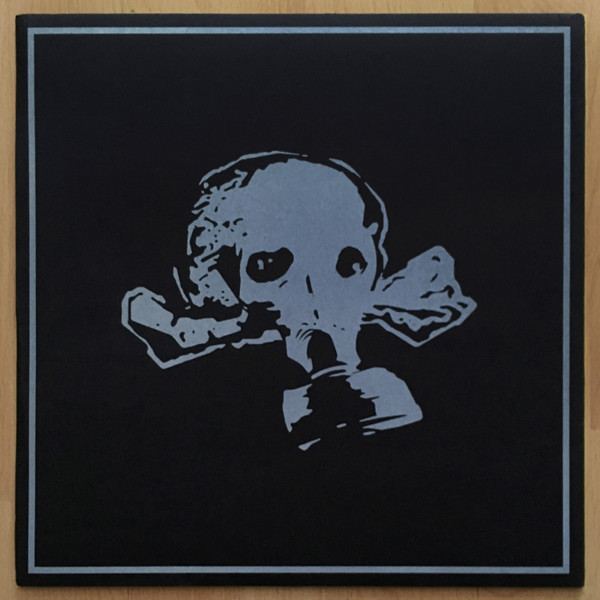
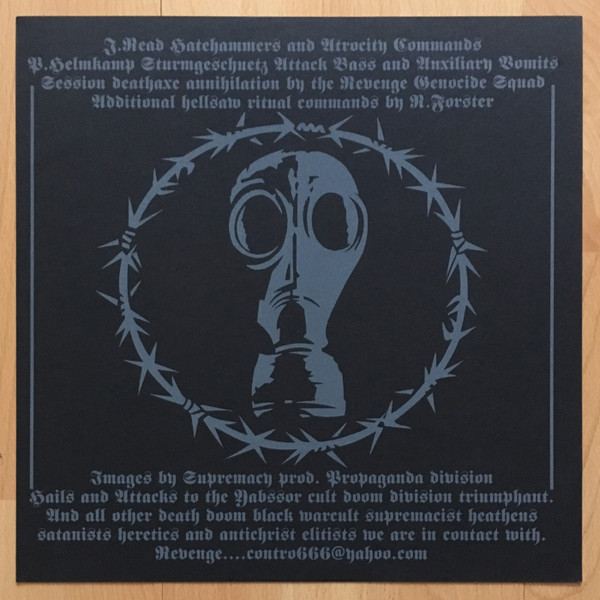
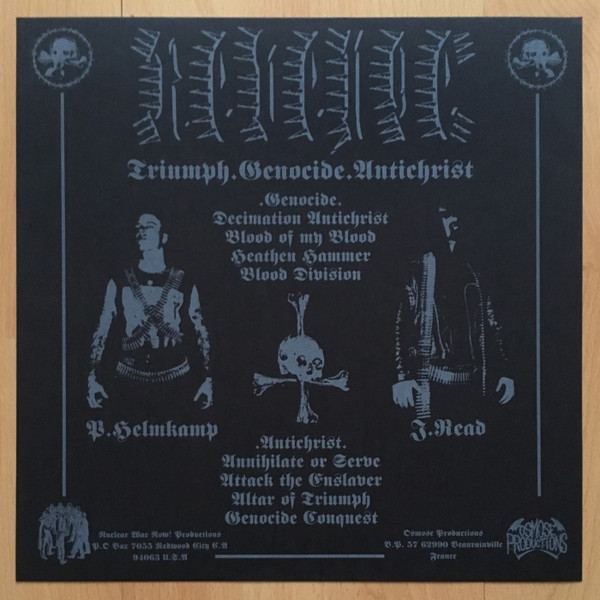
YOSUKE: Working with REVENGE always sat in the back of my mind. To me, that band represented the purest form of bestial black metal in the contemporary scene; nothing else came close. I reached out to J. Read, and I think Hervé from Osmose helped coordinate the process of reissuing their debut.
“Triumph.Genocide.Antichrist” came out through Osmose Productions on CD and LP in January 2003. The following year, a picture-disc edition further strengthened N.W.N!’s bond with the Ross Bay lineage: conceived by BLASPHEMY, carried forward by CONQUEROR, and sharpened by REVENGE. The matte cardstock and silkscreened sleeve reinforce the stark, militant feel of James Read’s iconic aesthetics.
YOSUKE: Now it’s almost a standard blueprint for ‘war metal’ – but J. Read is the originator. He created that entire look and deserves full credit for it. His style has been copied endlessly; for instance, I myself took clear cues from him when shaping N.W.N!’s visual identity.
The Die Hard edition included the usual extras like a poster and vinyl sticker, but also highly atypical packaging: a metal outer sleeve that slipped over the standard LP jacket.
YOSUKE: That was a complete pain in the ass. Some copies were made from hand-glued aluminum sheet metal, and the fit ended up too tight; you had to be careful not to bend the jacket when removing it. Other versions used recycled signage – road signs or similar – screen-printed on one side and manually bent into shape.
YOSUKE: I first met Brandon and Marco from BONE AWL around the time of my VON reissue; both of them came down to South San Francisco to pick it up in person. Klaxon Records was just getting off the ground then. We talked for a while, and they handed me their demo.
Brandon and Marco – also known as He Who Gnashes Teeth and He Who Crushes Teeth, respectively – make up the minimalist black metal duo BONE AWL. Operating out of Novato, California, their first demo tape, “Magnetism of War”, was released in 2002.
YOSUKE: I’m at least ten years older, so they must’ve been extremely young at the time. Still, Brandon and Marco were fully committed to underground black metal, which gave us plenty to talk about. We liked many of the same bands, and that shared passion naturally led to our labels working together.
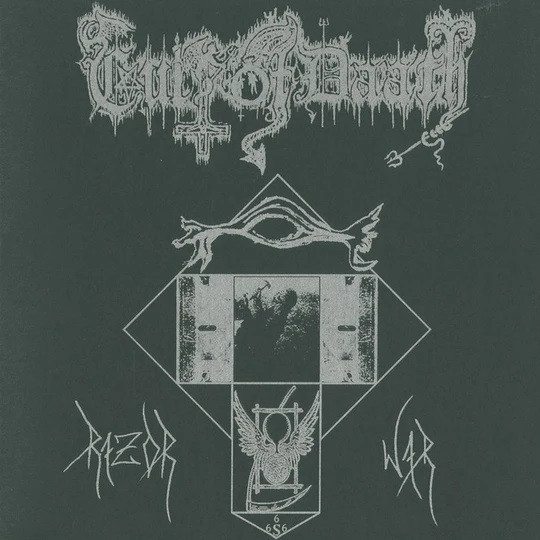
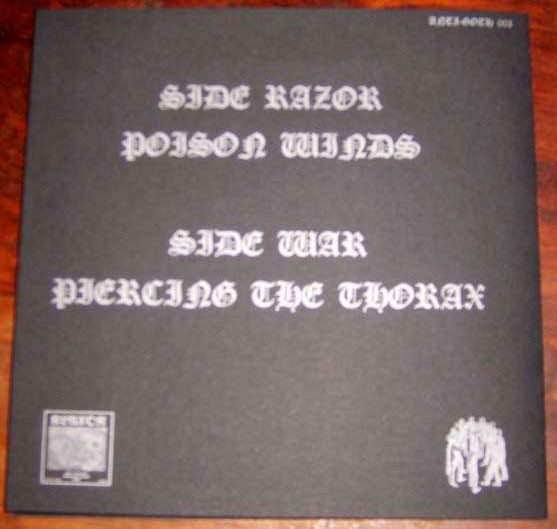
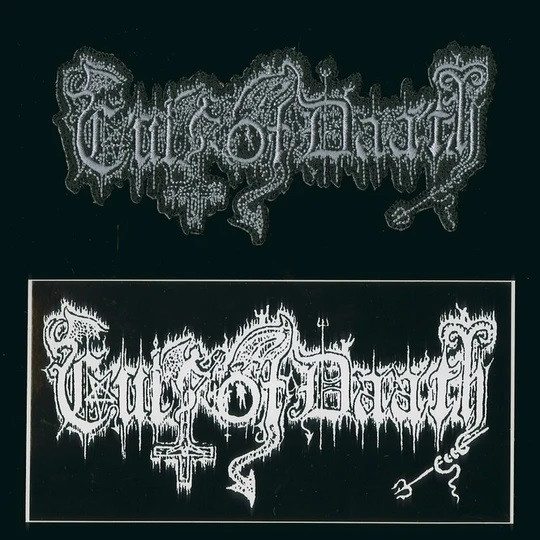
The first official collaboration between Nuclear War Now! and Klaxon Records surfaced in June 2004 with “Razor War”, a seven-inch by another US black metal duo: CULT OF DAATH.
YOSUKE: CULT OF DAATH was easily one of the strongest bands to come out of the millennium-era American underground. Honestly, very few others were doing anything particularly interesting. They also stood apart from that other ‘USBM’ scene that got embraced by outsiders.
In 2004? Who are you referring to now?
YOSUKE: Bands like XASTHUR and LEVIATHAN that – for whatever reason – gained traction beyond the metal audience. I personally believe this had a lot to do with Jef’s ties to the tattoo world and his skateboarding background. He was even on the cover of a Nintendo game.
During the late 1980s, California native Jef Whitehead was skating alongside future founders of major brands, gaining sponsorships of his own, and even appearing on the cover of Skate or Die 2: The Search for Double Trouble.
Whitehead became a professional tattoo artist in 1991. By 2004, around the time of “Razor War”, Moribund had recently issued LEVIATHAN’s second album, “Tentacles of Whorror”, and Jef was in the process of opening his own San Francisco parlour after almost a decade working under Ed Hardy at Tattoo City.
YOSUKE: Because of those connections, LEVIATHAN’s audience extended well beyond the metal scene – which helped blow up the whole ‘bedroom black metal’ phenomenon. I rejected the entire thing outright; none of it ever appealed to me, and I’d tell Jef as much straight to his face. These days, I care a lot less, but I was more of a purist back then.
After three years of working with United Record Pressing in Nashville, Tennessee, Nuclear War Now! started using the Czech vinyl plant GZ Media in 2004.
YOSUKE: That whole process was shifting away from pure DIY. Instead of dealing directly with the plant, I handed everything over to a broker – Eric at RecordPressing.com – and received finished vinyl. GZ made the CULT OF DAATH seven-inch, but I think the covers were printed separately.
Why was that?
YOSUKE: I’m trying to remember… in theory, everything could’ve gone through GZ. It might have been a materials issue – we wanted silver ink on black paper stock, which they couldn’t offer. Jimmy worked at a print shop in Chicago, so we probably had them made there.
Jim Kapsalis, vocalist and guitarist of CULT OF DAATH, handled the layout for many of Nuclear War Now!’s early releases.
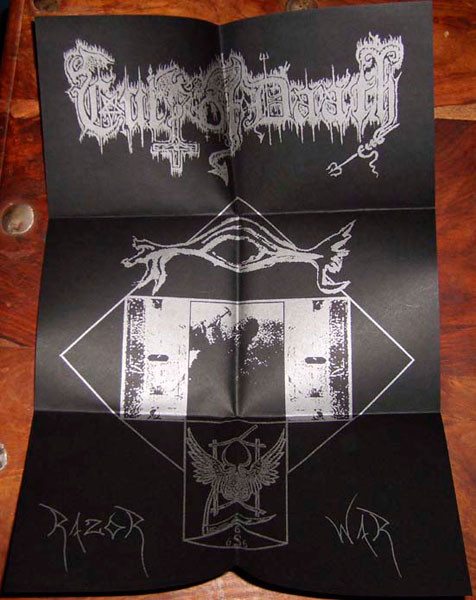
YOSUKE: Assembling those EPs involved a lot of manual labour. The covers arrived completely flat and had to be put together by hand. The posters – shoutout to Imprint Indie Printing – came the same way, which meant folding them down to a very specific size so they’d fit inside an EP jacket.
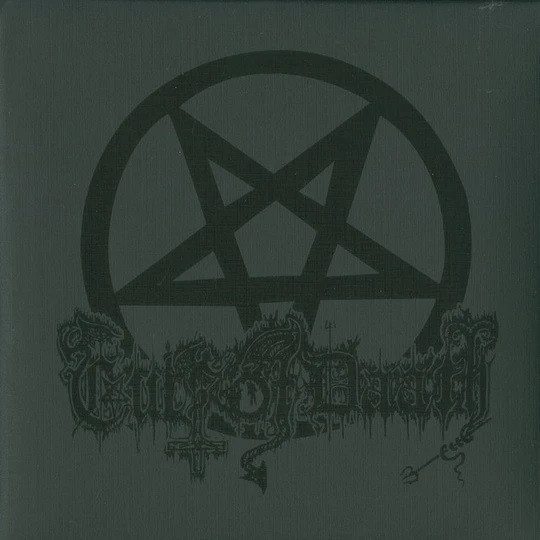
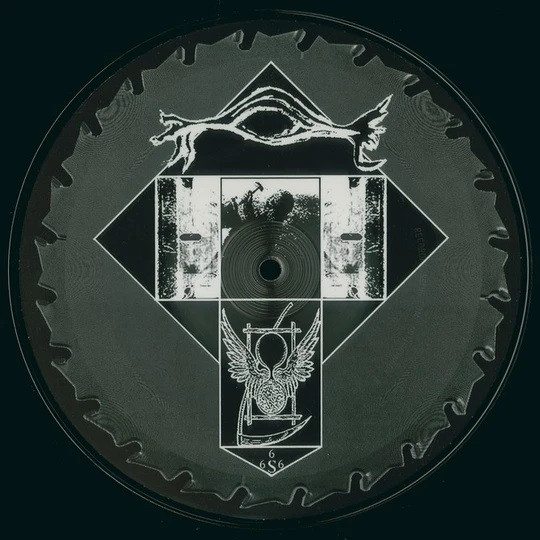
The Die Hard edition of “Razor War” – a heavyweight picture disc rather than a standard seven-inch – included a sticker, an embroidered patch, and a silver-print poster. All of it was housed in an industrial-grey envelope with low-contrast black artwork, courtesy of Silicon Genetics’ inkjet printer.
YOSUKE: I had no idea how to pull it off on those old machines, which led to endless experimentation – adjusting the paper tray and figuring everything out through trial and error. A few envelopes got jammed in the printer, and I remember panicking as I tried to fix it before anyone walked into the office.

YOSUKE: When we met, Brandon from Klaxon worked for Blackmetal.com. They were based in Novato, so I’d cross the bridge to the other side of the Bay Area – roughly an hour and a half from my apartment in South San Francisco – and pick up stacks of records in person.
Initially known as Extreme Subterranea, Blackmetal.com launched in March 1997. After two years as an online mail-order, the company expanded into music publishing, with “Fire Burns in Our Hearts” – the debut album of Finland’s CLANDESTINE BLAZE – as its first official release.
YOSUKE: The owner, Elden, came from the noise scene and used to have a project called ALLEGORY CHAPEL LTD. That’s how Blackmetal.com and CLANDESTINE BLAZE found each other – there was a connection through Mikko’s industrial label, Freak Animal. I also think Klaxon reissued some of Elden’s old tapes.
Klaxon Records’ first title was a 2003 BONE AWL seven-inch titled “Night is Indifferent”; shortly after, the label issued cassette editions of three ALLEGORY CHAPEL LTD albums.
YOSUKE: Looking back, Blackmetal.com had a significant influence on N.W.N! – I started ordering from them when I still lived in Virginia. They were among the very first online distros for underground metal, which meant I could go to the library and browse their catalogue.
log in to keep reading
The second half of this article is reserved for subscribers of the Bardo Methodology online archive. To keep reading, sign up or log in below.
Related reading