Liber Ketola X
2026-04-15
by Niklas Göransson
At the heart of Watain’s Casus Luciferi lay a deliberate inversion of the sacred. For Timo Ketola, intention was the decisive factor – the point at which art ceased to be mere design and became a form of magical work.
TIMO KETOLA: Art and design are such vast topics – and like everything else in man’s hands, we try to mature and refine them through rationality. The irony is that if I hadn’t spent so many years immersed in all kinds of layout work, it would probably be easier to follow my instincts.
KOSTA PAPAVASSILOU: Timo worked in a way where, in order to create, he needed to feel inspired – that was always his Achilles heel. He often struggled to find inspiration and wouldn’t draw anything unless he genuinely had it. So, I’d sit next to him and throw out ideas in a stream of consciousness to get the wheels turning.
TIMO: As things stand, I have to consciously strive for the unconscious. Paradoxically, I often need structured theory to explain why proper design is, for my purposes, the wrong choice – and why no design at all is the only right answer. So, I’ll sometimes recognise: ‘Yes, that looks good. Let’s not do it.’
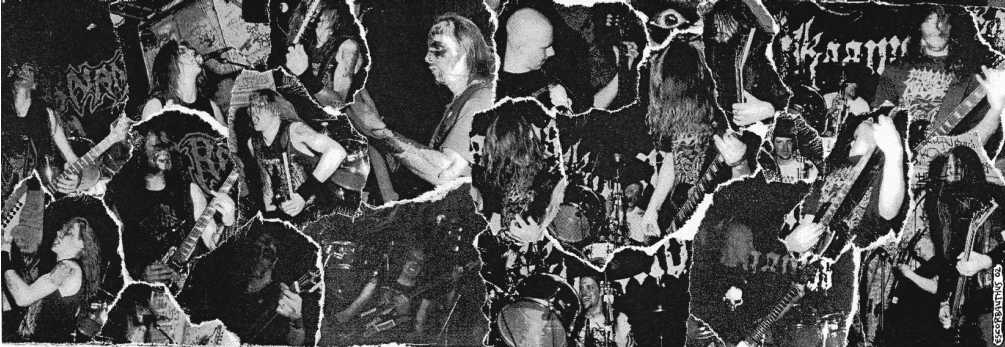
KAAMOS recorded their self-titled debut album in January 2002. In conjunction with the Candlelight Records release four months later, the band printed shirts adorned by one of Timo’s most recognisable KAAMOS designs: Shrines of Khem.
KOSTA: Shrines of Khem, what we called the ‘KAAMOS egg’, was Timo’s own thing entirely. Most other designs came from our brainstorming sessions, where I’d describe what I saw in my mind’s eye – ‘This is what I want, this is how it should look.’ He’d get the right feeling and then start working.
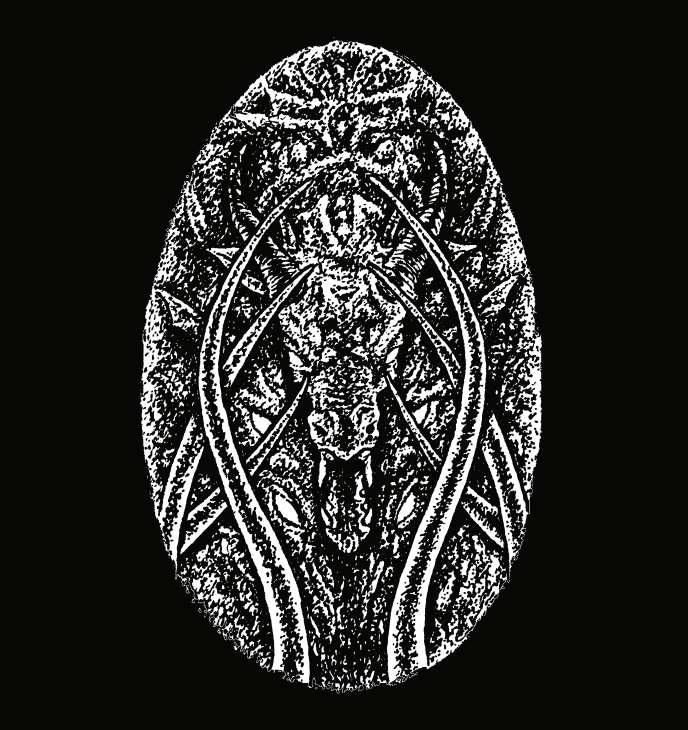
Kaamos - Shrines of Khem by Timo Ketola
TIMO: When we first heard the second REPUGNANT demo, Kosta and I just looked at each other, shaking our heads in disbelief. That these supremely skilled musicians could produce something of such raw, relentless power – it defied all expectation.
After REPUGNANT’s 1999 “Hecatomb” EP, founder and frontman Tobias Forge and guitarist Johan Wallin brought in Thomas Daun on drums and Gustaf Lindström on bass. In July 2001, the new line-up recorded the band’s second demo, “Draped in Cerecloth”.
TIMO: I doubt anyone who didn’t live in Sweden at the time can fully grasp how impossible “Draped in Cerecloth” was; none of that millennium-era retro crap. And speaking of which – if ‘old-school death metal’ exists, does ‘new school’ exist too? Not for me. There is only the school both REPUGNANT and KAAMOS belong to.
ERIK DANIELSSON: REPUGNANT and KAAMOS really stood out from the contemporary death metal scene, which was largely infested by hollow, grindcore-adjacent acts stripped of any darkness – the kind Euronymous would’ve called ‘life metal’.
In 2003, death metal veterans MORTEM made history as the first Peruvian metal band to tour Europe. Unfortunately, logistical issues forced the cancellation of several dates – among them a planned Stockholm show with REPUGNANT as supporting act. In their stead, KAAMOS stepped in on short notice.
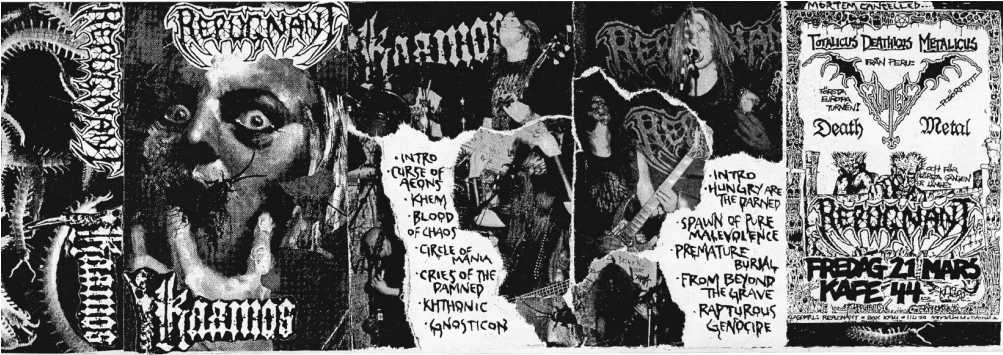
TIMO: I saw KAAMOS perform on many occasions – always a fucking great live act. The only time they didn’t sweep the remaining bands off the stage was that Kafé 44 show in 2003, when REPUGNANT were possessed by all the Satan in the universe.
ERIK: Insane gig. Seeing REPUGNANT and KAAMOS share a stage in Stockholm felt like a milestone in itself – something genuinely significant. And it was obvious to me that Timo had been the spider in the web behind it all.
KOSTA: I don’t remember if Timo was involved in organising the gig beyond making the poster – though he did release that KAAMOS–REPUGNANT live tape recorded the same night.
Later that year, Dauthus 1899 and Escorbuto – operated by REPUGNANT guitarist Johan Wallin – co-released the “Live in Stockholm 21.03.2003” cassette.
ERIK: That was the first show REPUGNANT did with corpse paint and blood. Before, they’d just worn… I don’t know, blue jeans and a DESULTORY T-shirt. But something clearly shifted there. Where this impulse came from is anyone’s guess – thoroughly overdue, in my view.
Did you see anything in their vision for death metal that resembled what WATAIN were trying to achieve?
ERIK: Yes, in the sense that we were essentially a counterreaction to the bands promoted by big magazines, and the grotesque spectacle they made of death and black metal. All of us – REPUGNANT, KAAMOS, WATAIN – dreamed of a situation where the glossy Photoshop aesthetic would be undermined by a decrepit, rotten darkness.
In terms of aesthetics, do you think WATAIN had more in common with them than contemporary black metal acts?
ERIK: Without question. Even the black metal bands we were close to, like CRAFT, KILL, or ONDSKAPT – aesthetically, that ambition simply wasn’t there. For them, it was more about conviction, and perhaps the music itself.
CHRISTIAN BOUCHÉ: There are great albums – and by 2003, we’d already released plenty of those through E.A.L. – and then there are albums that make history. In my personal pantheon of black metal, and sinister music in general, “Salvation” ranks among the most important works of all time.
In June 2003, both FUNERAL MIST’s “Salvation” and Norma Evangelium Diaboli appeared without prior warning, sending a ripple of surprise through the underground.
CHRISTIAN: Some actually dismissed FUNERAL MIST as ‘Christian black metal’. This ended up crystallising a few long-latent disagreements, leading me to cut ties with people who clearly didn’t understand it at all. In a sense, NoEvDia’s subsequent releases remained controversial in the scene, further vindicating my vision.
The earliest version of NoEvDia’s website announced several upcoming releases: KATHARSIS’ “Kruzifixxion”, WATAIN’s “Casus Luciferi”, the CD edition of MALIGN’s “Divine Facing”, and DEATHSPELL OMEGA’s “Si Monvmentvm Reqvires, Circvmspice”.
With the exception of FUNERAL MIST and KAAMOS, “Casus Luciferi” must have been Timo’s most intimate artistic collaboration up to that point. Unlike “Rabid Death’s Curse”, which mainly took form through emails, Erik would regularly travel to Brandbergen.
ERIK: “Casus Luciferi” was probably our best collaboration. Two memories stand out in particular: first, a remark Timo made on the profound significance of using Christian imagery, <Finnish accent>, ‘but turning them against God.’
Timo had moved from Helsinki to Stockholm as a young child, and never fully shed his accent. To a native ear, Finnish-accented Swedish has a distinctly hard, jagged quality – almost inherently melancholic in cadence.
ERIK: His point being: art undertaken with the right intention becomes a magical act. Then it’s no longer just an upside-down cross – now you’re working against creation itself, inverting what is sacred and making it profane. That was Timo’s fundamental perspective.
This, I can attest to. Whenever we discussed cover artwork for the printed editions of Bardo Methodology, any request involving esoteric symbolism would invariably demand explanation and justification.
ERIK: Timo wasn’t someone who’d just throw in a random pentagram somewhere. It was more like, ‘Okay – but in which direction should the trident be placed so the northern point ends up in the correct alignment?’ And yet, no matter how uncomfortable I sometimes felt under his critical eye, it helped me grow into my own values and ideas.
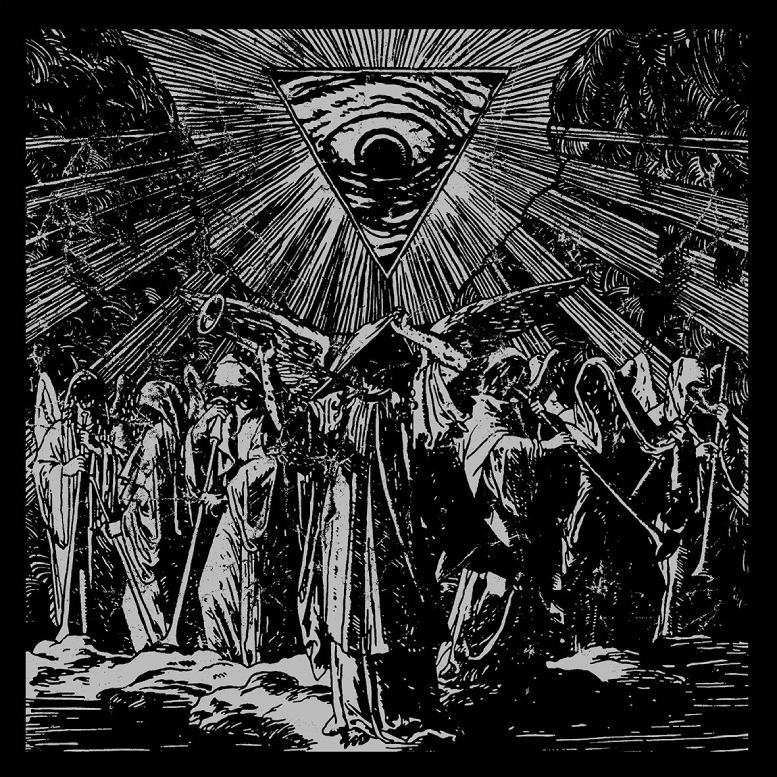
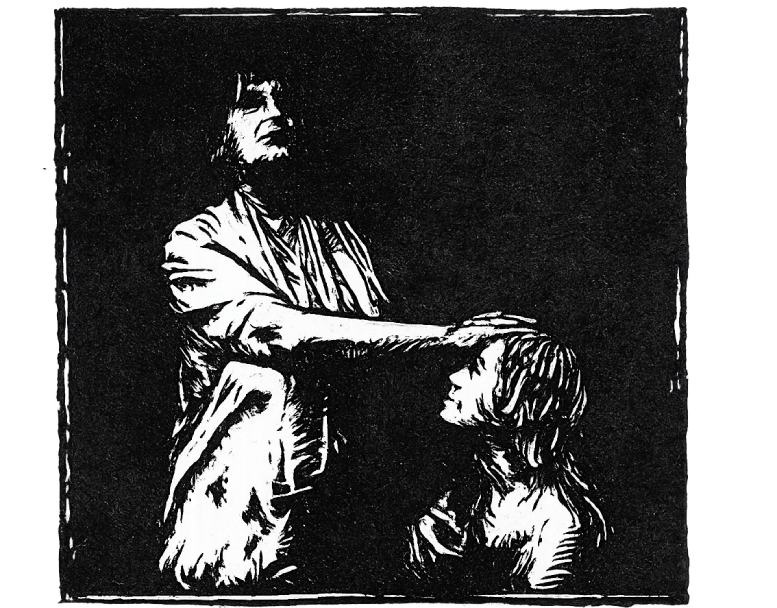
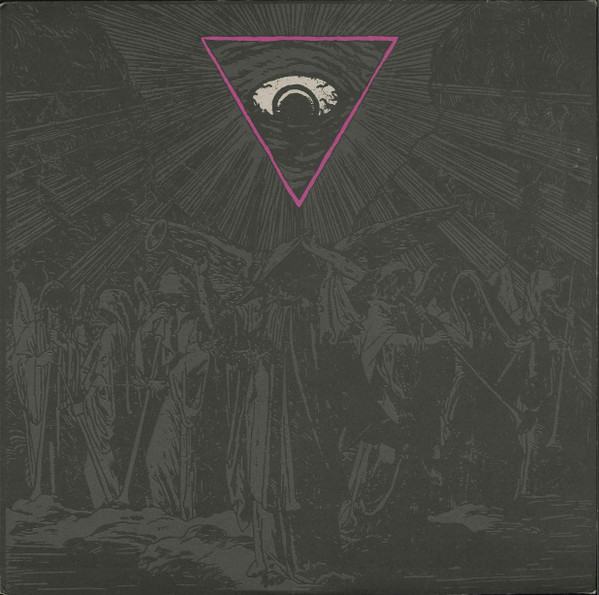
ERIK: I was browsing the website of some American Pentecostal church – they had a whole collection of black-and-white biblical illustrations – when I came across this woodcut. Such an incredibly album-cover-friendly image, with those seven angel trumpeters arrayed before the heavens.
When explaining his vision to Timo, Erik used Julius Schnorr von Carolsfeld’s engraving The Silence in Heaven as a reference point, along with some rough ideas for how it might be altered and expanded.
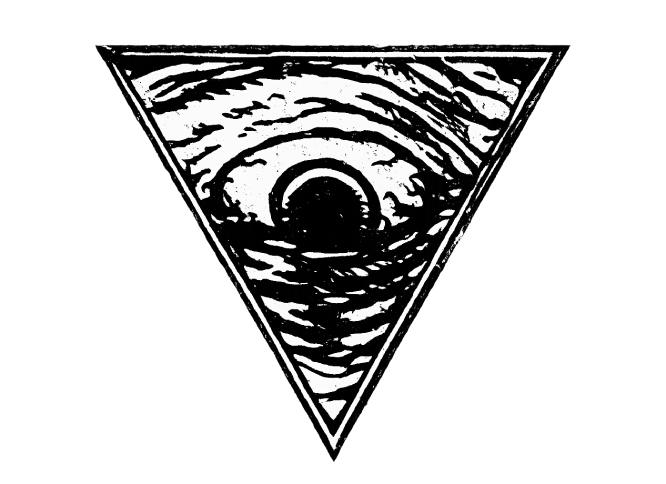
ERIK: When presenting ideas like the eye, I probably assumed Timo would have plenty of opinions. And sure enough: ‘Hm, but is there any thought behind this triangle?’ Which I had, actually. The number three, the trinity, the triad – I was deeply inspired by numerology leading up to “Casus…”.
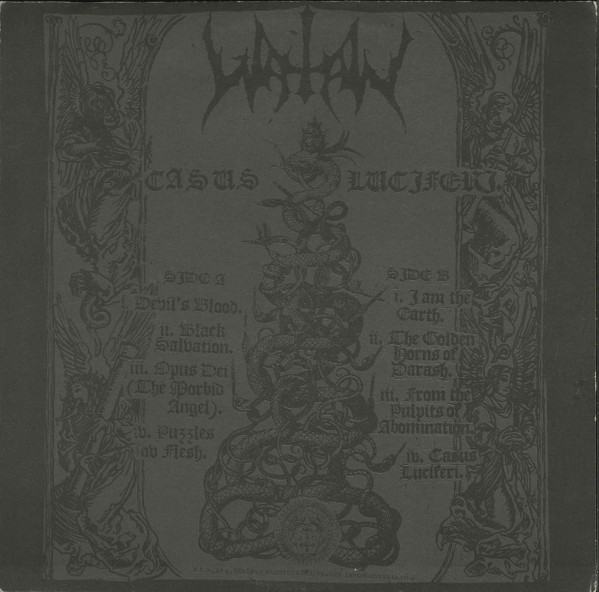
On “Casus Luciferi”, the number three recurs obsessively – in lyrics, imagery, structure, and even in what Erik calls ‘coincidences’. For instance, the line ‘…until all three cups are filled’ in “Devil’s Blood” falls precisely at 3:33.
When I interviewed WATAIN for Sweden Rock Magazine in 2007, Erik described the album as an unconscious convergence of these elements: the triangle as the simplest complete form, the trinity as a symbol of divine manifestation, and numerology as a way of aligning artistic intent with underlying patterns of meaning.
ERIK: The second standout memory, something Timo said about the cover, has always stayed with me: that this isn’t a dragon’s eye, or the pupil of some creature one could picture whole. Have you noticed what you might almost sense as eyelids – just faintly, the suggestion of them?
Not until now, no.
ERIK: Timo’s point being: this entity has no end. It continues beyond the triangle into eternity – formless, nothing but an eye at the centre of an infinite body. Every time I see the cover, I think of the perspective Timo had while drawing it. He was very grounded in matters like religion and magical practice.
By 2003, Timo had practised magic with Dragon Rouge for nearly four years. He was also deeply knowledgeable about Christianity, having been raised in a religious household.
ERIK: Timo’s background laid a crucial foundation – raising the level of our conversations and shaping how we approached the visual work from a magical standpoint. The layout I had in mind was woodcut-like, dense with charged symbolism. And it marked the first time we brought in Hebrew and Enochian.
TIMO: Regrettably, we failed with the Hebrew. I recall an Israeli fan writing to say it was all wrong – ‘but probably intentionally so, for blasphemous purposes.’ Well, no… I messed up. It’s not always easy to navigate the iconographical dichotomy of rock’n’roll. You gotta know the right from the wrong and the wrongful right!
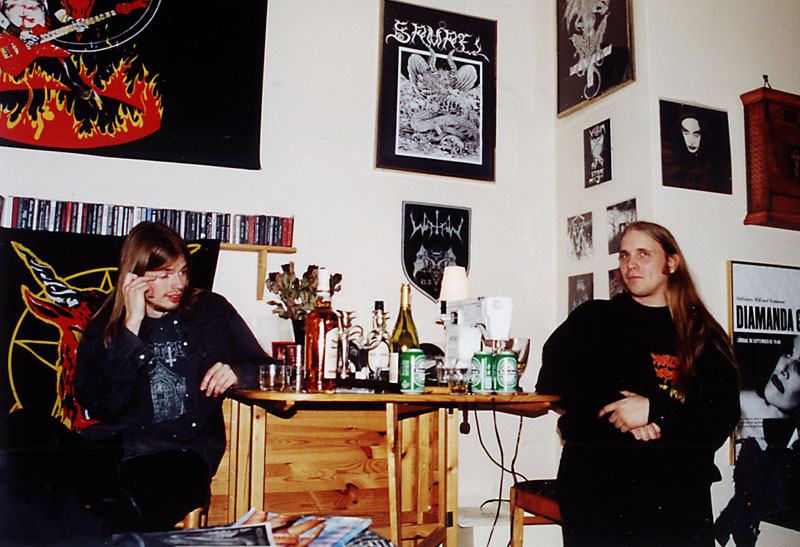
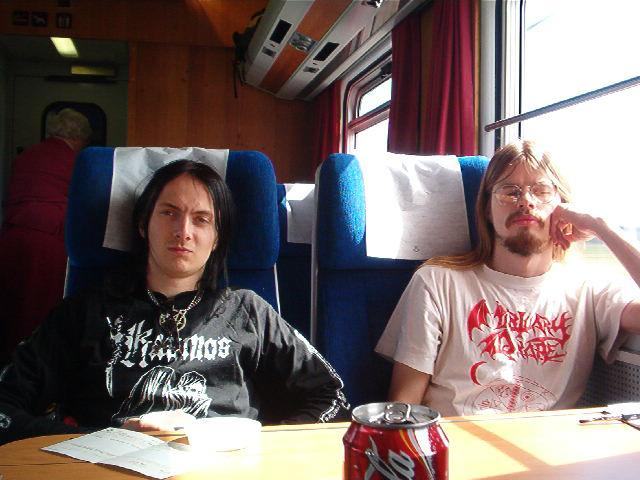
ERIK: At that point, our friendship was still coloured by the age difference between us. I don’t know if he succeeded, but Timo tried to teach me to drink whisky in a civilised manner – actually savouring it. I also remember the working atmosphere as quite grim, shaped in no small part by his stripped-back, almost ascetic home environment.
Sneering at the mere notion of computer audio, Timo’s work desk housed a pair of stereo speakers – draped in old-fashioned cloth to match the wallpaper – connected to the living-room turntable. Every twenty minutes or so, he’d have to leave the office to flip the record.
ERIK: The surrounding austerity, combined with the whisky and Timo’s characteristically dour outlook, almost made me feel responsible for the prevailing mood – especially since we were working on our album. Because he was very critical of the music.
While Timo was ecstatic over “Rabid Death’s Curse”, “Casus Luciferi” met with a more measured response. In the Dauthus Appendix, he acknowledged it as ‘a grand & majestic opus’, yet ‘fully within today’s borders’ – ‘I can count all its tentacles and understand everything about them.’
His main issue, unsurprisingly, was the clarity of sound: ‘So much is audible, as to leave little for the subconscious.’ Literally half the interview consists of Erik defending himself against snarky questions about the production – ‘What would the “Thy Mighty Contract” artwork be if you whisked away the fog?’
ERIK: He’d say, <Finnish accent> ‘I don’t get it. Erik, why doesn’t this sound like “Bride of Insect”?’ – ‘I’ve never tried to emulate NUCLEAR DEATH.’ – ‘Well, perhaps you should start!’ <laughs> I had to tell him, ‘Timo, the music is my domain. Right now, we’re focusing on the visuals.’ And he muttered, ‘Sure, sure. Still, it must be said; everyone else just tells you what you want to hear.’
The Appendix interview makes this point even more bluntly – ‘Have you received anything other than praise?’ Timo also questions the band’s ability to wage war against the world when ‘the world wants to make love to WATAIN’.
ERIK: God, how I miss that. More than anything else about Timo, actually – his complete refusal to tell you what you wanted to hear. It was quite liberating, if I’m honest.
ERIK: The vinyl sleeve was technically quite complex: no white base layer, printed colour by colour directly onto cardboard, purple first and then black. Nowadays, this is probably more commonplace, but I remember a lot of emails going back and forth between Christian and the factory.
CHRISTIAN: From what I recall, I basically tried to follow the instructions provided by Timo and make sure we were on the same page. There was a sense of experimentation, of not settling for the conventional.
ERIK: When selecting which shade of purple the triangle should be, Timo had to specify it with a colour code – and somewhere along the way, something must’ve gotten lost. In any case, I wasn’t happy; I thought it looked pink.
This would become a point of contention for years to come.
ERIK: When I voiced my displeasure, Timo scoffed, rolled his eyes, and said: ‘Listen to me now, young man: you don’t know what you’re talking about. This is a sacred shade of violet; it’s only your childish mind that sees pink.’
CHRISTIAN: A sacred shade of violet, heh. An unconventional choice – a bold move – but once Timo explained the thinking behind it, the result was clearly exactly what he’d envisioned. Later editions turned out slightly different, so some adjustments must have been made along the way.
ERIK: I remembered that “Deathcrush” had a pink cover, so at least some connection could be drawn. Nevertheless, in my eyes, it was the wrong shade. For the second pressing, we shifted to a much deeper purple tone.

CHRISTIAN: I was obsessed with what the next leap forward for black metal might be and likely projecting my very personal ambitions onto others. A deeply flawed way of thinking, of course. We were infinitely blessed to have strong-willed individuals such as Rostén, Erik, and the Germans of KATHARSIS pushing their own vision to its utmost limit.
Norma Evangelium Diaboli released the vinyl edition of “Casus Luciferi” in November 2003 – the same month as KATHARSIS’ “Kruzifixxion”.
CHRISTIAN: When the “Casus Luciferi” master tape arrived, I was desperately curious to discover what kind of vision had developed up north. Add to that the personal dimension: knowing Erik’s ambitions and capabilities firsthand, my expectations were even higher.
Can you elaborate on what you were expecting?
CHRISTIAN: I don’t know, perhaps a radically renewed WATAIN? After the first listening session, my analytical mind was somewhat taken aback to find the band building on elements already present in their earlier material, such as certain types of riffs and drum patterns.
ERIK: We weren’t really trying to revolutionise the genre – our main motivation was to recapture experiences we’d already had ourselves. We talked a lot about atmosphere and the physical impact of music: those cold chills, moments where your body responds before the mind does.
CHRISTIAN: I caught myself and thought: ‘Stop analysing – just listen.’ Only then, once I let the music reach me at an emotional level rather than fixating on form, did the full, brilliant magnitude of “Casus Luciferi” wash over me. By the end of the second listening session, I was sweating and shaking, almost suffocated by its intensity.
ERIK: Håkan and I wrote most of the material, and both of us had a strong fondness for primitive, chaotic black metal like BEHERIT, early SAMAEL, and so on. Maybe this doesn’t come through all that clearly in strictly musical terms – but atmospherically, I think we managed to capture something of it.
It may be a tired cliché to describe “Casus Luciferi” as a hybrid of “De Mysteriis Dom Sathanas” and DISSECTION, but it’s difficult to avoid that comparison altogether.
ERIK: Right, it really is hard to get around. Those were very much cornerstones of our temple at the time – and remain so, frankly. But you must also factor in aspects that weren’t strictly musical, yet still had a profound influence on the sound.
log in to keep reading
The second half of this article is reserved for subscribers of the Bardo Methodology online archive. To keep reading, sign up or log in below.
Related reading