Liber Ketola XI
2026-04-22
by Niklas Göransson
Si Monvmentvm Reqvires, Circvmspice saw Deathspell Omega pursue totality across every aspect of the work. Timo Ketola played a central role, carrying concept, language, and visual form through with discipline and precision.
Artwork by Timo Ketola
CHRISTIAN BOUCHÉ: As a young musician, you probably start by stealing album artwork from books. The next logical step is commissioning an artist to help bring your vision to life. When the time came to define the visual identity of DEATHSPELL OMEGA’s second era, I immediately thought of Timo.
In its latter stage, Christian’s first serious band, HIRILORN, drew on historical documentation – human atrocities in particular – as both conceptual and visual foundation. Similarly, the early DEATHSPELL OMEGA releases favoured a crude, minimalist aesthetic.
CHRISTIAN: The entire first era is a bit of a blur, so my memories are somewhat murky. Those years were spent obsessively digging through the rotten soil of reactionary black metal – musicianship felt largely irrelevant, since the material wasn’t very technically demanding.
What Christian refers to as the first DEATHSPELL OMEGA era spans from the 1999 demo “Disciples of the Ultimate Void” to the year 2002.
CHRISTIAN: From a musical standpoint, the one release I consider subpar is the MOONBLOOD split – solely because the backbone of our line-up was missing: a proper drummer. Shaxul had just resumed playing, and we should’ve waited another six months for him to recover some degree of stamina.
Aside from DEATHSPELL OMEGA’s demo, which featured HIRILORN drummer Yohann, Shaxul handled both vocals and percussion throughout the first era.
CHRISTIAN: Generally speaking, a creative, energetic drummer can make a world of difference. Without one, your rhythmic foundation is bound to be mediocre – dragging entire songs down as you’re forced to settle for slower tempos and a mere handful of reliable drum patterns to choose from.
The first two albums, “Infernal Battles” and “Inquisitors of Satan”, were released by Northern Heritage as vinyl-only editions limited to a few hundred copies. In hindsight, Christian has characterised this fiercely underground mindset as both elitist and somewhat naïve.
CHRISTIAN: We lived that ultra-radical, militantly primitive approach to black metal twenty-four hours a day – fully focused on conveying our clearly defined, deliberately narrow vision. Those early releases were essentially variations on a single idea, both musically and conceptually.
While the themes bear some resemblance to HIRILORN, Christian had also begun exploring a lyrical tone intended to be both disturbing and excessive, yet distinct from death metal’s often caricatured extremity.
CHRISTIAN: Those lyrics hold no particular pride of place for me – neither better nor worse than much black metal of that era. They were clearly influenced by the excesses of the Marquis de Sade, whom I began reading at the tender age of fifteen, and whose work profoundly altered my understanding of what humans are capable of.
The Marquis de Sade – an 18th-century French nobleman, libertine philosopher, and author of works so transgressive they earned him nearly three decades of imprisonment – occupies a peculiar place in the Western canon. Dismissed for centuries as mere pornography, his writings have since been reclaimed by psychoanalysts, existentialists, and avant-garde artists alike.
CHRISTIAN: There’s a reason why the Surrealists were so fond of Sade: his writings tend to melt the veils concealing reality, acting as a form of liberation from everything upon which society is built. Some of those limits exist, obviously, for good reason.
CHRISTIAN: By 2002, the first era of DEATHSPELL OMEGA had run its course. I’d already mentally outlined what I felt was the next necessary step, both conceptually and musically: “Si Monvmentvm Reqvires, Circvmspice”.
When you say ‘mentally outlined’, did that initial spark contain anything close to the end result?
CHRISTIAN: The ambition, in skeletal form, certainly existed. A lot was planned. The full scope of our undertaking revealed itself gradually – some things fell into place, others didn’t, and certain missing pieces had never been part of the initial vision. The impulse felt larger than life; it pushed me to my limits and beyond.
The shift must have been abrupt, given that DEATHSPELL OMEGA discarded a full album’s worth of material. Originally intended for a split with CANTUS BESTIAE and the “Crushing the Holy Trinity” compilation, it was later released as “Manifestations 2002”.
CHRISTIAN: In isolation, the material was strong and competently executed – but measured against my new ambitions, it felt limited and underwhelming. That said, the first era embodied something meaningful; without it, none of what followed would’ve been conceivable.
Much like End All Life Productions laid the groundwork for Norma Evangelium Diaboli, the radical nature of the first DEATHSPELL OMEGA era served as a necessary foundation. Notably, both trajectories ran in near-perfect parallel.
CHRISTIAN: Two sides of the same coin. Our accomplishments up to that point – musical and otherwise – were not cast aside entirely. But what came next differed fundamentally in nature: born from everything the previous era had given us in experience and values, yet equally a rejection of its limitations, and boiling over with radical new ideas.
As DEATHSPELL OMEGA entered its second phase, bassist Khaos was entirely on board. Shaxul, on the other hand, parted ways with the project. After considering several vocalists, Christian brought in Mikko Aspa of CLANDESTINE BLAZE and Northern Heritage – the Finnish label that had released the first two albums.
CHRISTIAN: Mikko is an incredibly creative individual, and the breadth of his career clearly attests to that. As a musician, he’s probably more intuitive than methodical, yet he’s adapted effortlessly each time we’ve ventured into uncharted territory.
The connection traced back to record trades between End All Life and Northern Heritage in 1999 – a working relationship that gradually became personal. Equally important was Mikko’s broader artistic background; his involvement in noise and industrial projects aligned with Christian’s ambition to push beyond conventional black metal structures.
CHRISTIAN: There is an anecdote about SLAYER’s “Reign in Blood” – the greatest thrash album of all time, in my view – that has always stayed with me. When you consider who shaped its sound, and apparently also streamlined some of the song structures, it turns out to be two men from outside the metal world entirely: Rubin and Wallace.
Rick Rubin had made his name in hip hop – co-founding Def Jam Recordings and working with artists such as RUN–D.M.C. Andy Wallace, brought in as engineer, was similarly unencumbered by metal orthodoxy.
CHRISTIAN: And yet SLAYER arrived at a clear, massively violent production that redefined what the genre was capable of. The same logic applies to musicians: if the intention is to broaden your scope, it helps to work with someone whose perspective is not limited from the outset.
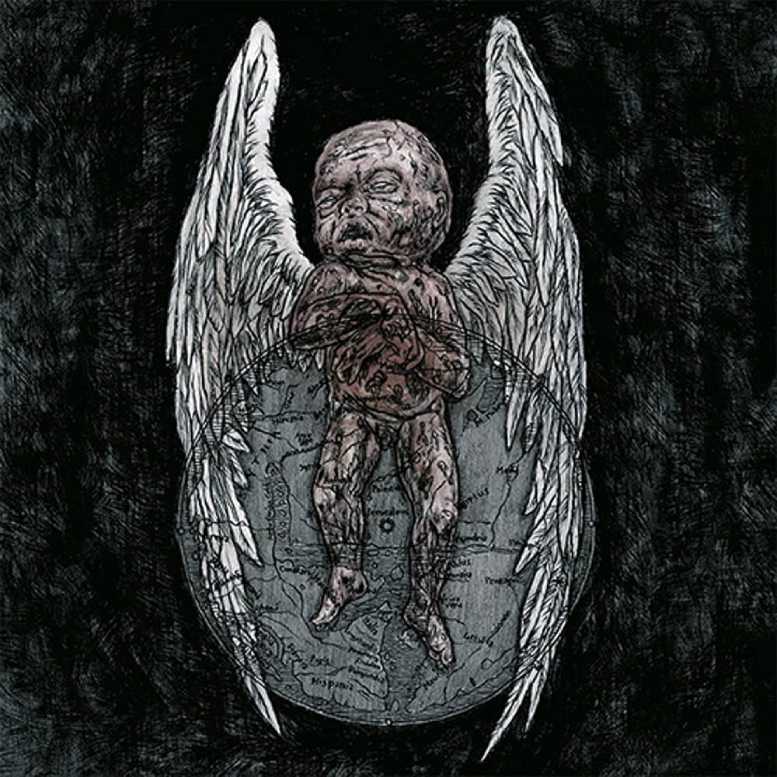
CHRISTIAN: For “S.M.R,C.”, we still used plenty of archival imagery, some of it modified to suit our purposes. But the overall layout, the cover art, and many of the details owe their precise form to Timo’s swift understanding of what we were trying to achieve.
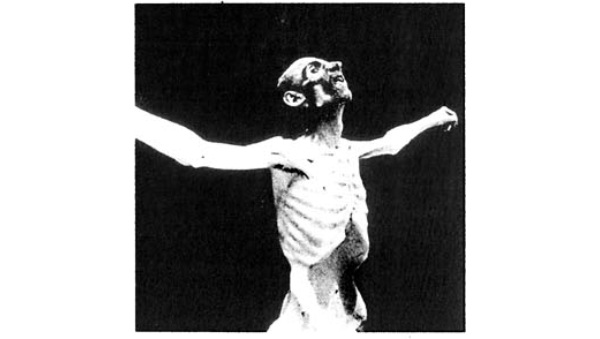
Much of the original artwork was developed from carefully selected source material. Mikko Aspa contributed some of this, including a reference photo for the expired cherub on the cover. Once the overall structure had been defined, Timo and Christian turned their attention to the finer details.
CHRISTIAN: Timo suggested the expressive gesture of the winged creature – specifically its hands. In this, he drew on a long-standing tradition of classical painting, whereby the body’s movement reveals its soul, serving as a bridge between the visible and the unseen.
This idea comes from the classical and Renaissance traditions, where gesture was treated as a precise visual language. Hands carried particular weight, conveying inner states and spiritual tension.
CHRISTIAN: All of this is quite codified in iconography, as one can see in any museum. We were, at once, engaging with and perverting that entire tradition. Timo’s suggestion was absolutely spot on: since the lyrics already drew on classical texts, incorporating such elements allowed us to connect with the traditions of painting as well.
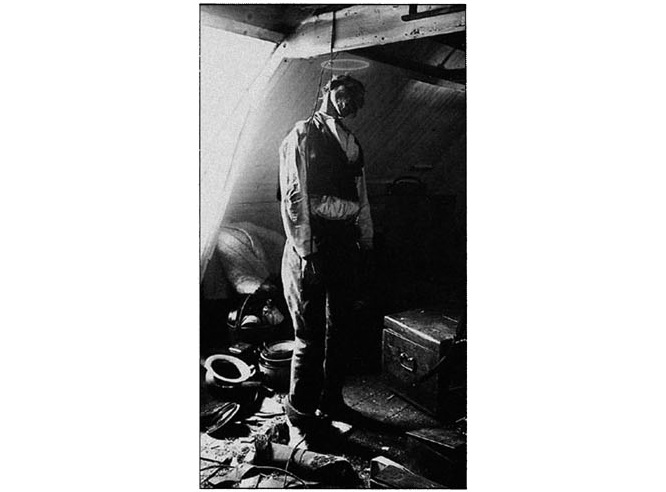
Much like the FUNERAL MIST collaboration with Rostén, DEATHSPELL OMEGA’s conceptual direction – themes, imagery, references – came from Christian, while Timo gave it form. Beyond the commissioned artwork, he also introduced symbolic elements into archival photographs.
CHRISTIAN: I would send Timo a given image and describe the changes I wanted made. For the hanged man, I requested an aureole – a halo. For the two lesbian women, angel wings, and so on.
Was this a deliberate choice – to work from documentary material rather than depicting fictional scenes through original artwork?
CHRISTIAN: Yes. Photographs lend a sense of reality no drawing can fully replicate, however well executed. A form of digital montage, if you will. Collage is a fascinating technique, one that industrial music has employed to great effect.
As did Daniel Rostén and Erik Danielsson, Christian emphasises Timo’s responsiveness and critical engagement – both in developing ideas and in dismissing weaker ones without hesitation.
CHRISTIAN: I already had a tremendous amount of respect for Timo, and he was invited into the project with my full willingness to hear him out. You do not bring someone vastly more competent in a given field on board only to ignore them from the outset.
Was the twenty-four-year-old Christian able to process such uncompromising feedback constructively – without tempers flaring?
CHRISTIAN: When I disagreed, it never became a confrontation – merely a discussion about which path would lead to the best result. We were both in the same boat. And, to Timo’s credit, he was incredibly generous with his time, explaining each and every suggestion.

CHRISTIAN: The entire layout felt like a mountain to climb – and as such, best approached one step at a time. That’s how an otherwise insurmountable problem yields to gradual progress. Every element demanded the same attention, from the cover to the typography.
With “Si Monvmentvm Reqvires, Circvmspice”, the written word became the foundation – the central axis of DEATHSPELL OMEGA’s creative process. The King James Bible was a key structural and stylistic influence, shaping the lyrics in both language and cadence.
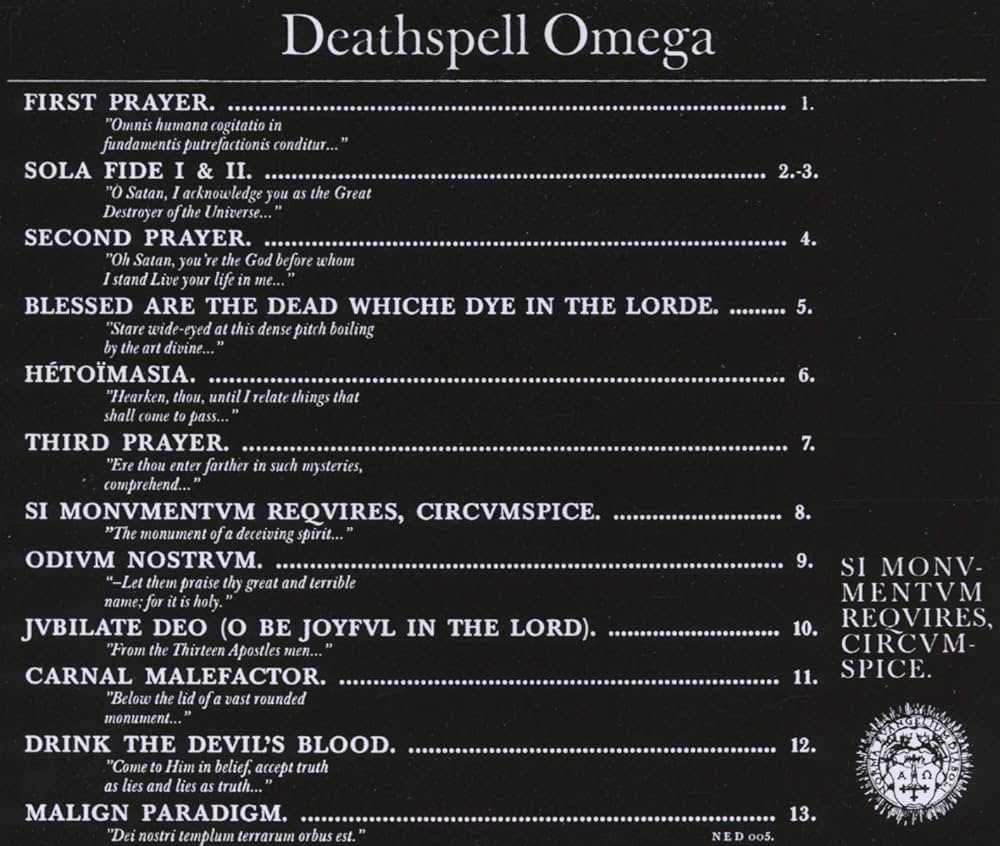
Typography was equally central. Timo’s handling of text drew directly from the album’s conceptual sources – the back cover’s arrangement of song titles being the most visible example.
CHRISTIAN: The tracklist idea shows precisely why I chose Timo: he brought perspectives and experience we did not possess. I expected him to think differently, to challenge my assumptions and push back. He was such a singular being that anything conventional or lukewarm would have surprised – and annoyed – me to no end.
The collaboration operated under strict anonymity. Though never formally credited, Timo became an integral part of the collective. From 2003 onward, his role within DEATHSPELL OMEGA extended beyond visual design into reviewing lyrics.
CHRISTIAN: Imperfect as it remains, my command of English owes much to the months I spent studying the King James Bible while working on “S.M.R,C.”. Timo was already exceptionally well versed in English – especially in what lies beneath a language, its syntax and inner architecture.
What kind of feedback would he provide?
CHRISTIAN: All kinds. Mostly punctuation, but also the occasional question about a metaphor. I remember one very long email explaining semicolons; I believe it ended with the words, ‘A friend doesn’t let a friend use semicolons lightly’, or something to that effect. More often than not, he simply shared his thoughts on the texts.
As evidenced by the OFERMOD, FUNERAL MIST, and WATAIN features in Dauthus, Timo had strong opinions on ‘orthodox black metal’. Were you subjected to a similar level of theological scrutiny?
CHRISTIAN: Not that I recall, no. Our exchanges remained constructive; nothing combative comes to mind. If I may venture a guess, DEATHSPELL OMEGA’s lyrics often approached things from a different angle than those of the Swedish bands you mention. Timo regularly asked about the origin of certain references, some of which were new to him. An exceptionally well-read man – but no one knows everything.
Did he introduce you to any of his favourite writers?
CHRISTIAN: Quite a few – the Portuguese Fernando Pessoa, for instance – though the exchange also worked in the other direction. One of the principal merits of DEATHSPELL OMEGA’s work has been bringing attention to writings that were uncommon: not only within the metal subculture, but in popular culture more broadly.
CHRISTIAN: In light of the grandiose vision behind “S.M.R,C.” – one driven by genuine aspirations to elitism and excellence – any form of limitation stood in the way of fulfilling our goal. That standard had to manifest not only conceptually, but musically as well.
Rather than relying on intuition, the material was meticulously composed and refined through extensive rehearsals.
CHRISTIAN: Lofty ideas demand technical means to realise them – one cannot simply plug one’s brain into an amplifier, not yet anyway. This meant improving as musicians out of artistic necessity and to ensure coherence: the broader aspiration included advancement on every level.
Musically, “Si Monvmentvm Reqvires, Circvmspice” departs from the hostile, lo-fi malice of the first era, moving toward a more expressive and atmospheric sound.
CHRISTIAN: The songs still rely on relatively simple, riff-based structures, but the biggest change lay in the character of the riffing, and in how bass and drums interacted with it. The musical architecture, however, with the prayers woven through it, was a genuine novelty.
“Si Monvmentvm Reqvires, Circvmspice” incorporates fragments of liturgical chants, spoken invocations, and manipulated choral passages threaded through the music – appearing as intros, interludes, and underlying textures.
CHRISTIAN: Allow me to illustrate: for “First Prayer”, it was a fairly simple process. I recorded the choir passage from a vinyl record I owned onto a tape player, then altered the pitch. I also produced the inverted guitar myself, using the same equipment.
Attentive listeners will notice an obvious homage in “Malign Paradigm”, which incorporates the main riff from MALIGN’s “Ashes and Bloodstench”. One wonders, however, whether DEATHSPELL OMEGA drew from the same source in the long, atmospheric non-metal passage in “Carnal Malefactor”.
As it happens, I once asked MALIGN songwriter Mörk about the choir interlude in “Ashes and Bloodstench”. He said the song was too ‘headbanging-friendly’, and that they wanted to dissuade drunken metalheads from playing it at parties.
CHRISTIAN: I had no such concerns, no – we were mainly trying to enhance the emotional dimension of the song, to make it more of an inward trip. But the “Malign Paradigm” tribute was quite transparent, wasn’t it? We simplified that riff and built something around it to close the album.
CHRISTIAN: The same logic that led us to seek genuine expertise for the visuals applied to the sound as well. Having recorded and mixed the album ourselves, we listened back – and were completely underwhelmed. The anticipated great leap simply wasn’t there.
In retrospect, this was the logical consequence of relying on the very same equipment as for the first-era recordings.
CHRISTIAN: Frankly, I was never much of a recording engineer – I took on that role purely out of necessity. It became a valuable lesson: for certain tasks, however strong the urge to control everything, you’re better off entrusting them to those who have devoted their lives to mastering a single craft.
After discarding a second fully recorded album in succession, Christian reached out to his friend Franck Hueso, who’d produced HIRILORN’s 1999 EP “Depopulate (Prelude to Apocalypse)”.
CHRISTIAN: Franck hauled all his equipment into our rehearsal room and set up an impromptu studio. Once everything had been tracked, he finalised the mix at a modest home setup. Given the limited means he started with, it’s a pleasure to see where he’s ended up today.
Better known as Carpenter Brut, Franck Hueso is a prominent synthwave artist. The two met in high school, bonding over metal – Hueso having noticed Christian because of his band shirt.
CHRISTIAN: As part of the curriculum, we had to complete a creative project of some sort. The school ran a radio station, so I opted to do a show with Franck and a couple of other guys. I played BURZUM and EMPEROR, while they focused on, I suppose, BIOHAZARD or NAPALM DEATH – an unfortunate mix that Euronymous would not have approved of.
It is curious how two childhood friends would go on to make such an impact in vastly different genres. On a related note, I learned that their hometown, Poitiers, is known as the ‘City of a Hundred Steeples’ due to its high density of religious monuments. This, in turn, brings to mind the album title, “Si Monvmentvm Reqvires, Circvmspice” – ‘If you seek His monument, look around you’.
CHRISTIAN: No, it really was about Christopher Wren’s epitaph, which I stumbled upon in the copious documentation I’d gathered for “S.M.R,C.”. In a nutshell, our use of it amounts to a variation on the belief held by certain Gnostic and Manichaean currents, as well as by the Cathars – that the material world is devoid of God’s saving grace.
log in to keep reading
The second half of this article is reserved for subscribers of the Bardo Methodology online archive. To keep reading, sign up or log in below.
Related reading