Liber Ketola XXXIV
2026-09-23
by Niklas Göransson
In the blood-smeared pages of Dauthus, StrataNael editor Pierre recognised a kindred spirit. By 2010, their shared convictions had found expression in years of correspondence – much of which would resurface in a rare interview with Timo Ketola.
MR PIERRE: I originally started the fanzine back in my early tape-trading days, around 1989 or so, but never managed to finish it. Several years later, I decided to redo everything and see it through. So, in ‘95, The Rose became the first issue of StrataNael.
Then why isn’t it called #1?
PIERRE: Look at the past issues, and there’s always the same foreword explaining that I don’t believe in numbers or chronology: I believe in words. Think about it – would you take your favourite band and call their records BATHORY #1, BATHORY #2, and BATHORY #3? No. It’s “Blood Fire Death”, then “Twilight of the Gods”, et cetera.
Researching the publication arm of StrataNael presents some unusual bibliographical challenges: the editions are named rather than numbered, spelt differently depending on which flyer or cover you happen to be holding, and dated nowhere at all.
The sole trace of the second issue comes from an unlikely direction: a 2006 Vice post in which WATAIN frontman Erik Danielsson – broke at the time – put parts of his ‘zine collection up for sale. Item twelve is ‘StrataNaël #MUCILAGE’, dated 1997 and summarised as ‘Satan, Satanism, Satan, Drugs, Satan etc.’
PIERRE: Mucilage is the worst of the worst, so it’s the best of the beast. To give you an idea, I made it on a gigantic, fifteen-kilo Macintosh with a floppy disk inside. MS Word didn’t exist; the program was called Claris, which is why the fonts came out weird. There wasn’t much to choose from beyond Arial – even finding a gothic font took me several years, so visually it’s all over the place. But the point of that issue was to squeeze everything in.
Once that was achieved, the result ran to 120 pages.
PIERRE: I tried making shorter issues afterwards and found it dissatisfactory. Sometimes, you’ve got very good interviews – but they’re long, and the band itself might not be especially sellable. So, you need to fill the magazine with some more famous names to generate attention, even if those features themselves aren’t necessarily the most interesting.
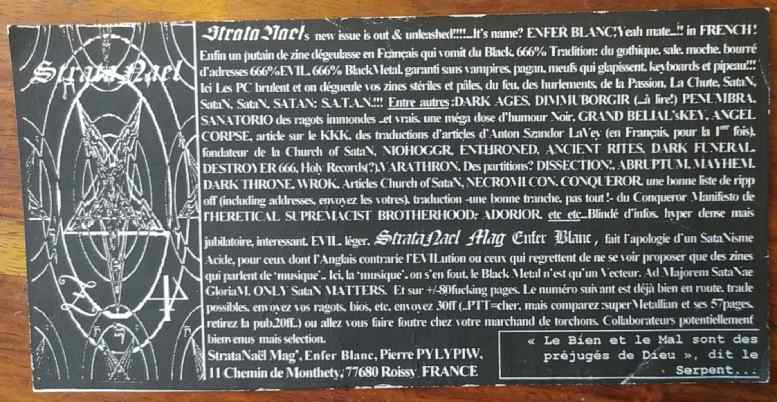
Mucilage was written and assembled in Pierre’s Paris apartment. By the time he made its successor, EnFer Blanc – published in ’99, entirely in French – he had moved to London.
PIERRE: ‘Fer’ means iron, and Enfer Magazine was the name of a music mag I used to read as a kid. And ‘fer-blanc’ means tinplate – literally, white iron. That’s why it’s suitable for an issue written in French: you’d have to be from France to really understand both the pun and the reference.
EnFer Blanc ran to more than eighty pages, featuring interviews with and articles about GRAND BELIAL’S KEY, ANGELCORPSE, ANCIENT RITES, DARK FUNERAL, DESTRÖYER 666, VARATHRON, DISSECTION, ABRUPTUM, MAYHEM, DARKTHRONE, CONQUEROR, ADORIOR, and assorted others.
PIERRE: I wanted the real underground voices – Ryan Förster, Melissa and Chris of ADORIOR, Pete Helmkamp – to reach the decent, working-class, non-computerised French metalheads: people I knew were out there, but who weren’t on the internet. It was also a time when black metal took off, so you had all these completely unfounded rumours and bits of gossip being repeated by clueless cretins.
The musical content sat alongside rather less conventional material: an article on the Ku Klux Klan, translations of texts by Anton Szandor LaVey, and excerpts from the Heretical Supremacist Brotherhood’s Conqueror Manifesto.
PIERRE: I translated various things myself – articles from the Church of Satan and so on – so people could actually make up their own minds about matters they thought they knew, if you see what I mean. EnFer Blanc got such great fucking feedback that I discovered some absolute loonies.
Loonies?
PIERRE: I mean, really. Someone sent me a tape sealed shut with two fucking massive nails, and his name was A Mort Tout! – ‘Death to All’. In fact, I’m going to see him on Friday – it’s the ALUK TODOLO guy. That’s also how I met Saint Vincent from BLACKLODGE. I made a lot of French friends through that issue.
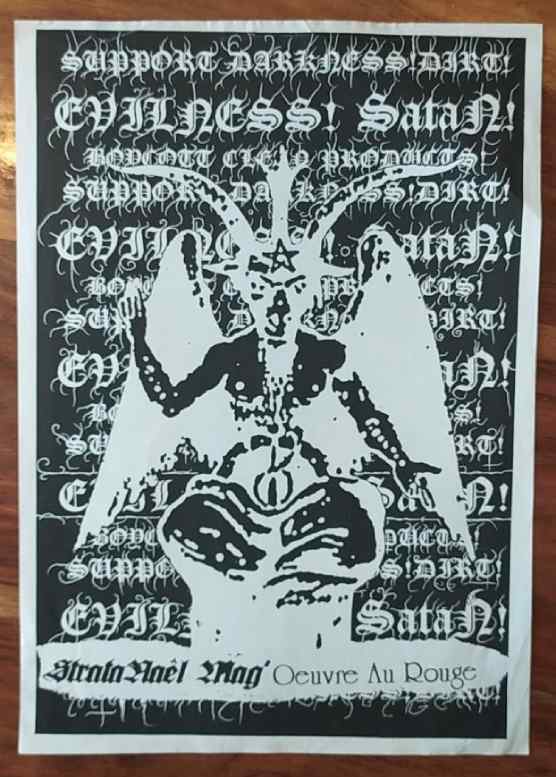
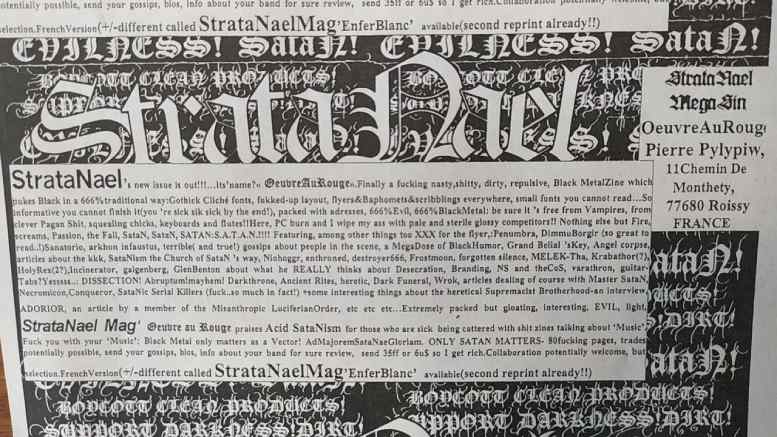
The next StrataNael, Œuvre au Rouge, returned to English, recycling much of EnFer Blanc intact. ARKHON INFAUSTUS, KRABATHOR, MELEK–THA, FROSTMOON, and Holy Records were added, along with a piece on Satanic serial killers and an article by a member of the Misanthropic Luciferian Order.
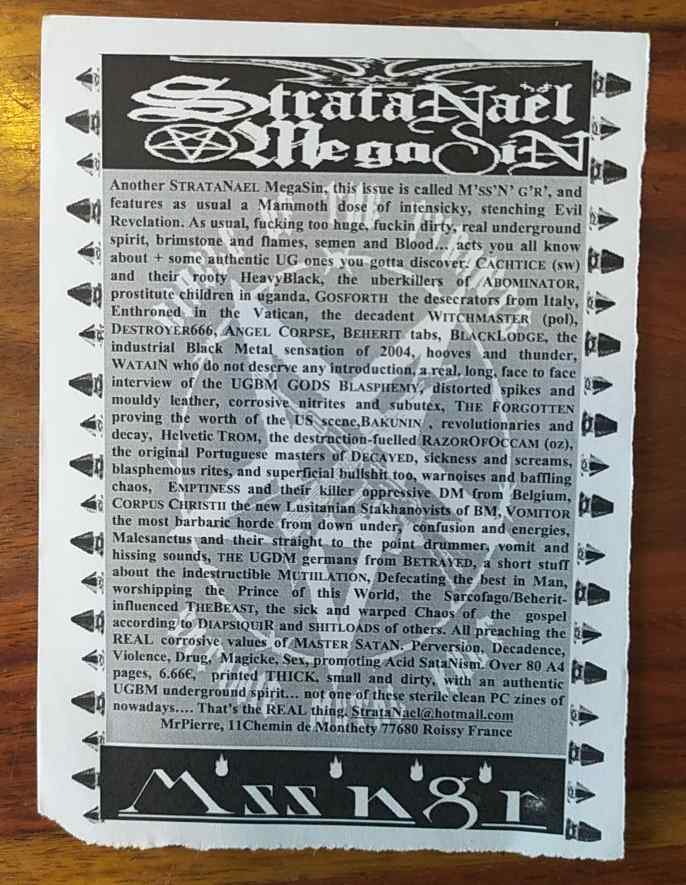
It was followed by M’ssN’Gr, another eighty-plus-page A4 publication promising material involving Mikhail Bakunin, Subutex, ‘prostitute-children in Uganda’, and further proclamations of what Pierre termed ‘Acid Satanism’. Among the more readily identifiable contents were WATAIN, VOMITOR, DESTRÖYER 666, ANGELCORPSE, WITCHMASTER, BLACKLODGE, ABOMINATOR, CORPUS CHRISTII, and EMPTINESS, plus a lengthy face-to-face interview with BLASPHEMY frontman Black Winds.
PIERRE: Gerry (Black Winds) is a very old friend of mine – we’d known each other through letters for a long time. He and I were supposed to meet on BLASPHEMY’s first tour, when he had his accident in Denmark, so I followed the dates but never saw him.
In March 1993, Canadian black metal skinheads BLASPHEMY embarked on a European run alongside GORGUTS. A week into the tour, after arriving in Denmark following a Swedish show with MARDUK, Black Winds returned home to Vancouver. Seven years later, the old pen pals finally met in person at the 2000 edition of Wacken Open Air, where Pierre conducted the interview.
PIERRE: I recently discovered another BLASPHEMY interview among my old microtapes. We took some ecstasy beforehand, so as it goes on, I realise Gerry is getting more and more off his face, and so am I. At one point, he says, ‘Yeah, I used to be a German shepherd.’ I ask, ‘You mean you were a shepherd in Germany in a previous life?’ And he looks at me with these fucking evil dinosaur eyes and snarls, ‘No – the dog.’ <laughs>
He told me the same thing when I interviewed him in 2018.
PIERRE: Yeah, that’s the sort of weird thing you get in a live interview. Very often, when answering in writing, people adopt this attitude of bravado and grandiloquence that prevents them from giving honest, interesting responses to what, in my opinion, are perfectly valid questions.
PIERRE: I’m not sure exactly how I got hold of Dauthus #3 – whether Timo sent it to me or Erik gave me a copy – but I clearly remember having to pry off the staples just to open it, which I loved. Then leafing through the pages, going, ‘Wow.’ Everything was luxurious and decadent, decaying, fucked up. Perfect.
In early 2004, around the time M’ssN’Gr was published, Pierre discovered the third issue of Timo’s publication, Dauthus.
PIERRE: Coming across such a ‘zine – dirty, messy, personal, idiosyncratic, navel-gazing, obsessive fucking evil! – you understand that whoever went to the effort of producing it is probably on the same wavelength as you. If nothing else, it makes their reviews worth reading, whether you agree with them or not.
Dauthus #3 had originally appeared in October 2002 as eighty A4 pages bound in blood-smeared cardstock and stapled shut. The deliberate assault on conventional readability extended to the body text, set in an archaic blackletter devised in 1580.
PIERRE: The only thing I dislike is also one of Dauthus’ qualities: the font is hard to read. I don’t think typography should obscure the message – ideally, it’s the rest of the page that complicates text navigation, with your eyes being pulled towards things everywhere.
How would you achieve that?
PIERRE: I sometimes underline a word or sentence and draw a marker leading outside the paragraph. You might follow the reference line to its source, then to the face of whoever said it, perhaps onward to an extract from a famous book by that person, or a related article.
Like StrataNael, Dauthus never confined itself to bands. All three issues, for instance, feature graveyard reviews; to gather material for the second, Timo travelled alone through the United Kingdom. The same issue included Free Your Spirit: A Survey on Suicide Methods, Death, and the Decaying Process across three illustrated pages, alongside an interview with the obscure Estonian artist Indrek Jets, whose work Timo had noticed at a library exhibition before tracking him down at an art school.
PIERRE: I’ve always found it important to include things that aren’t directly related to the music, but to whatever lies at the source of underground metal. So, to me, an article about Rasputin is at least as relevant as most bands. Or an interview with Timo Ketola can be far more interesting to read – and he wasn’t a musician.
StrataNael was among the few publications to interview the notoriously reluctant Timo. The connection stretched back years before the two editors actually met. In the late ‘90s, Timo came across a flyer advertising Mucilage that ended with ‘No contact address. Ask around for it’ – an attitude he later cited as influential.
PIERRE: Flyers were an essential part of the underground. Who you got them from, how they looked, the band name and logo, the nationality – all of it told you something. Swedish? Probably gods. Finnish? Probably CARCASS-y. American? Probably shit. People would even stamp the backs of other people’s flyers to piggyback their own names; or, after about 1992, to slag ‘em off.
TIMO KETOLA: That StrataNael flyer I saw also had a mysterious car tyre advert on the reverse. When I first met Pierre in 2004, I asked him about it – but he seemed to have no idea what I was referring to.
PIERRE: Ah, I get it now. I was seeing the girl who ran the photocopy room at my university, and she told me they only counted the paper used, not the actual clicks on the machine. So, wherever I went, I looked for A4 sheets with one blank side – party posters, general notices, discarded documents, anything. That’s why the backs of my flyers had petitions for Ethiopia, Tiananmen support groups, student radio, fire instructions, and, evidently, tyre adverts.
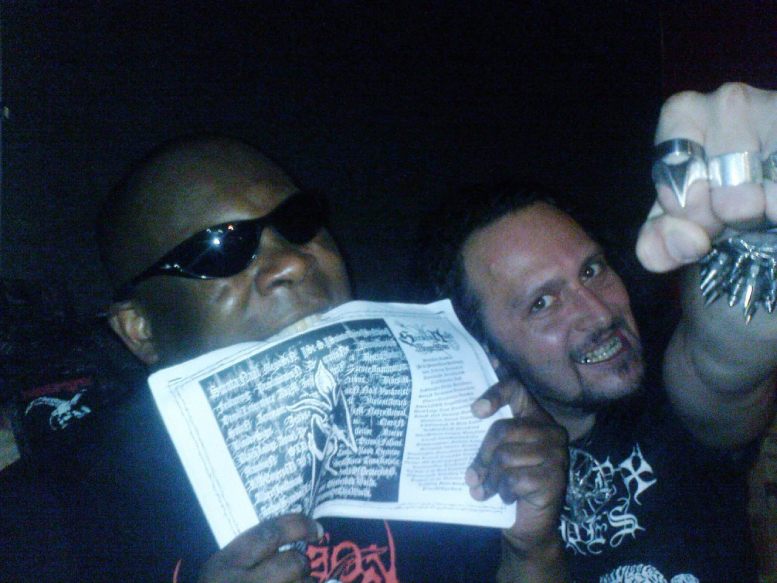
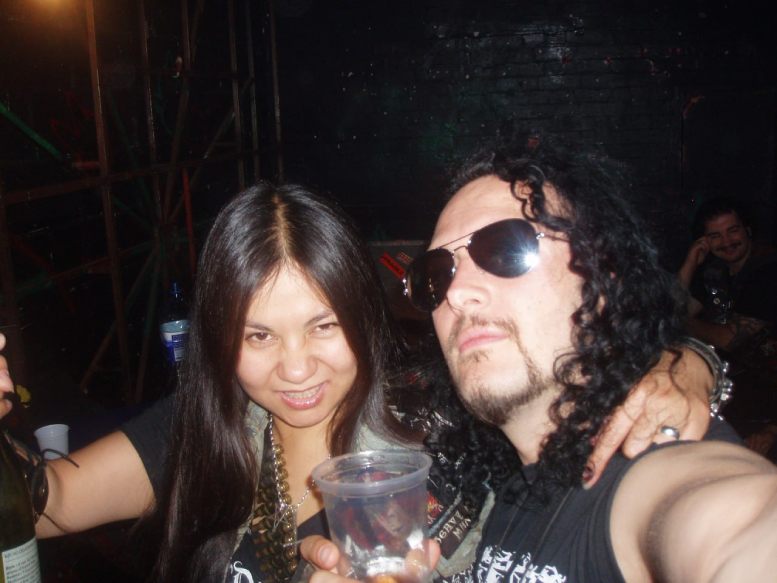
PIERRE: Timo was exactly what I expected: the quintessential tape-trader underground metalhead. There aren’t enough decent, quality people in the world for you not to realise when you’ve just met one. I’m very social – you know me – so after ten minutes, we were chatting as if we’d known each other for years.
Timo and Pierre first met in person in October 2004, at the Rebirth of Dissection show in Stockholm.
PIERRE: We had much in common. I still have a handwritten note with things Timo insisted I listen to – like the name of a LIGEIA EP and a track by NUCLEAR DEATH. He wrote them down very intensely and handed me this piece of paper.
TIMO: Now, these were exclusively beer-ridden moments, so my memories might not be entirely reliable. But I seem to recall Pierre telling me he used to run an official MORBID ANGEL fan club.
PIERRE: Fan club? No. My number-one tape trader, Volker, was making a fanzine dedicated to MORBID ANGEL called MorbidoManiac, and I helped him. We took my little Renault 5 and followed their ‘91 tour through Germany, Belgium, Holland, and so on – much to David’s proud amusement and Trey’s total satisfaction.
TIMO: I’m pretty sure Pierre also said the coat Trey Azagthoth often wore in photos from the “Blessed are the Sick” era used to be his. While I can’t really vouch for the credibility of these claims, I’ve never caught him in an untruth so far.
PIERRE: Trey, back then, was already a bit difficult – but not yet a sad nutcase. He really liked my long black coat, so I gave it to him. In return, he handed me his camouflage army shirt, which I never wear except for gardening. The real reward, however, came months later, when some friends were reading Metal Hammer and said, ‘Hey, isn’t Trey wearing your coat?!’ Student Pierre is still smiling inside about that.
TIMO: What else? Oh, I don’t remember the full details, but he’d somehow managed to work out that Michel of MUTILATED had taught Trey to play guitar. Admittedly, taken at face value, this story has a few geographical issues.
PIERRE: In fact, Trey and Michel were corresponding very intensely. Listen to the earliest MORBID ANGEL recordings, and you’ll realise how SLAYER-ish the guitar is – far removed from the invigorating and galvanising lava-riffing on “Altars of Madness”, while this sprawling, crazily aggressive style was already present on MUTILATED’s “Psychodeath Lunatics” demo the year before.
The topic likely came up because MUTILATED was one of Timo’s obscure death metal obsessions. Formed in Bourg-en-Bresse in 1987 out of the thrash outfit MUTILATOR, they recorded two demos: “Psychodeath Lunatics” in 1988 and “Resurrected” three years later.
Pierre’s infatuation with the former is clear from a 1990 flyer for the unfinished first StrataNael issue, which opens by greeting fellow ‘Psychodeath lunatix’.
PIERRE: I was a fan of MUTILATOR already, but these guys had a horrible reputation – they were really elusive, didn’t answer letters, ripped people off… I wrote them this very long teenage letter; then, years later, Michel replied, and we became friends. I met him a couple of times before he founded ABYSSALS.
Reportedly, Osmose and Peaceville showed interest in MUTILATED, but guitarist Michel Dumas decided they weren’t ready, and no album ever materialised. After the band folded, several members continued as ABYSSALS, recording the project’s sole output, “Demo 94”.
Writing in the Dauthus Appendix, Timo treats both projects as a continuous trajectory, describing them as ‘some of the last truly brutal death metal before things turned around’. The MUTILATED demos possess the earlier ‘magic’ and ‘subconscious horror’, he writes; by the time of ABYSSALS, the music remains excellent but has crossed a border into something more ‘conscious’. This became the source of a longstanding disagreement between the two editors, with Pierre arguing that a steep decline can already be heard after the first demo.
PIERRE: Ian from DESTRÖYER 666 would always say, ‘Pierre, you listen to the vocals; I listen to the guitar.’ And that’s very true. On “Psychodeath Lunatics”, Michel’s voice is cold, authoritarian, and flat – a bit like SINDROME’s “Into the Halls of Extermination” demo, which is fantastic.
On the second demo, Dumas delegated vocal duties to MUTILATED’s new bass player, Philippe Herbaut, whose delivery was closer to a conventional death metal style.
PIERRE: Secondly, on “Psychodeath Lunatics”, the guitar is flying – both the solos and the rhythm. With ABYSSALS or “Resurrected”… sure, maybe the sound improved and became more polished, but that crucial madness was gone. And by then, I’d already discovered “A Blaze in the Northern Sky”, so perspectives had forever changed.
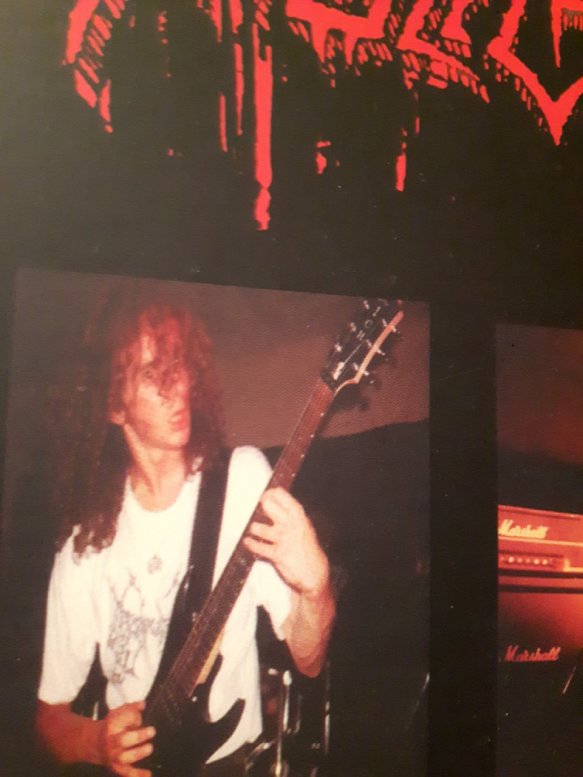
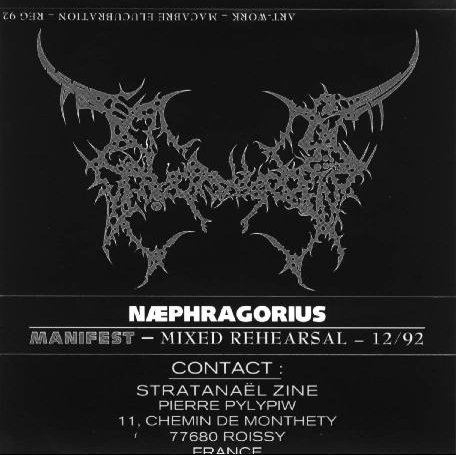

TIMO: Come to think of it, Pierre also said something along the lines of, ‘You know the shirt the MUTILATED guitarist is wearing on the Foreign Legion bootleg back cover? That used to be my band; I was the singer.’ I don’t remember their name now, though, and I can’t quite place the logo.
PIERRE: NÆPHRAGORIUS. Great logo, actually; made by the band’s drummer, Régis, a graphic designer back in an era when everything was still done with pen and paper. Extremely difficult fellow – a genius, not entirely unlike Timo, but drawing from a much darker artistic well. He blew his head off at breakfast, in front of his girlfriend, Isa, who ended up institutionalised afterwards.
When Timo discovered Foreign Legion Records’ 2004 MUTILATED bootleg – gathering the band’s demos and an unreleased EP on vinyl – he abandoned his own plans for an official reissue through Dauthus 1899. At the time, he had just released the label’s second title, a seven-inch edition of LIGEIA’s 1996 demo, “In Death Overshadow Thee”.
PIERRE: Personally, I don’t believe in digging up dead things that deserve to stay buried. Take any shitty old demo tape, and sooner or later somebody will put it on YouTube anyway – there’s no need to turn every underground relic into a compilation, remastered, remixed, repolished, et cetera. So, when Timo and I talked about MUTILATED, I told him it was a terrible idea.
Curiously, the Foreign Legion episode seems to have reaffirmed the impulse behind the label’s founding – Timo’s almost spontaneous decision to release the first KAAMOS seven-inch.
In an email to Pierre, Timo stressed that resurrecting obscure old material was never meant to become his focus. If Dauthus 1899 released another title, he wanted it to contain something recorded in the present rather than ‘living on behalf of the past’. He didn’t require ‘original ideas’, only a band with some visual understanding of its own music and ‘a couple songs that destroy’.
That remark becomes rather prophetic in hindsight, because not long afterwards he encountered a band almost tailor-made for those criteria.
PIERRE: Could it be NECROS CHRISTOS?
No, TEITANBLOOD – in early 2007, Timo heard rehearsal recordings of material that later became “Seven Chalices”.
PIERRE: Ah, of course; I wasn’t too far off. Back then, I mainly knew Nasko through his fanzine, Final Solution, and as the vocalist for PROCLAMATION. When we organised a London date with ARCHGOAT and BLACK WITCHERY in 2007, PROCLAMATION seemed like the obvious choice to open the evening.
log in to keep reading
The second half of this article is reserved for subscribers of the Bardo Methodology online archive. To keep reading, sign up or log in below.
Related reading