Nuclear War Now! Productions III
2026-01-06
by Niklas Göransson
Until 2001, Nuclear War Now! existed through ideas, tapes, and minor artefacts. As resources accumulated and networks widened, observation gave way to proximity, and an ephemeral moment was fixed in physical form: Live Ritual, the return of Blasphemy.
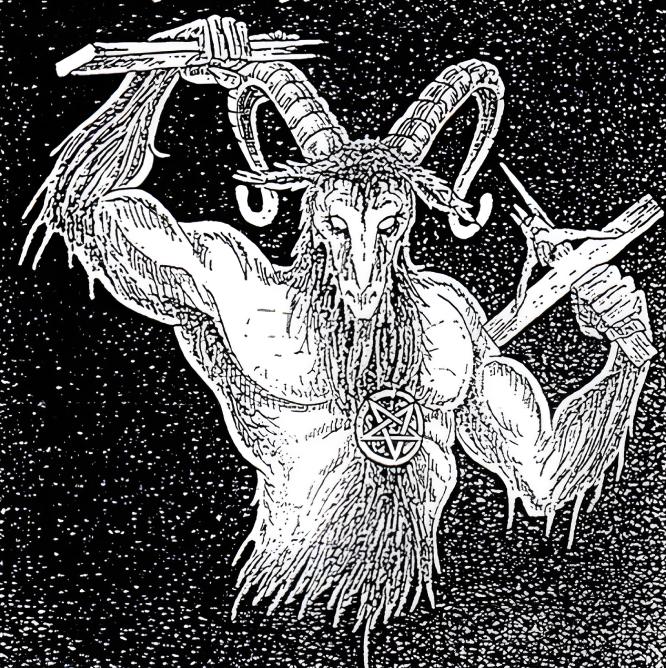
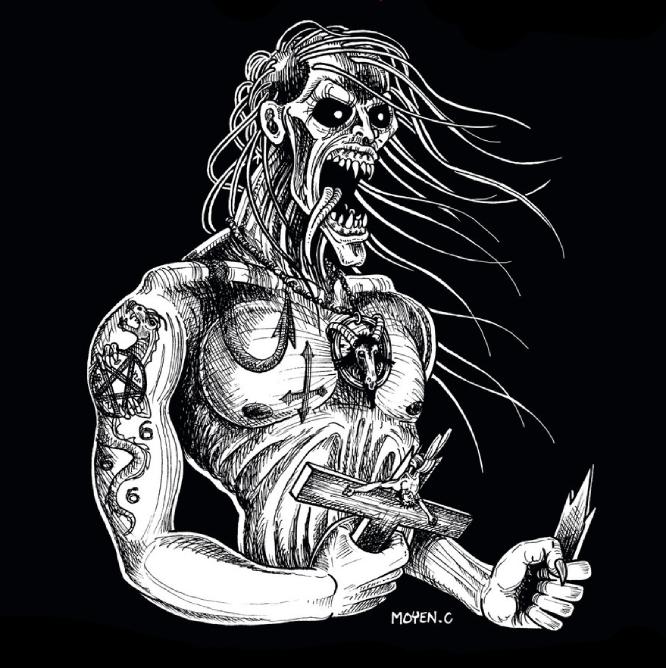
Artwork by C Moyen
YOSUKE KONISHI: My academic fervour carried me through four years of university – but towards the end, I could feel the craziness dissipating. The desire to learn no longer burned inside as strongly. Despite knowing I had no future in that field, I took this bullshit job just to pay the bills.
After completing degrees in biochemistry and molecular biology, Yosuke was drifting from the career path he’d once pursued with near-religious zeal. In the autumn of 2000, he began a full-time position at DNA Plant Technologies in Berkeley, California, working on genetically modified research specimens.
YOSUKE: Post-graduation, I needed a place to live, so I moved into a tiny three-bedroom apartment in South San Francisco with a few of my coworkers. Figuring it would make finding a new job easier, we chose the area on purpose – because that’s where all the startups were.
Before long, Yosuke was hired by Zymed Laboratories – a South San Francisco firm specialising in research antibodies. The role, while rooted in a scientific setting, drew him away from hands-on medical work and closer to its technical infrastructure.
YOSUKE: I worked in tech support, basically; still bullshit, but a better job in a bullshit industry. For whatever reason, people there seemed to like me – and when one of them left for a new startup company, Silicon Genetics, I ended up recruited on his recommendation.
The new wave of early-2000s biotech startups, including Silicon Genetics, reflected a changing landscape where biological research increasingly relied on specialised software rather than traditional lab work.
YOSUKE: Gene expression was becoming a big deal, and data analysis suddenly mattered a lot more. Before, you could work through lab results on paper – but with the newer DNA tech, you needed computer programs to make sense of it. That’s where Silicon Genetics came in.
YOSUKE: My roommates were biology nerds who mostly kept to themselves; I was probably the noisiest one, blasting music way too loud <laughs>. I’d regularly visit Jan Svanhill – a German record dealer based in the Bay Area, about fifteen minutes from where I lived. He introduced me to a lot of Eastern European metal.
Do you mean bands like MASTER’S HAMMER?
YOSUKE: No, I already knew them from the Osmose catalogue. Thanks to Jan, I discovered far more underground bands like TÖRR and DEBUSTROL. I think ROOT came through him as well. The records he sold me opened up an entire vein of obscure music I’d never have encountered otherwise – not even at Amoeba.
Just like during Yosuke’s college years, visiting Amoeba Music became a daily routine. San Francisco housed the chain’s flagship store, set inside a former roller rink – far larger and rowdier than its Berkeley counterpart.
YOSUKE: It’s kind of crazy because these places only exist in the US; Americans seem to love making everything oversized for no good reason. Picture the floor space of a supermarket or IKEA’s showroom section – that’s the scale we’re talking about. Walking in for the first time felt like entering a temple.
With considerably more financial resources at hand, this was when Yosuke’s collecting madness really took hold. He also began expanding his local network.
YOSUKE: I learned a lot of underground lore – news, rumours, whatever was going on – just by hanging around Amoeba. It became a central meeting point for Bay Area metalheads; a huge portion of my connections came through that shop. Stevil from CREBAIN worked there, and Jef Whitehead lived just down the street.
At the time, American tattooer and multi-instrumentalist Jef Whitehead was employed at Ed Hardy’s San Francisco parlour, Tattoo City. Following a brief stint as drummer for BLACK GOAT in 1997 – shortly after John Gossard left to form WEAKLING – Whitehead launched LEVIATHAN as a black metal solo project. Using a rudimentary home studio equipped with an analogue four-tracker and a digital drum kit, he recorded several album-length demos that initially circulated only among close contacts.
In 2000, Whitehead shared LEVIATHAN’s sixth demo, “Shadow of No Light”, with Amoeba’s metal curator, Stevil, who encouraged him to dub copies, print proper J-cards, and sell them through the shop.
YOSUKE: I knew LEVIATHAN existed but assumed it wasn’t the kind of music I’d be into, so I dismissed the band entirely. California had this whole phenomenon we used to call ‘bedroom black metal’ – XASTHUR, LEVIATHAN, that sort of thing. Ironically, not long after, I became good friends with everyone involved.
YOSUKE: Back when I worked at Silicon Genetics, the internet wasn’t developed enough to support remote instruction over video conferencing. You can’t really talk someone through software over the phone – you need to see what’s happening – so I would travel and train people in person.
In the spring of 2001, one of those trips brought Yosuke to Chicago, Illinois.
YOSUKE: A co-worker and I visited a university basically in the middle of nowhere and trained their professors. After handling the class, we headed back into Chicago for the night. I decided to visit Metal Haven, meet up with the owner, Mark, and buy some records.
Opened in 1999 by Mark Weglarz – former head of Tower Records’ Midwest security office – Metal Haven was a Chicago record shop renowned for its extensive stock of obscure titles.
YOSUKE: Metal Haven must’ve been the first proper metal-only shop I’d ever seen; the underground selection was just unreal. And somehow – don’t ask me how – Mark had that damn ENSLAVED bootleg <laughs>. I walked in, introduced myself, and he pulled out the CD-R.
In August 2000, Yosuke recorded ENSLAVED performing live in San Francisco on his MiniDisc. After transferring the audio to CD-R, he assembled a rudimentary booklet bearing the Nuclear War Now! imprint and the title “Vikings Cometh Through the Fog”. Though never intended as an official release, a small number of copies circulated – one of which evidently reached Chicago.
YOSUKE: With bands like USURPER and CIANIDE, Chicago had one of the strongest US scenes. The Satanic Hispanic wing held down their corner: Fernando Castel’s Sempiternal Productions put out that ARGHOSLENT compilation, and THE CHASM were based there. I also remember meeting Jimmy from CULT OF DAATH around then.
Beyond facilitating Yosuke’s first visit to a record store dedicated to metal, Silicon Genetics unexpectedly set the stage for one of Nuclear War Now!’s defining moments.
YOSUKE: My flight home got delayed or cancelled; I can’t remember which. Instead of putting me on the next plane, the airline offered me a first-class ticket back to San Francisco if I waited until the following day – plus a travel voucher worth something like five hundred bucks.
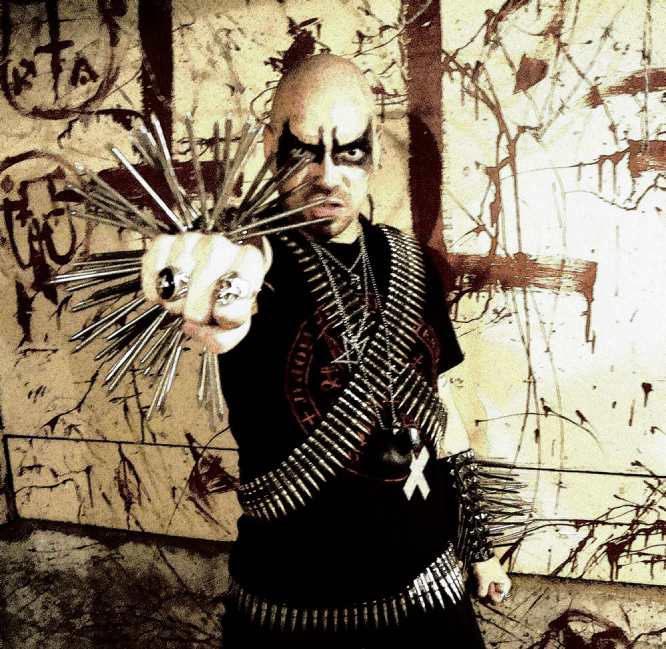
YOSUKE: I’m not sure how I started talking with Ryan Förster, but it must’ve been through tape trading and our shared taste in music. Back then, how many people were into weird South American stuff like DEATH YELL? I remember dubbing him a NECROFAGO demo and mailing it to Vancouver, and he’d send things back in return.
In 1999, after the demise of CONQUEROR – a Canadian black/death duo based in Victoria, British Columbia – guitarist Ryan Förster joined the resurrected BLASPHEMY. A few weeks after Yosuke visited Chicago, Vancouver’s black metal skinheads announced two hometown shows – one in July 2001, followed by another with BLACK WITCHERY the next month.
YOSUKE: Using that travel voucher, I jumped on the July date. My friend Ryan Allen wanted to come too but couldn’t afford the flights, so he took a bus up from Los Angeles instead – thirty-six hours straight. I reached out to Jay (Othalaz) of GODLESS NORTH, who was kind enough to let me crash at his place.
Great guy, killer band – I met both him and Ryan Förster in Germany a few months after that Vancouver weekend.
YOSUKE: Jay came by my apartment in South San Francisco when he visited his girlfriend, Anna. She was known in the Bay Area for dating black metal musicians <laughs>, and Jay just happened to be next in line. I remember giving him the DESTRÖYER 666 debut on vinyl because I had a second copy and he wanted it.
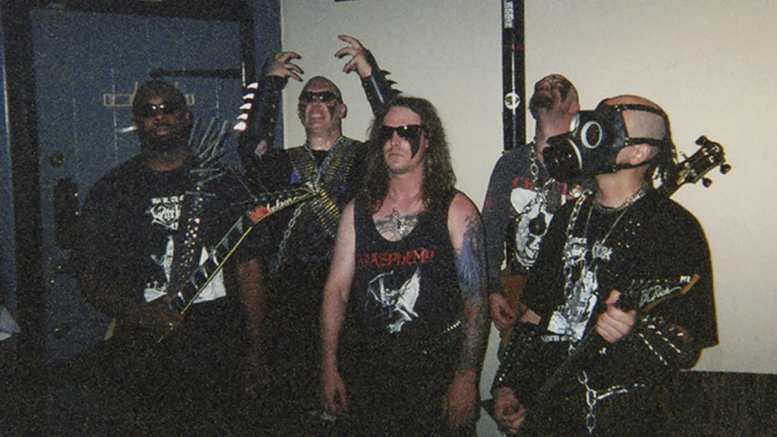

On the morning of July 13, 2001, a twenty-five-year-old Yosuke boarded a flight to Vancouver.
YOSUKE: I went from listening to “Fallen Angel of Doom….” in Vaughn’s car to watching BLASPHEMY soundcheck at some venue in the suburbs of Vancouver; the whole thing felt like a dream come true. For me, it was a life-changing experience that ended up reshaping my trajectory.
After securing permission from the band, courtesy of Ryan Förster, Yosuke captured BLASPHEMY’s set on the same MiniDisc he’d used for his ENSLAVED bootleg.
YOSUKE: You can actually hear me screaming on that recording. It surprised me how lightly attended the gig was, though – maybe two or three hundred people. Death metal dominated Vancouver at the time; BLASPHEMY were respected among the older crowd, but nowhere near the level they’ve reached today.
Following the concert, attendees and artists alike gathered at Othalaz’s place. That night, Yosuke found himself surrounded by some of the most infamous figures in Canadian underground metal.
YOSUKE: My strongest memory from Jay’s afterparty is probably 3 Black Hearts – BLASPHEMY’s drummer – going on and on about IMPETIGO while the rest grew increasingly annoyed. I also remember everyone but me being piss drunk; I didn’t enjoy that part at all.
log in to keep reading
The second half of this article is reserved for subscribers of the Bardo Methodology online archive. To keep reading, sign up or log in below.
Related reading