Nuclear War Now! Productions IV
2026-01-08
by Niklas Göransson
With Live Ritual, Nuclear War Now! shed its provisional skin and began asserting intent – through analogue formats, austere aesthetics, and a sonic framework favouring force over refinement. What followed is where curation became doctrine.
YOSUKE KONISHI: My mom is very outsider-minded, but she was still disappointed that I didn’t go to medical school. It definitely pissed off her brother, who’d helped pay for my UC Berkeley tuition. One of his sons became a physician, the other got a PhD in biology, and they expected me to be next in line.
Rather than beginning a new chapter, graduation marked the end of Yosuke’s medical ambitions. Instead, he moved to South San Francisco, where successive jobs carried him further away from laboratory work and towards the technical side of research.
YOSUKE: Staying in biotech wasn’t a choice driven by passion; the Bay Area is insanely expensive, and I needed something that paid well enough to cover my rent and basic living costs. I couldn’t rely on the label yet, as N.W.N! only had one official release – nowhere near enough to live off.
Until 2001, Nuclear War Now! existed largely as a personal outlet: small runs of home-dubbed demos and an ENSLAVED bootleg circulated among friends and contacts. That changed with BLASPHEMY’s “Live Ritual – Friday the 13th”, an LP conceived from the outset as a proper release.
YOSUKE: Everything before that, like the EREBUS demos, had just been for fun; it wasn’t until “Live Ritual…” N.W.N! truly came alive. Only then did I feel as if I’d actually started a label. Still, you need an extensive catalogue and solid distribution to sustain yourself.
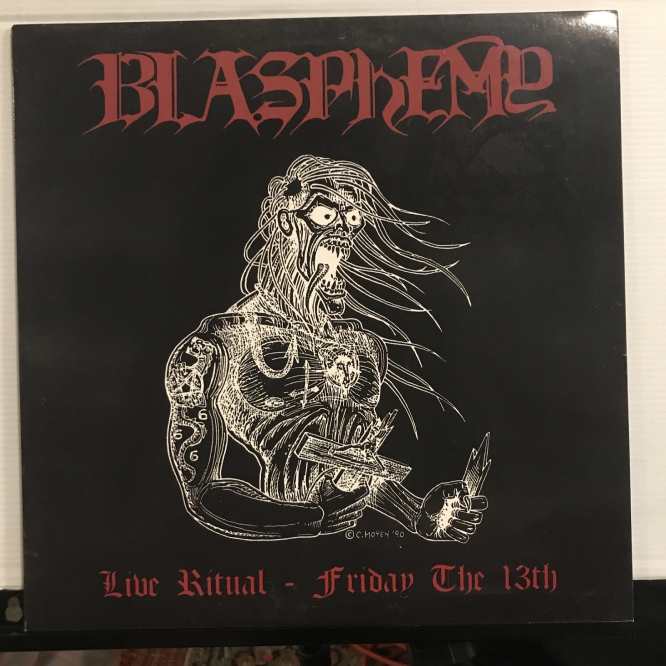
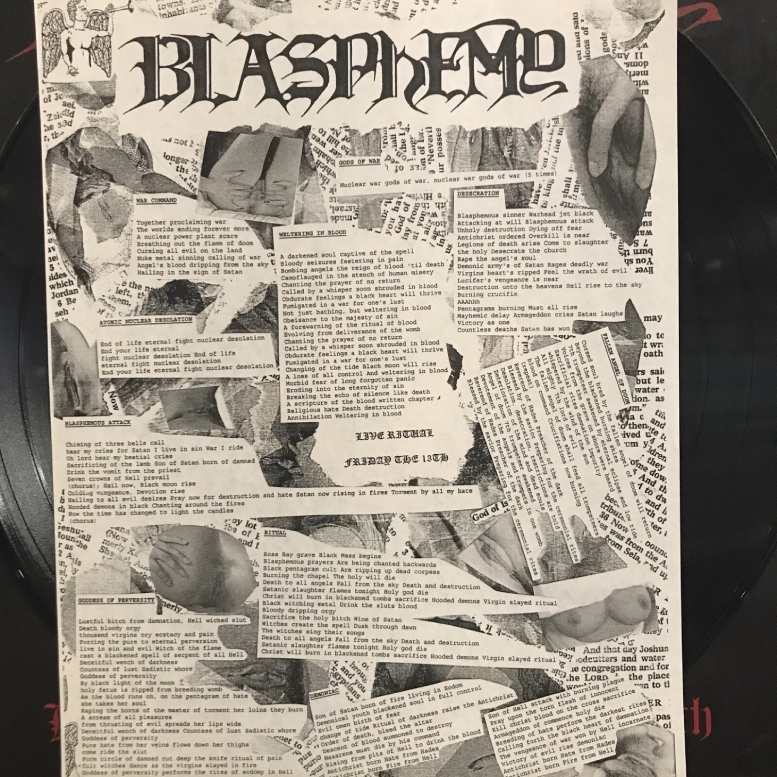
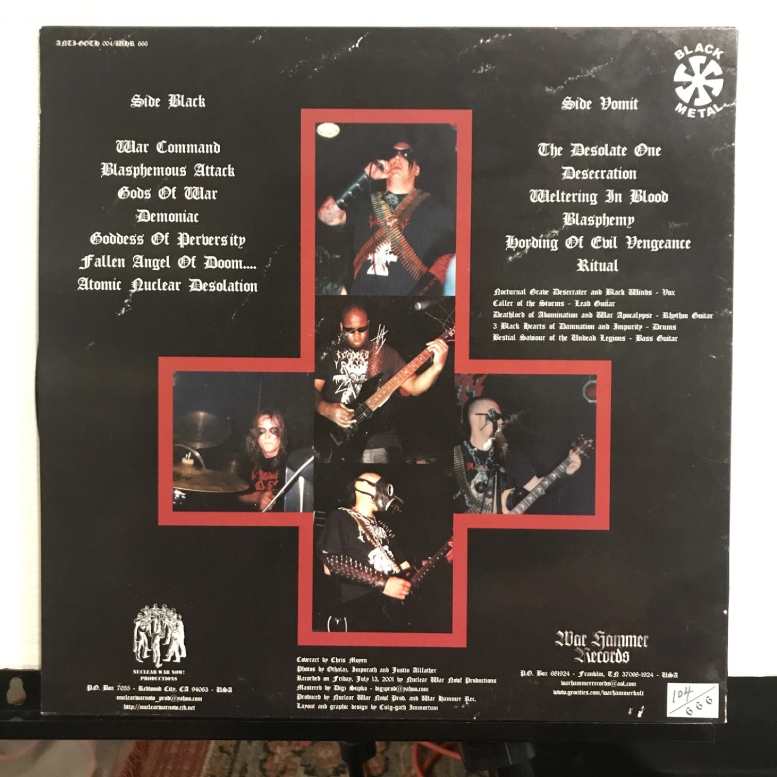
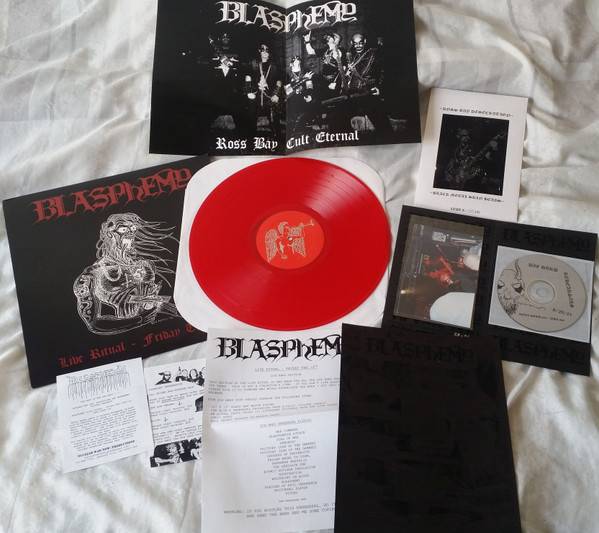
While “Live Ritual…” did little to improve Yosuke’s finances, it was nonetheless the moment Nuclear War Now! shed its amateur skin. The release introduced what would become the label’s defining format: a limited ‘Die Hard’ edition pressed on red vinyl and bundled with an array of extras.
YOSUKE: All my BLASPHEMY correspondence went through Ryan Förster, and he loved it. I don’t know whether the other members were thrilled about a rough live recording coming out – I never actually asked them. But from a commercial standpoint, the band had nothing available at the time, no physical media at all.
The downfall of BLASPHEMY’s original label, Wild Rags Records, had left the 1990 debut, “Fallen Angel of Doom….”, out of print for several years. Their 1993 follow-up, “Gods of War”, met a similar fate when Osmose Productions declined to repress it, citing limited commercial interest in the bestial strain of black metal.
YOSUKE: Going from zero releases to having at least something out there must’ve helped in some way. And after that August 2001 show with BLACK WITCHERY, BLASPHEMY didn’t play live again for many years – during which “Live Ritual…” helped keep their name alive.
Around this time, while browsing the shelves at Amoeba Music, Yosuke discovered MORBOSIDAD’s self-titled debut. I can certainly see why he liked the music – what I don’t understand is how that cover could’ve enticed him to listen to it in the first place.
YOSUKE: Somebody must’ve recommended it. That terrible orange–sherbet-looking abomination with all the 3D effects perfectly captures the era of Photoshop filters; it was ‘cutting edge’, and amateur graphic designers tend to use every new tool they can get their hands on.
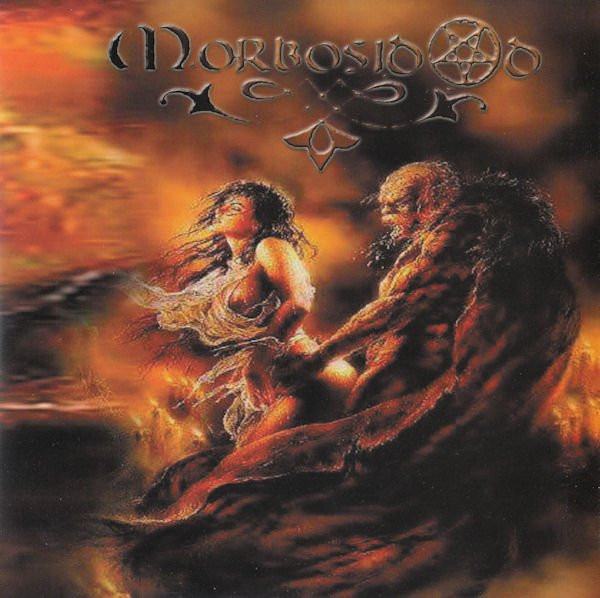
This particular aesthetic atrocity was perpetrated by Quadrivium Records – the California-based label that issued MORBOSIDAD’s debut on CD in March 2000.
YOSUKE: I reached out to the band about licensing their album on vinyl. Around the same time, I’d been talking to Keagan from ARCANE SHADOWS. He’d started a new black metal solo project, X.E.S., so we decided to pair his demo with a MORBOSIDAD rehearsal recorded on my MiniDisc.
Released by Nuclear War Now! in late 2001, the MORBOSIDAD / X.E.S. split CD came in an A5 envelope with flyers, lyric sheets, and band biographies. Jason Campbell’s label, Bird of Ill Omen Recordings, handled the cassette edition.
YOSUKE: I’d hoped to push MORBOSIDAD deeper into the underground; even with an album out, they were barely known beyond the Satanic Hispanic scene. This dynamic changed once the internet took over – but back then, bands like that existed entirely within their own ecosystem.
Formed in 1991, MORBOSIDAD drew heavily on the raw, confrontational savagery of the early VON shows witnessed by Mexican-born but California-raised founder Tomás Stench. After two demos – “Demo ‘93” and “Santísima Muerte” – the band’s trajectory was abruptly halted in 1995 when an explosion at their rehearsal space claimed the life of drummer Yegros.
After a three-year hiatus, MORBOSIDAD started recording their debut album in September 1998. It then sat unfinished until early 2000, when the band joined forces with Quadrivium Records.
YOSUKE: None of those releases really circulated outside their own ethnic circle. This is how it worked: a Mexican band like LUZBEL could show up in the Bay Area with zero promotion in the local metal scene, yet all the Latin Americans already knew about it. So, since MORBOSIDAD were virtually unknown, the split was meant as a teaser for the upcoming LP.
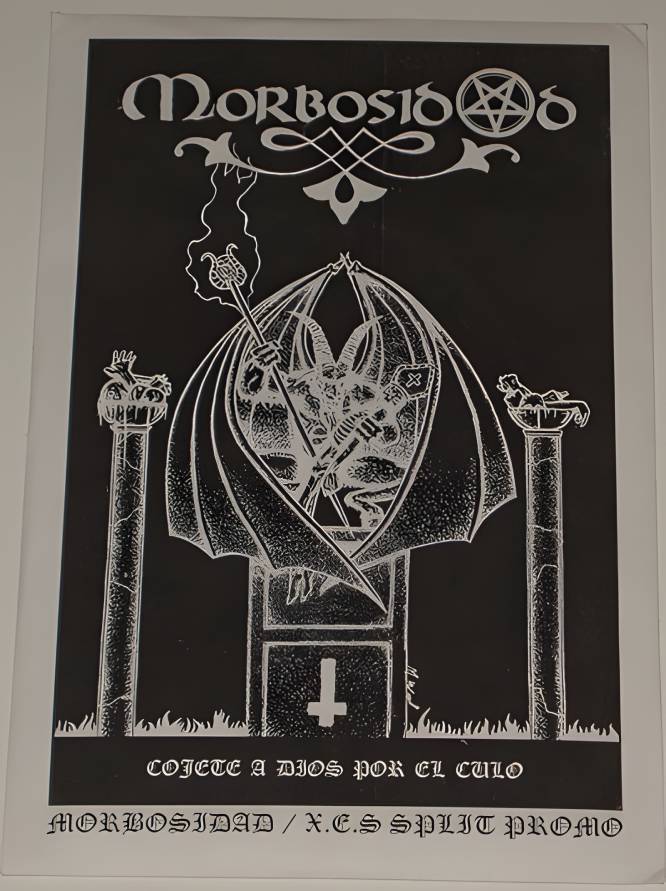
Dissatisfied with the garish, digitally rendered artwork on the original CD, Yosuke set out to translate MORBOSIDAD’s chaos into an aesthetic language that honoured the roots of underground metal.
YOSUKE: Tomás gave me a bunch of old flyers, and I lifted some artwork from the border of one of them – a mid-’90s show with MORBOSIDAD and a bunch of other Hispanic bands. Only about an inch tall, I blew up the skull design until all the dirt and grime became visible. That’s what made it work.
Starting from a tiny fragment of border art, Yosuke repeatedly enlarged the image on a xerox machine, then manually isolated and reshaped the skull with a marker pen and correction fluid before copying it again – each pass exaggerating its imperfections.
YOSUKE: That whole aesthetic came from studying LPs I loved – the “In the Sign of Evil” (SODOM) back cover, “Fallen Angel of Doom.…”, “The Oath of Black Blood” (BEHERIT), the Banzai pressing of BATHORY’s debut… all these stark designs built around two or three colours, sometimes inverted, a lot of them looking almost xeroxed.
The MORBOSIDAD logo on the first pressing looks a bit out of place.
YOSUKE: That was all they had at the time – drawn by Jorge of Torched Records. Funnily enough, he also designed the original version of ZEMIAL’s “Sleeping Under Tartarus” seven-inch, the one with blue ink on white paper. Compare that little squiggly shape on the cover to MORBOSIDAD’s logo.
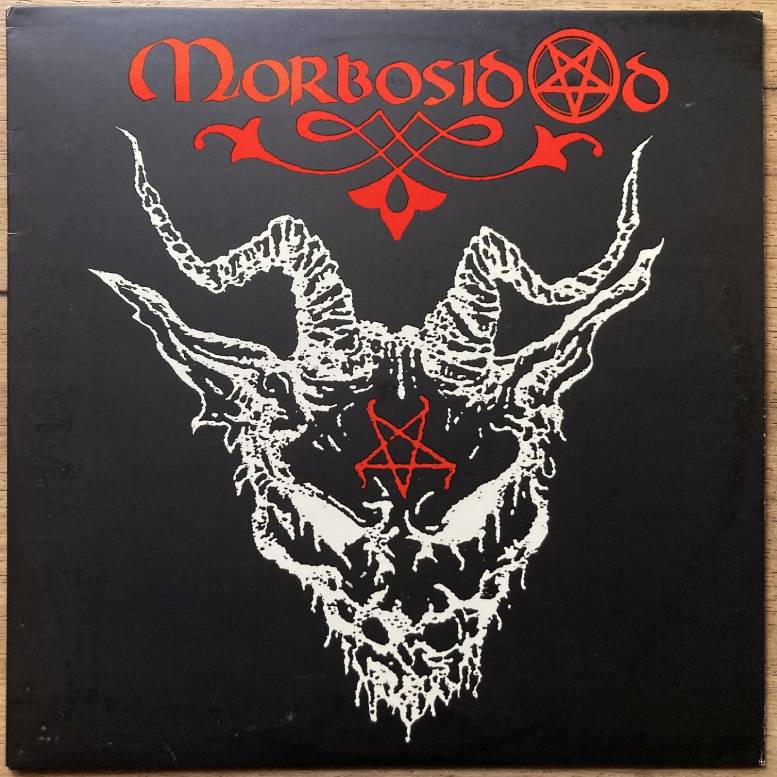
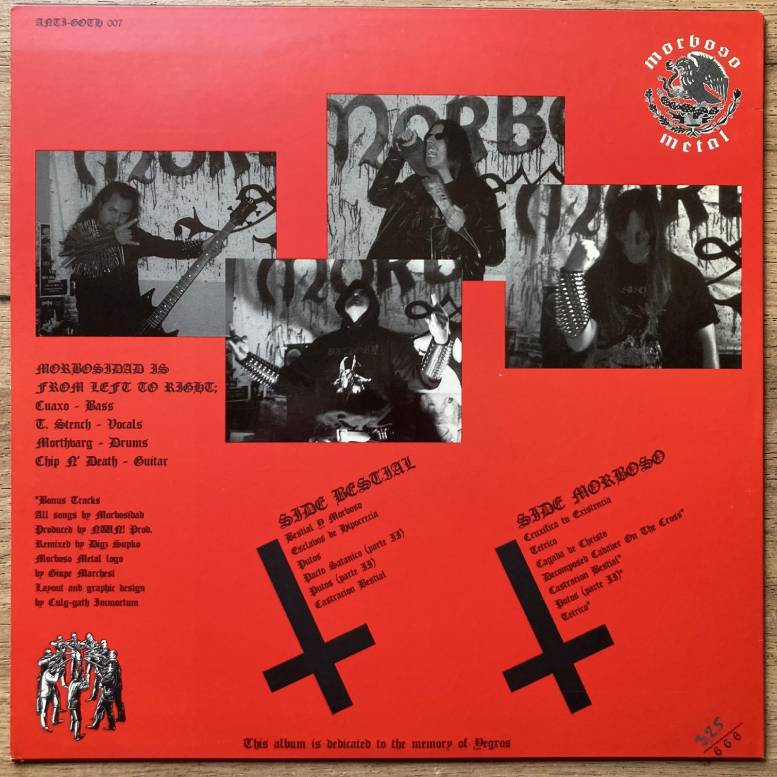
YOSUKE: Once MORBOSIDAD and N.W.N! started working together, I commissioned a new logo from Vomit Priest. I’m not sure about these days – but in the early 2000s, he was active as an underground artist. This guy also ended up making some artwork for CULT OF DAATH.
Jim Kapsalis of Chicago-based black metal band CULT OF DAATH handled the layout for the MORBOSIDAD LP – just as he had with “Live Ritual…”.
YOSUKE: Jimmy and I despised pixel-stepping, fuzzy drop shadows, and all that Photoshop garbage. So many labels – No Fashion, Century Media, and so on – kept churning out these awful collage-style layouts with 3D logo effects. Invasion Records were the worst offenders.
Germany’s Invasion Records launched in 1990 and folded a decade later. Toward the end, the label upheld an almost impressive streak of unfortunate design choices.
YOSUKE: I wanted the complete opposite: stark, almost monochromatic images, sharp resolution, clean lines, absolutely no fuzziness or pixelation. I loved PROFANATICA’s “Weeping in Heaven”, where elements were literally cut and pasted on paper, then photographed. Japanese punk design was another big influence – bands like G.I.S.M.
Throughout the early-to-mid 1980s, G.I.S.M. frontman Sakevi Yokoyama developed his influential aesthetic using crude photomontages, scissors-and-glue collages, and copy-machine reproductions.
YOSUKE: The stripped-back approach of late ‘80s and early ‘90s layouts felt harsher and more deliberate. Maybe the technology limited them, but constraints often force people to step up – hardship breeds creativity. I think that applies just as much to music as it does to graphic design.
How so?
YOSUKE: Look at the old South American scenes: awful instruments, primitive recording setups, yet bands like REENCARNACIÓN, PARABELLUM, and SARCÓFAGO came out sounding completely unhinged – pure adrenaline and passion bleeding through shitty equipment. By comparison, a lot of those pristine Morrisound productions ended up sterile and lacking fire.


YOSUKE: During the early 2000s, the underground was dominated by bands modelled after the Norwegians and Swedes. Sombre Records, End All Life, Northern Heritage… everything revolved around European heritage black metal. I love that style too, but I wanted N.W.N! to focus on the ugly, brute-force South American/Canadian sound.
Canada’s CONQUEROR had built a strong following after “War.Cult.Supremacy” – released by Full Moon Productions in 1999 – but overall, there wasn’t much interest in bands like BLASPHEMY, BEHERIT, SARCÓFAGO, and BESTIAL WARLUST.
YOSUKE: The bands I locked onto were purely about aggression and violence; as an angsty, hateful young man, that kind of single-mindedness resonated deeply. Very few European labels touched anything like it – I can’t even name one with certainty. Full Moon had CONQUEROR and BLACK WITCHERY, but they were American as well.
BLACK WITCHERY’s debut album, “Desecration of the Holy Kingdom”, was released by Florida-based Full Moon Productions in September 2001 – the month after their second Vancouver show with BLASPHEMY. That December, Yosuke caught them live in New York City, supporting ENSLAVED and ELECTRIC WIZARD.
YOSUKE: That’s where I met several of my East Coast contacts: Lino (HEMLOCK), Will Rahmer (MORTICIAN), and Stephen O’Malley (SUNN O))), Descent Magazine). Rich from Vinland Winds was there, too. I also talked with the BLACK WITCHERY guys – Impurath, Vaz, and Tregenda.
log in to keep reading
The second half of this article is reserved for subscribers of the Bardo Methodology online archive. To keep reading, sign up or log in below.
Related reading