Liber Ketola VII
2026-03-26
by Niklas Göransson
Come 2001, Kaamos had taken form as a fully realised mutual vision – one in which music, imagery, and philosophy were inseparable. At its core stood Timo Ketola, shaping the band’s identity from within.
TIMO KETOLA: You know the feeling when you’ve been listening to your friends’ music for years — and then suddenly they record something that just fucking blows it all apart? Despite everything Kosta and I had in common, it wasn’t until he started KAAMOS I could truly give it a hundred percent.
KOSTA PAPAVASSILOU: The KAAMOS seven-inch generated a fair bit of interest; we even got a few offers for record deals. I remember Timo feeling uncomfortable about that, but I told him, ‘Don’t worry – we’re doing another demo.’ And he went, ‘Exactly! Flat-out refuse all labels.’
Did you hear from anyone of relevance?
KOSTA: Actually, we received an offer from Black Mark. Boss sent us a letter, acting like some bigshot businessman: ‘Hey boys, your demo sounds fantastic. I’ve got a brilliant idea: record four more songs and – bish-bash-bosh! – I’ll stitch it together into a full-length.’ We just shook our heads: ‘Eh, no. That’s not how this works.’
After KAAMOS’ debut EP in 1999, vocalist and bass player Johan Thörngren was replaced by Karl Envall. The drummer, Thomas Åberg, left soon thereafter; his position went to Chris Piss, who’d played in REPUGNANT alongside Karl.
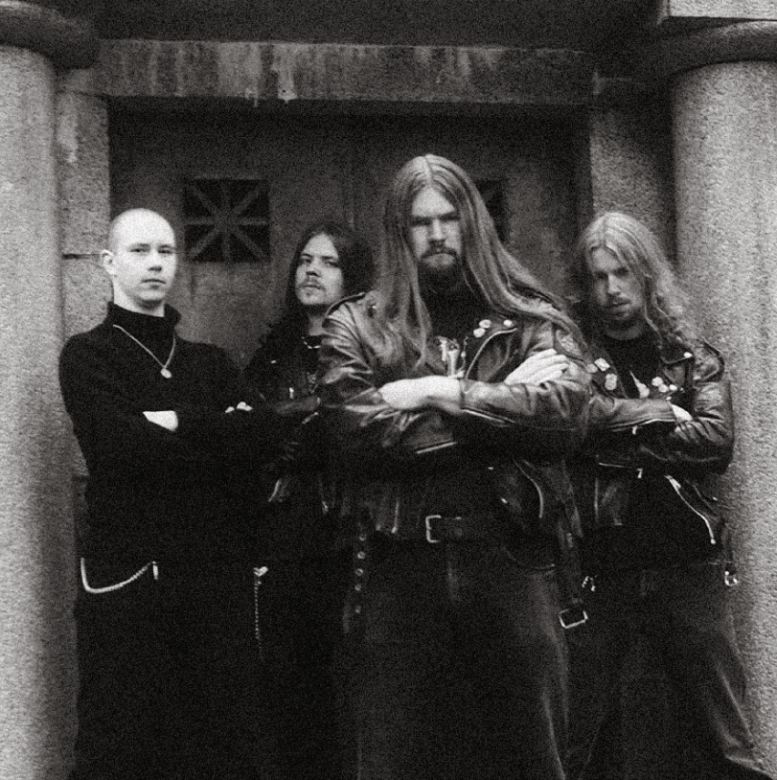
With Kosta and Nicklas Eriksson on guitars, the band’s classic line-up was complete. On a related note, I believe Thomas Väänänen once described Timo as ‘the fifth KAAMOS member’ in Sweden Rock Magazine.
KOSTA: I absolutely agree with Thomas. In fact, I’d say Timo shared my vision for KAAMOS far more than the actual musicians in the band, if that makes sense. From the very beginning, I told him my number one priority was to have the visual side reinforce the music – and vice versa.
Hellish Massacre #2 included a review of KAAMOS’ “Promo 99”, written by co-editor Erik Danielsson before he knew who Timo was. Erik noted that although the material itself might not be groundbreaking, the layout, lyrics, and music together create a potent dark atmosphere which strengthens the entirety.
ERIK DANIELSSON: Flipping through old issues of Hellish Massacre now, I often have a hard time reading those reviews – I just want to slap my sixteen-year-old self. I was trying to approach things from a slightly more conceptual, all-encompassing angle; sometimes it worked, other times it didn’t. But in the KAAMOS case, yeah, it’s actually pretty on point.
The observation is indeed pertinent, given how Kosta and Timo’s core vision was for all components to work together and form a unified whole.
KOSTA: When you spend so much time together, there is a merging of ideas and ambitions that begins to permeate everyday life. And once this happens, it will start seeping into every aspect of your collaboration: the lyrics, the music, the visual side.
I’m assuming the KAAMOS layout sessions were also interrupted by the famous Ketola naps?
KOSTA: <laughs> That constant napping… What can I say? I remember yelling at him a few times, like ‘For fucks sake, Timo, you can’t keep doing this!’ I’m only speculating now, but looking back with some distance – maybe a bit more insight – I’d argue it was tied to his depression.
In what way?
KOSTA: I think he’d get so overwhelmed by the extreme swings between despair and inspiration that it became both physically and mentally exhausting. So, in order to prevent his head from exploding due to everything happening inside, he had to pause intermittently.
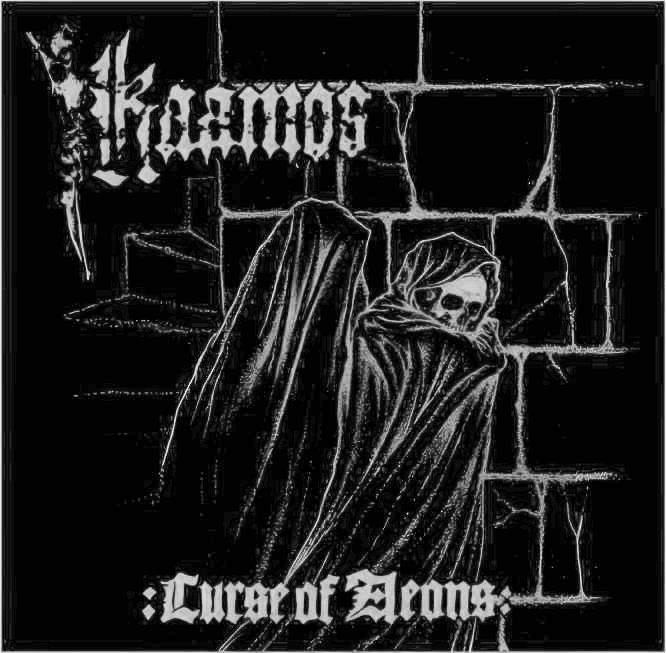
In early 2001, KAAMOS self-released their second demo, “Curse of Aeons”.
KOSTA: “Curse of Aeons” generated even more interest and attention. That’s when we really started affecting our surroundings, influencing other bands. Not in the sense of them trying to sound like us, but in the way they adopted the various principles KAAMOS pushed – the death metal energy, the darkness, Satanism.
Even though KAAMOS had gained some recognition abroad, it is worth noting that traditional death metal remained extremely peripheral in the Swedish underground.
KOSTA: An uphill battle on every front, all the time. Playing death metal was the most unfashionable, least current thing imaginable. Getting any kind of traction – especially shows – seemed impossible. Promoters weren’t interested in bands like KAAMOS or REPUGNANT; they wanted symphonic so-called black metal.
Erik interviewed Stockholm-based death metal band REPUGNANT in the debut issue of Hellish Massacre, while #2 featured a glowing review of their 1999 EP, “Hecatomb”.
ERIK: REPUGNANT was an extremely important band to me; everything about them just felt right. It never really showed in WATAIN, but you can see it clearly in the look and feel of Hellish Massacre. Tobbe and I were definitely aiming for a similar aesthetic.
Besides the ambitious, decidedly old-school layouts of REPUGNANT’s “Spawn of Pure Malevolence” demo and “Hecatomb”, founder and frontman Tobias Forge also produced a similarly styled fanzine called Outshitten Cunt.
ERIK: KAAMOS shared members with REPUGNANT for a while, and we started running into each other at gigs. They also came out when WATAIN played in Stockholm. So KAAMOS quickly became important to me as well – particularly, I think, because the band had Timo’s stamp of approval.
Were his opinions influential?
ERIK: It wouldn’t be an exaggeration to say Timo became a mentor to me – not just in terms of design, but also how to engage with this music in a worthy way. Which factors actually matter? How should we relate to the figure of the Devil? What is the right angle to approach death-related concepts? Timo was one of the few people I knew who had strong, informed opinions on these matters.
Did you know then that he’d had a religious upbringing?
ERIK: No, I assumed he was simply extremely well read, often referring to passages from the many obscure books in his collection. I’d always struggled with those questions myself, but except for Ynas (MALIGN), never really had anyone to consult about them.
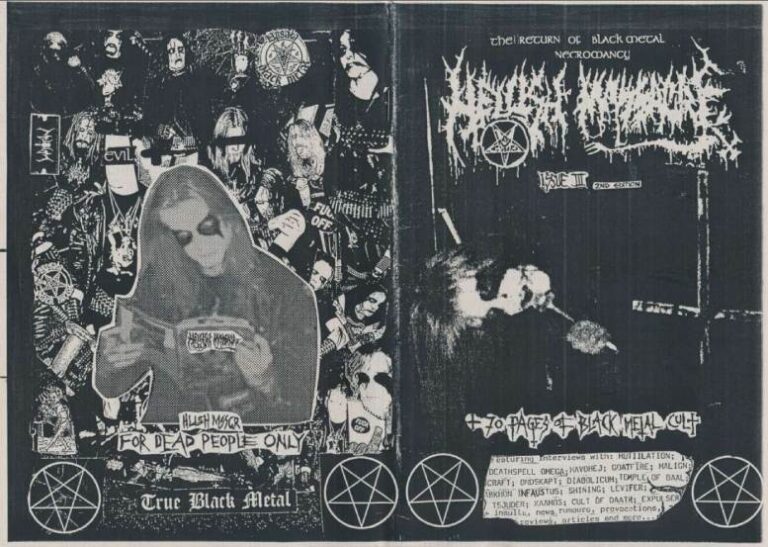
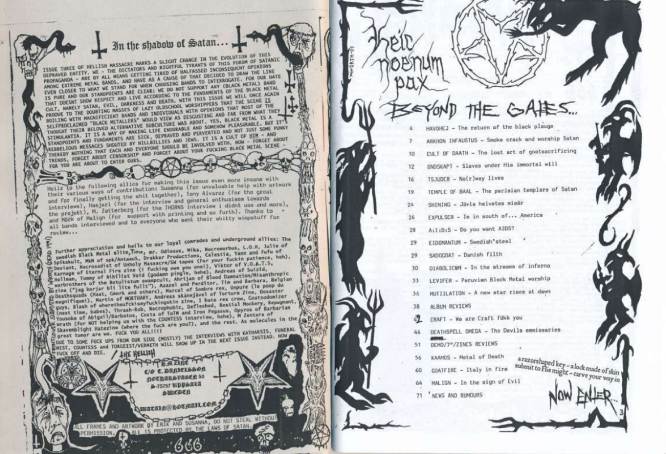
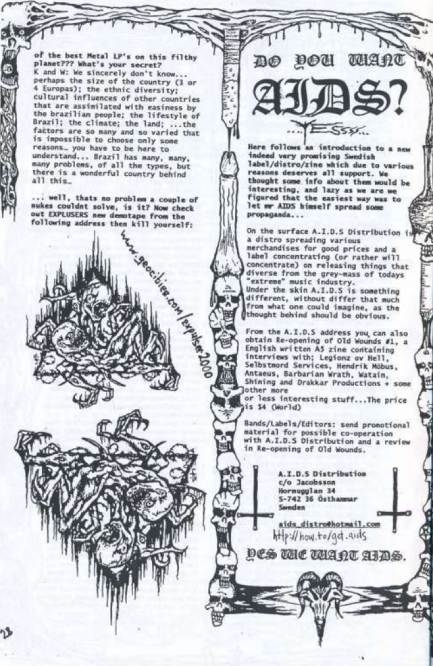
The third issue of Hellish Massacre appeared in 2001. In the acknowledgements, Timo is listed first.
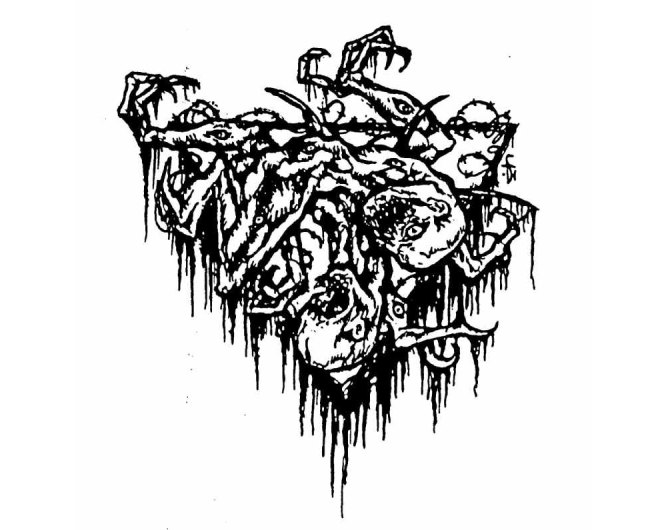
ERIK: The main reason his name appears first is that he helped us print the magazine. Timo also contributed an illustration: a downward-pointing triangle with some kind of foetus inside. I think it was originally meant for WATAIN but ended up in Hellish Massacre instead.
Hellish Massacre #3 was printed at Timo’s local haunt, Haninge Tryckeri in Brandbergen, next door to KAAMOS’ rehearsal space.
ERIK: Timo came with us, selected the paper and got very involved. He also helped figure out the page order – #3 was our thickest issue so far, and we didn’t really understand how to arrange the pagination properly. He stepped in almost like some kind of executive… editor, or whatever you’d call the person who assembles a magazine.
The issue offers a snapshot of the underground scene in 2001. Interviews with ARKHON INFAUSTUS, CRAFT, DIABOLICUM, MALIGN, ONDSKAPT and TEMPLE OF BAAL provide a multifaceted sample of the new black metal generation emerging from the stagnant, Moonfog-infested malaise around the turn of the millennium.
ERIK: By the third issue, we’d started travelling abroad, going to festivals and meeting like-minded people. I was also quick to adopt things like email and direct messaging, which made it much easier to stay in touch with international contacts. This, in turn, helped us reach worthy bands.
Without doubt, the most notable feature is the exclusive DEATHSPELL OMEGA interview. At the time, the French black metal band had released “Infernal Battles” through Northern Heritage and recently recorded their second album, “Inquisitors of Satan”.
ERIK: I believe they’d done one interview before – with Mikko Aspa, right? It was still a huge deal, because people were very curious about DEATHSPELL OMEGA. Which actually reminds me… “Infernal Battles” has a song called “Drink the Devil’s Blood”. That title struck such a deep chord in me, I had to ‘borrow’ it.
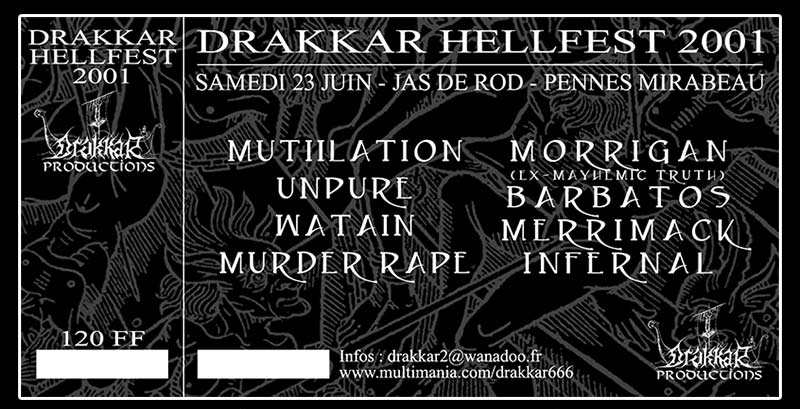

In late October 2000, just before the release of “Rabid Death’s Curse”, WATAIN played their first two shows abroad – both in Belgium. The following summer, they were invited to perform at Drakkar Hellfest in Marseille, France, alongside BARBATOS, INFERNAL, MERRIMACK, MORRIGAN, MURDER RAPE, MÜTIILATION and UNPURE.
ERIK: We travelled down together with UNPURE, stopping for a gig somewhere in Germany along the way, and arrived at the Black Legions castle in Marseille the day before. I could barely believe my eyes – it really looked like some decaying medieval château. If I remember correctly, someone from MÜTIILATION had inherited the place.
CHRISTIAN BOUCHÉ: The castle belonged to relatives of Willy (Meyhna’ch) from MÜTIILATION, and he lived there. By then, parts of the Drakkar crew had moved in as well.
ERIK: The Drakkar guys brought us to a supermarket, where we stocked up on huge amounts of alcohol and food. Back at the castle, more and more people were showing up, all somehow connected to the event.
For a modest underground festival, Drakkar Hellfest 2001 had an impressive scope of international bands. Besides the two Swedish acts and Germany’s MORRIGAN, BARBATOS represented Japan and MURDER RAPE Brazil.
ERIK: What I remember most clearly is the circle around Christian, which included members of S.V.E.S.T. – who also had the 666 ‘zine – and people from an amazing older French fanzine called Stregoica. That one still gives me chills when I think about it. They were among the first to place more emphasis on religion than music.
Stregoica was a Marseille-based fanzine edited by members of a black metal band of the same name. Its first issue appeared in late 1990 and featured acts such as MAYHEM, SAMAEL, and ASPHYX.
ERIK: Initially, the mood felt quite solemn. Despite everyone drinking, they were still black metal people, if you know what I mean. Yasuyuki from BARBATOS stood out a bit, running around laughing and showing his ass. Otherwise, the atmosphere was fairly composed – until intoxication took over and things escalated.
CHRISTIAN: The evening grew as chaotic as you might expect from a large gathering of black metal fanatics of our generation – most of them inebriated beyond salvation. Pelle (WATAIN) was looking for someone to beat up. A man who decided to pick a fight with Willy had to be swiftly exfiltrated once Willy went off to fetch his shotgun.
ERIK: The mood was good overall, though there were a few fights. One guy got too drunk and obnoxious and ended up knocked out. A knife appeared at some point, and people started cutting themselves – a classic black metal evening, in other words.
CHRISTIAN: Håkan (WATAIN) cut himself so badly with a breadknife that folks worried he wouldn’t be able to play the show. It was a depraved gathering, no doubt. In short, it’s somewhat surprising we didn’t discover one or two dead bodies floating in the dirty pool in the early morning hours.
ERIK: I also remember MÜTIILATION rehearsing with everyone standing around watching – almost like a concert. My remaining memories from that night are quite fragmentary, but it created a very particular atmosphere. Despite being the youngest band there, we felt completely at home.
CHRISTIAN: This ecosystem is precisely what spawned many of the records that would later leave a lasting mark on the scene. Those who prefer their black metal stripped of all excesses misunderstand how inseparable these elements were from the creative process. And it’s not exclusive to our genre – there is no Ernest Hemingway without the brawls, there’s no Charles Bukowski without the alcohol.
log in to keep reading
The second half of this article is reserved for subscribers of the Bardo Methodology online archive. To keep reading, sign up or log in below.
Related reading