Liber Ketola IX
2026-04-08
by Niklas Göransson
When Dauthus #3 appeared in October 2002 – its pages bound in blood – refinement had given way to devotion. Timo Ketola brought his fanzine to a close through a sustained exercise in discipline, purpose, and ascetic attention to detail.
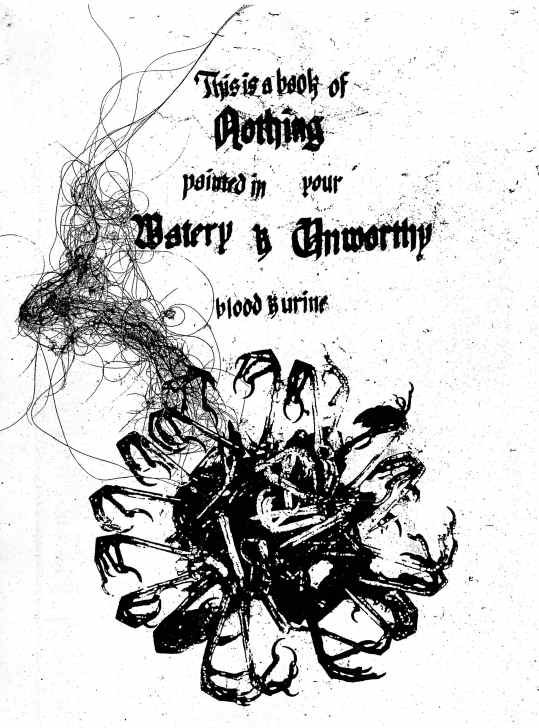
TIMO KETOLA: The title page of Dauthus #3 mentions both blood and urine – and since the former was very concretely present, I can see where the misconception came from. The piss rumours were amusing, though, so I neither denied nor confirmed. I realised later, ‘Damn, that’s what I really should’ve done.’
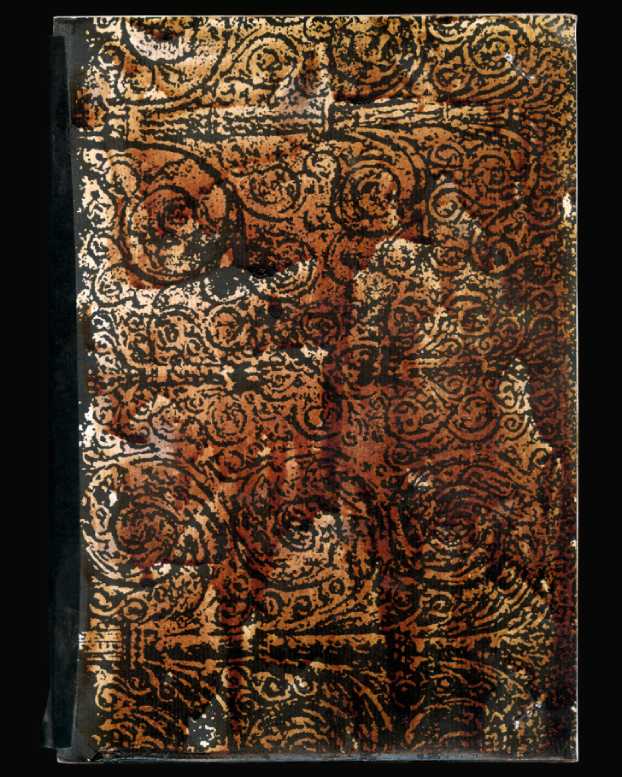
Published in October 2002, Dauthus #3 was the culmination and deliberate endpoint of Timo Ketola’s time as a fanzine editor: eighty A4 pages bound in blood-smeared cardstock covers.
ERIK DANIELSSON: I was absolutely blown away. I still am, actually; I can barely put into words what an impact Dauthus #3 had on my world, and how people around me spoke about it. I mean… just the physical dimension of handling that tome, feeling the blood stick to your fingers.
TYLER DAVIS: Dauthus #3 is almost like a point of no return, as if Timo went to the crossroads at midnight and sold his soul to the Devil. And suddenly – boom – the gift was there. He’d been honing that craft before, sure, but everything aligned for the third issue.
ERIK: You can open a spread at random and, wherever you look, there’s something to study. Which is pretty fucking… it’s actually unique. Especially in a time when the fanzine world was defined by a more digital thinking. What a contribution to underground metal history!
TYLER: From my perspective, looking at the egregore Timo created – it’s unparalleled, especially for that time. I didn’t have access to many of the smaller, more obscure European magazines, but those I do know look very basic, almost mundane, in comparison.
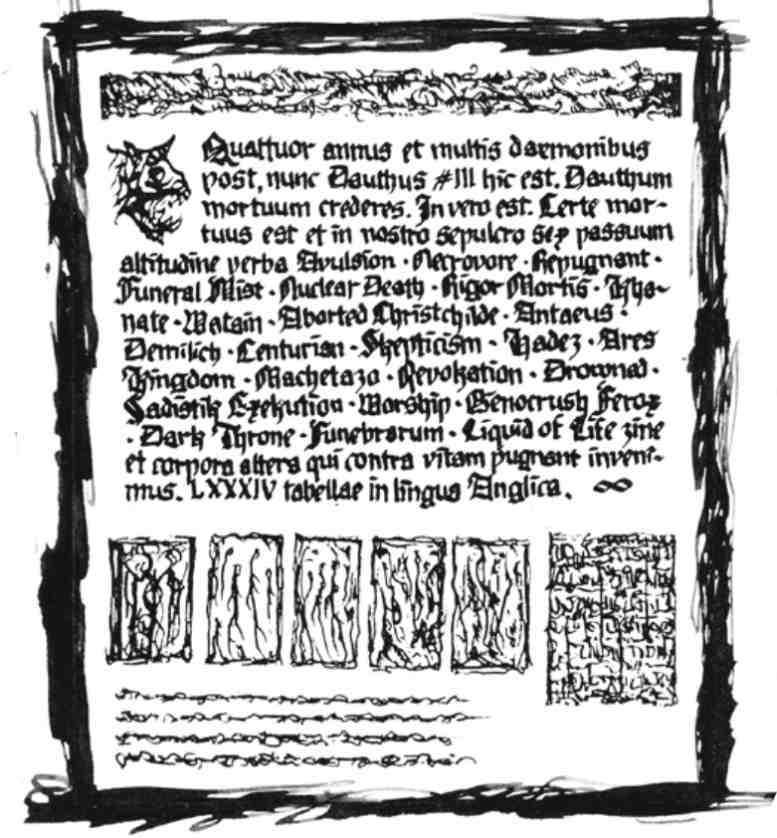
Aside from interviews and articles, Dauthus #3 continues the tradition of multifaceted review columns – spanning music, literature, and even graveyards. Fragments of lyrics written by Timo also appear throughout the layout, embedded beneath illustrations or woven into otherwise unrelated sections.
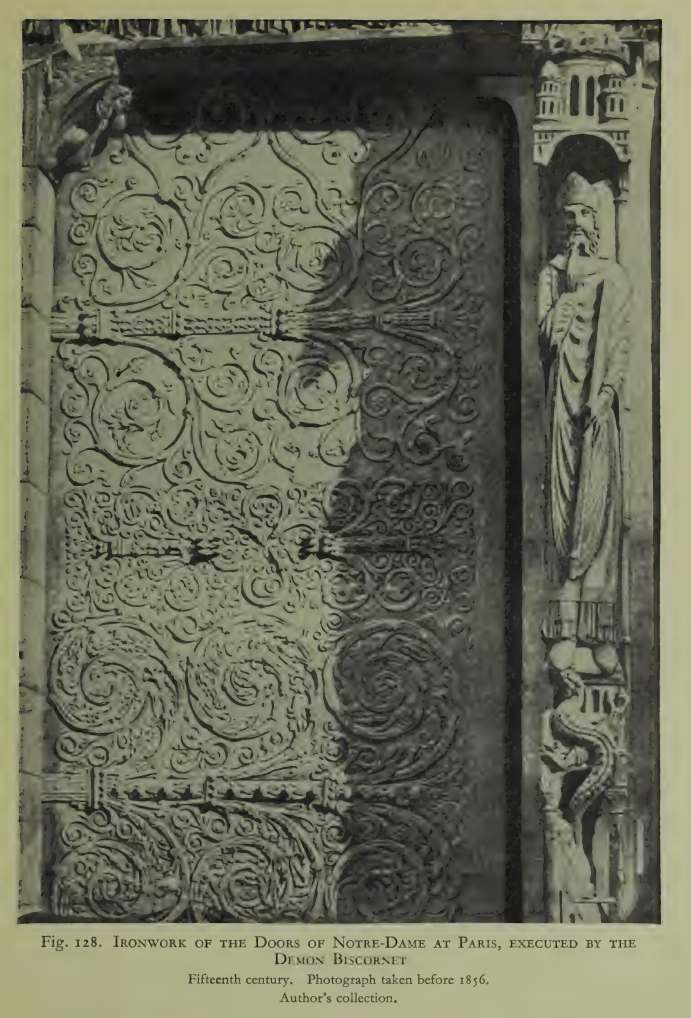
The cover artwork depicts ironwork on the doors of Notre-Dame Cathedral in Paris, taken from a mid-19th-century photograph published in Witchcraft, Magic and Alchemy by Émile-Jules Grillot de Givry. The text running along the page borders is drawn from the same book – quoted verbatim until the final passages, where Timo begins introducing subtle changes.
TYLER: Descent Magazine had a strong, clearly defined vision; the aesthetic felt precise, very much aligned with what Stephen was doing. But if you place them side by side on a table, it’s night and day. Both tap into a similar current, yet Dauthus just blows your mind wide open.
TIMO: Back in the early 2000s, flyers circulated announcing a new StrataNael issue, ending with ‘No contact address. Ask around for it’ – which sounded perfectly sane to me, given my already cemented vision of a scene within the scene. So, that ‘zine influenced me before I’d even read it or met the illustrious editor.
Didn’t you give an interview to StrataNael?
TIMO: Yes, years later. My replies were somewhat minimalistic, so Pierre also printed our email correspondence, adding the comment: ‘Timo will hate this.’ But I must say, it turned out quite entertaining. I took similar liberties with Dauthus – using outdated band logos to better fit my vision, technically risking friendships for the sake of a good feature.
Always willing to take things a step further, Timo’s Dauthus #3 flyers had no contact address either – and for a personal twist, they were written entirely in Latin.
ERIK: That truly is Timo in a nutshell. If memory serves, the entire information text was in Latin, followed by a few band names written out normally – and then it reverted to Latin, so you still had no idea what the flyers were about.
TIMO: It sufficed to alert observant readers that a new Dauthus was available. Having reduced the print run of each issue, it wasn’t like I needed to find distributors or anything.
What? Reduced the print run?
TIMO: Yes, each issue was released in fewer copies than the previous one – but for philosophical reasons, as opposed to pragmatism. I certainly wasn’t any less pleased with Dauthus #3; quite the contrary. The idea of a reverse print-run curve came from a Cold Meat catalogue.
But why?
TIMO: It was a deliberate irony aimed at the whole ‘supply and demand’ mindset. Many editors seemed more interested in increasing the number of printed copies than refining their content, as if a large edition confirmed something. I’d ditched Metal Hammer as soon as I discovered ‘zines – so to me, a small run has always been reassuring in itself.
What is ‘small’ in this context?
TIMO: Dauthus #1 was 265, the second 200, and the third around 190 – even though it’s the only issue I consider worth anything. Then again, truth be told, I later bootlegged my own ‘zine. I made roughly twenty copies of #3 with a paper cover instead of cardstock, and without blood. So much for that long-term print-run morality.

TYLER: My copy of Dauthus #3 is one of those bootlegs, but it does have blood. I remember Timo saying he’d run out of originals, so he photocopied the whole thing, assembled the pages, and stapled everything together. So – 210 copies in total? <laughs> That’s crazy, given the level of ambition.
ERIK: Dauthus #3 was the most ambitious fanzine I’d ever seen – probably the most ambitious artistic expression in black and death metal as a whole. Of course, there are comparable examples. “Salvation”, for instance, had that same quality – just so meticulously crafted and deep on every level.
When Dauthus #3 began trickling into the underground, FUNERAL MIST’s “Salvation” had been finished for nearly a year. As I understand it, the initial plan was for a 2002 release through Svartvintras Productions and Regain Records.
DANIEL ROSTÉN: That was the original plan, yes – but something, God knows what, jammed the machinery, resulting in delays rarely witnessed by mortal men. Luckily, NoEvDia had just appeared on the horizon; the timing felt uncanny, almost predestined, as this new label turned out to be the perfect harbour for a band like FUNERAL MIST.
CHRISTIAN BOUCHÉ: In many ways, I am a late bloomer. I do take some comfort in the fact that writers such as Bram Stoker and Umberto Eco published acclaimed works – Dracula and The Name of the Rose – well into their forties. Sometimes, potential takes time to reveal itself.
Earlier in the conversation, you described 1998 as the moment when the ‘real you’ began to emerge. What brought that about?
CHRISTIAN: 1998 is a rough estimate, right? It’s not as though you wake up one day and suddenly become a completely new person from head to toe. Yet there are moments in life that feel like tipping points – sudden accelerations. In this case, it was the convergence of several factors, each reaching a kind of critical mass.
One notable development that year came when Christian brought Nihil Magis – a fanzine he launched back in 1995, at sixteen – to a close after five issues.
CHRISTIAN: First of all, my knowledge of extreme metal had reached a point where I’d grasped the genre’s roots and histories, as well as which later evolutions felt right – or very wrong. By that I mean moving beyond instinct or youthful, superficial taste to being able to articulate a detailed and credible case in defence of one’s position.
Dismissed by Christian in hindsight as ‘not very good’, the publication nevertheless provided a network of contacts he would soon draw upon elsewhere.
CHRISTIAN: Secondly, I’d grown more confident as a musician. My years in HIRILORN taught me how to play guitar, write riffs, and structure songs. It was a steep learning curve – from near zero in the demo days to a decent, but not excellent, level by the time we recorded the “Depopulate…” EP.
1998 saw another closely related development: the founding of End All Life Productions. Its inaugural release, ANTAEUS’ “Rekordin 2000 – 1” mini-CD, was co-issued with Spikekult Rekords, followed shortly by the LP edition of WARLOGHE’s “The First Possession”. From then on, the label operated exclusively on vinyl, despite the format’s near-total lack of market demand.
CHRISTIAN: I was also envisioning – this is the third point – the need for a label embodying the radical, uncompromising attitude required to stay true to the ideals of black metal, while giving a new generation of musicians the space to show how things should be done. Even then, however, one further step had yet to materialise: NoEvDia.

CHRISTIAN: NoEvDia was meant to function as a magnifying glass, sharply focusing on specific aspects. The spiritual elements, for instance, thereby helping provide what I considered sorely lacking in a genre that presented itself as ‘Satanic’: a solid artistic expression of these currents.
When Christian founded Norma Evangelium Diaboli in 2003, it was a decisive step beyond the original framework of End All Life. The new label extended – or rather intensified – the vision he’d already begun to articulate.
CHRISTIAN: It certainly wasn’t that I’d suddenly found MÜTIILATION or BURZUM uninteresting. Rather, the genre was lyrically and conceptually all over the place, and perhaps not operating at the level I considered necessary to live up to its bold claim of being the Devil’s music.
At its inception, NoEvDia already had a core network of artists and collaborators in place. Bands like KATHARSIS, WATAIN, and MALIGN were involved from the start – all relationships established during the E.A.L. period.
CHRISTIAN: Merely repeating what already existed can only go so far. I’ve always taken more interest in shaping the future – or at least exploring untrodden paths. A vision centred on preservation alone would’ve been lacklustre; we needed a tool to sharpen our focus. Sometimes, you must cull branches to make a tree grow faster and stronger.

CHRISTIAN: During an early 2003 visit to the S.V.E.S.T. fellows, we dropped by a friend of theirs. I don’t quite remember who it was now, but he played us an advance tape of “Salvation”. Within minutes, it had left me awestruck.
Recognising both the artistic gravity of FUNERAL MIST and the uncertainty surrounding its debut album, Christian acted without delay. On March 15, 2003, MkM of ANTAEUS – who was already in contact with Rostén – reached out on NoEvDia’s behalf.
CHRISTIAN: When I founded NoEvDia, I envisioned a structure in which a few key individuals, each with their own distinctive qualities, would play a role. MkM did support us as best he could – on the one hand through his extensive personal network, and on the other by helping distribute our releases in Paris.
A few days later, Christian established direct contact. Negotiations progressed quickly; an agreement was reached in short order, including the transfer of rights from Svartvintras Productions, along with standard terms such as royalties.
CHRISTIAN: I knew “Salvation” would make history. It wasn’t merely good – it set new standards. Nothing comparable existed at the time, and in many ways it remains unique. I’ve often said it’s no less important than “De Mysteriis Dom Sathanas”. That may sound like a massive exaggeration, but hear me out: in my eyes, it was the first black metal album to open onto a multitude of sinister worlds.
How so?
CHRISTIAN: First, the lyrical content – showing remarkable depth and fanaticism, with angles that felt entirely novel. Then the vocal performance: unrivalled in execution, especially its layering. And the extraordinary use of samples, each one serving as a gateway into a different world.
ROSTÉN: My approach to samples varies greatly. There are certainly times when I’m actively searching for a particular sound to complete a riff or intro. But more often than not, what I end up using comes from material I’ve stumbled across – old films, documentaries, or music that isn’t too close to my own.
I have a distinct memory of you – before “Salvation” was recorded – being very taken by the scene in Körkarlen with the spectral carriage moving across the ice. If I’m not mistaken, that’s where the violin outro of “In Manus Tuas” comes from.
ROSTÉN: I’m constantly listening for new sounds, even if often unconsciously – they tend to appear in the most unexpected places. That’s why I always carry a portable recorder of some kind with me. Every sample I find is then handled in its own specific way.
CHRISTIAN: Furthermore, Tore’s frantic performance went far beyond typical metal drumming. Many of his mixing choices were equally inventive – although I suspect Rostén was sitting right behind him, watching every second.
ROSTÉN: That would be an accurate assumption.
CHRISTIAN: And last, though certainly not least: the artwork, innovative and full of references. There again are our many worlds; truly a unique creation for 2002. Oh, and I actually forgot to mention that all of this permeated the riffing as well – unquestionably black metal, yet something far beyond it.
In what way?
CHRISTIAN: The analytical part of me identified several pioneering aspects of Rostén’s riffing. It’s a strange balance where some of it trod ground familiar from other Swedish black metal bands, while the rest – notably the hectic parts and certain harmonies – was entirely unique to “Salvation”. Pure, swirling, razor-laced emotion.
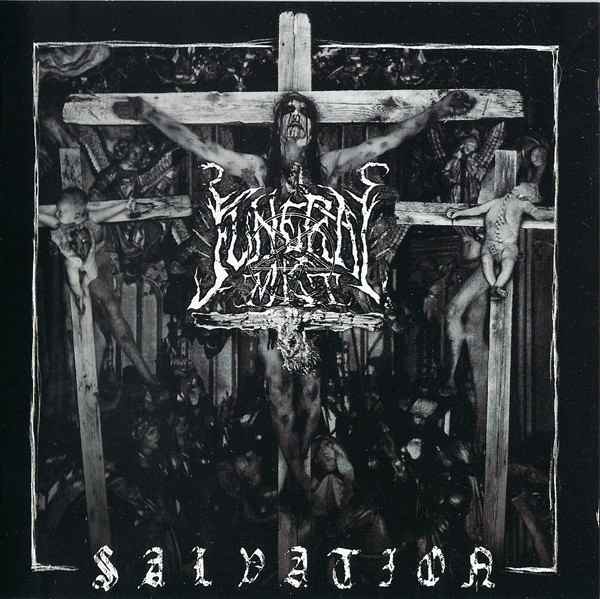

CHRISTIAN: Although End All Life had already put out around thirty releases by then, “Salvation” was my first attempt to handle every aspect in a truly professional manner: covering all costs, offering upfront cash royalties at a major-label level, and ensuring wider distribution and promotion.
In late March 2003, Timo had updated the visual material to reflect FUNERAL MIST’s change of label. Planned as a gatefold double-LP on heavy vinyl – a significant investment in itself – “Salvation” also became Christian’s first multi-format release, appearing on CD as well.
CHRISTIAN: None of our previous releases came anywhere close in terms of capital invested. In that sense, the financial commitment stood as a testament to both how highly I regarded “Salvation” and the level of risk I was prepared to assume to serve it properly. No expense spared.
log in to keep reading
The second half of this article is reserved for subscribers of the Bardo Methodology online archive. To keep reading, sign up or log in below.
Related reading