Liber Ketola XXIII
2026-07-08
by Niklas Göransson
By March 2009, Seven Chalices was finally in print, closing a two-year saga. Timo Ketola turned at once to the next, putting forward a brother of the draconian current to fill the guitar and production roles Teitanblood had lost.
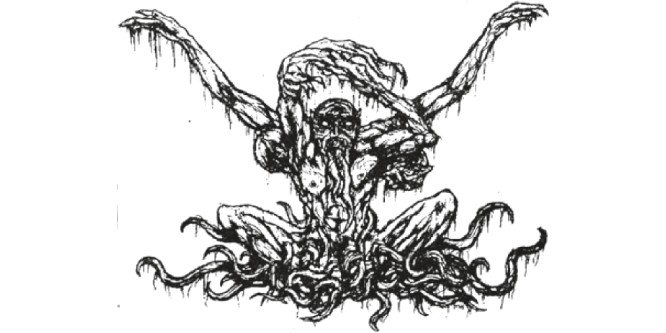
TIMO KETOLA: It was a strange thing, picking up the “Seven Chalices” LP with the outro of “The Abomination of Desolation” playing in the background. The dripping water and chanting monks worked almost like a soundtrack to the cover artwork – a connection I hadn’t made until that moment.
By late March 2009, “Seven Chalices” was pressed and delivered – the consummation of a process begun two years earlier. Receiving both the LP and CD, Timo proclaimed the physical production satisfactory in every respect. In an email to Nasko, Christian Bouché, and Tyler Davis, he writes, ‘Everything is as it should be when it comes to reproduction, paper stock, cardboard and so on.’
TIMO: Apart from the successful entirety, I cherish many of the smaller details – the vinyl labels, for one, are absolutely hideous. I can’t imagine anyone but Nasko agreeing to plain white with the titles set in Arial. Most bands would’ve protested, ‘No, that looks terrible.’ Which is objectively true: ugly as fuck, yet perfectly fitting.
Having lived with the material in fragments across two years, this marked Timo’s first experience of the album as a whole. Listening while following the handwritten text, he met the very disorientation he’d prized as an ideal: ‘In “Morbid Devil…” I was lost after ten seconds, and I wrote that bloody thing!’ For anyone without the lyrics to hand, he pictured something worse still: ‘It must be like a 10,000-piece puzzle where half the pieces have been burned and inverted and then forcefully reassembled.’
TIMO: In many parts of the booklet, you see the results of my chaotic way of working, where some artworks have been xeroxed, pasted together, glued, fixed, and fucked up again several times over. It leaves small clouds of minute grime – visible on the front cover, and near the snake-heads in “The Abomination…” – which I’m glad survived, as it skews everything a little further.
Reflecting on the broader timeline, Timo traced the project back to Walpurgis Night two years earlier, when he first heard the instrumental rehearsal recording. With the album finished and released, he considered the point closed: ‘Today, I feel this trip is concluded on my part…’
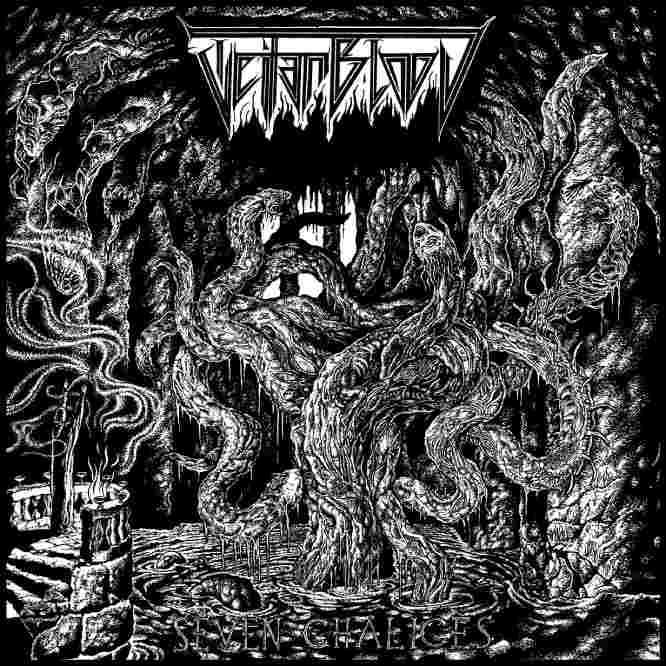
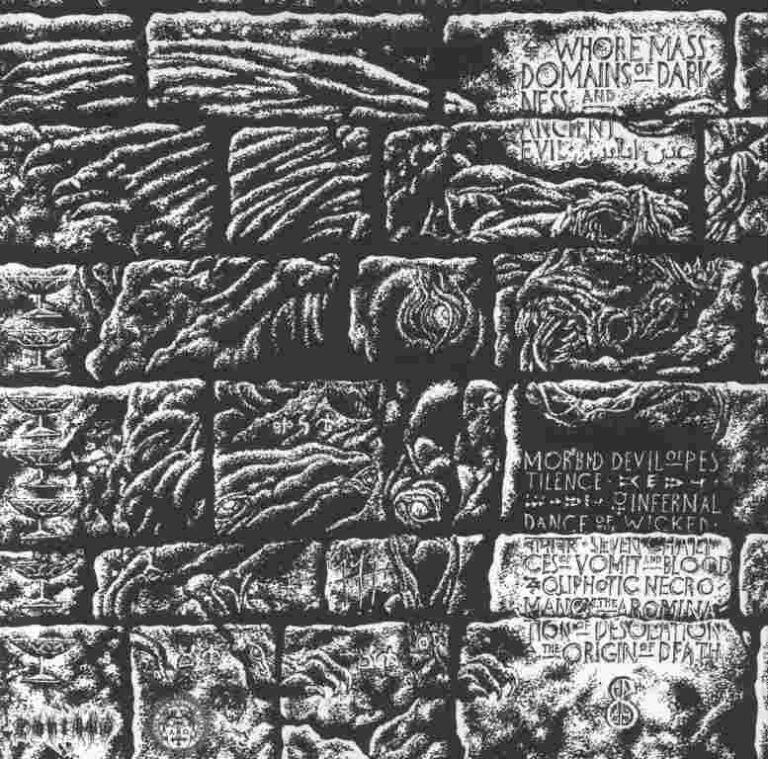
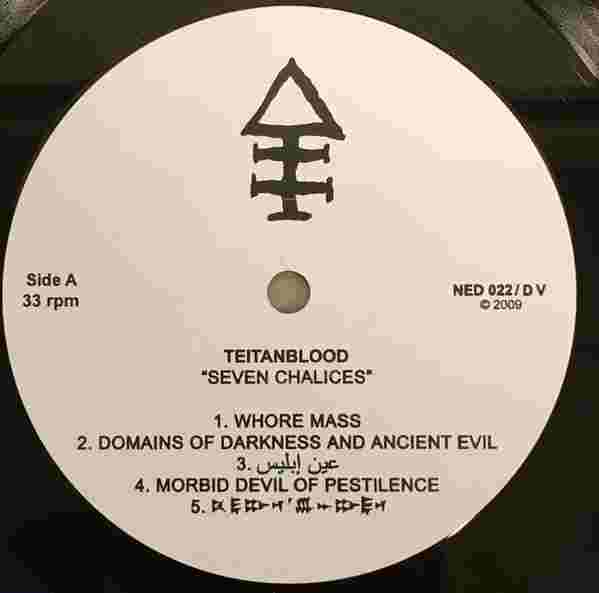
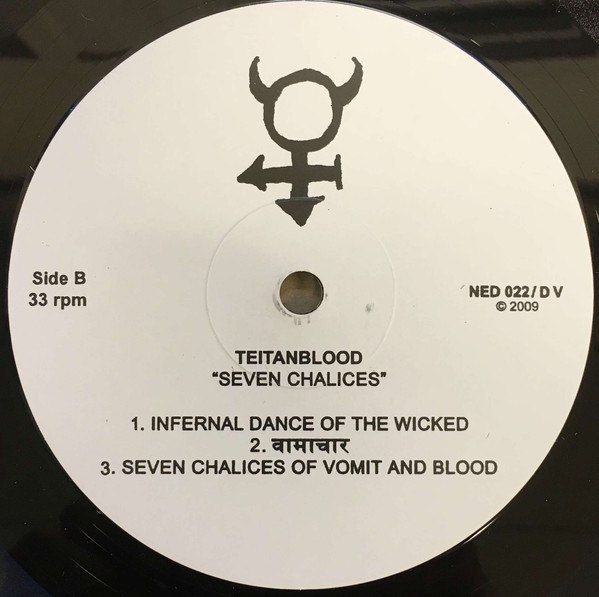
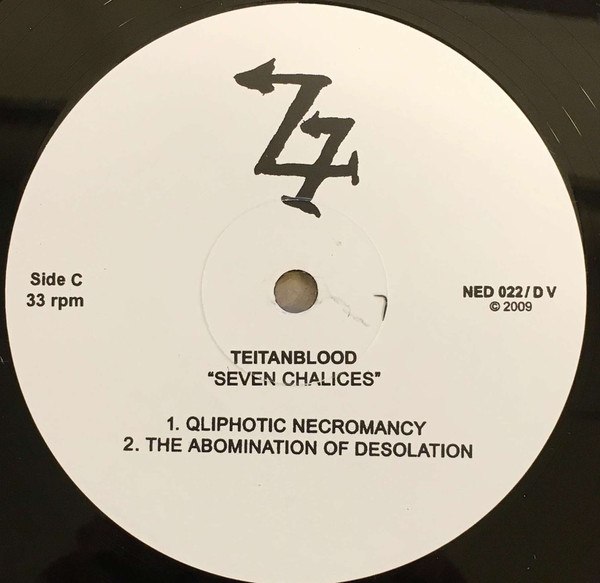
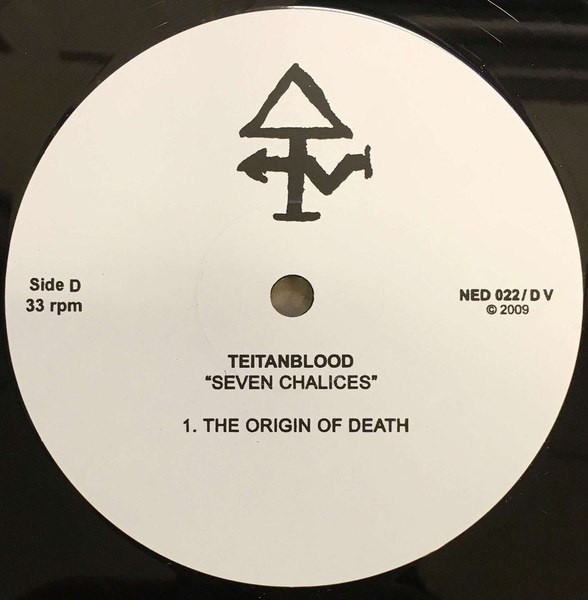
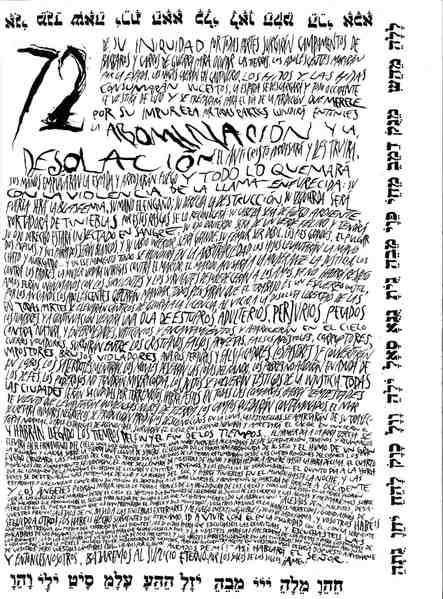
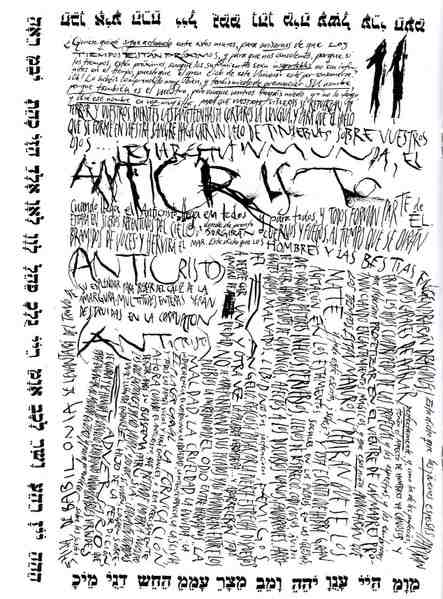
Norma Evangelium Diaboli and The Ajna Offensive released “Seven Chalices” on March 27, 2009. The LP edition – co-released through Timo’s own imprint, Dauthus 1899 – came with an ambitious sixteen-page A4 booklet.
CHRISTIAN BOUCHÉ: Those expecting pure black metal were taken aback, whereas listeners of a more death metal-oriented taste suddenly realised NoEvDia could release albums to their liking. In that sense, “Seven Chalices” was a bridge. It functioned as a time machine and yet raised the bar considerably – summoning the old-school spirit while pushing the form forward – which made it a genuine contribution.
Do you remember whether this was another one of those NoEvDia releases that appeared without prior announcement?
CHRISTIAN: No, sorry. I’m assuming any prior announcements would’ve been minimal, but Nasko will remember more precisely.
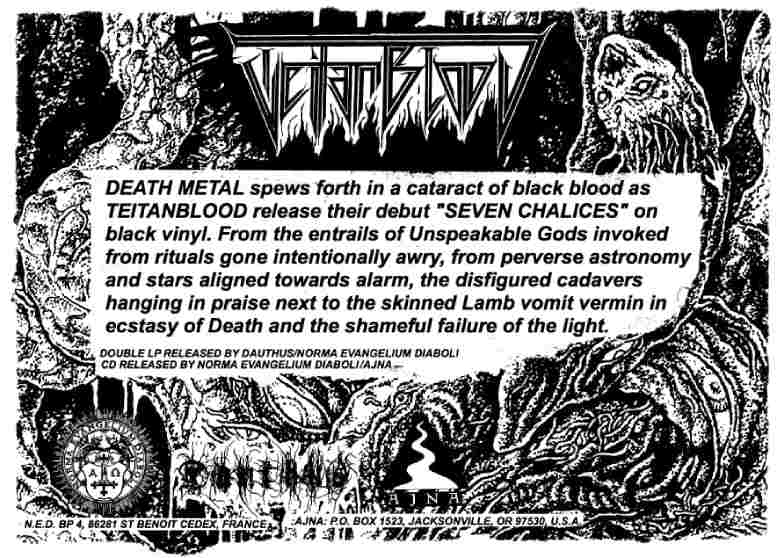
NASKO: There were no announcements at all – not even rumours about TEITANBLOOD having a new album coming, or who would release it. We were fully convinced that “Seven Chalices” had to arrive without warning, when nobody was expecting it.
TIMO: The whole packaging approach could easily have read as a gimmick, so the promotion went the other way entirely: minimalist by design. We published no photographs of the record anywhere, leaving its contents for the buyer to discover. An average, run-of-the-mill band – and label – would’ve trumpeted the thing to the skies.
CHRISTIAN: Obscurity was obviously familiar terrain to NoEvDia, so I imagine whatever objections I raised were meant to temper Nasko’s expectations for reception into harmony with the promotional efforts. If you refuse to play the marketing game, you must allow the work plenty of time to find its way organically through the scene. You have to think in terms of years rather than instant feedback.
NASKO: The minimalism was completely deliberate. I remember when Osmose listed the album in their mail-order catalogue, they mentioned ‘artwork by Timo Ketola’, probably as a selling point. He wrote to them immediately, very angry: ‘Remove my name at once!’ We didn’t even provide a description of the music, only a statement, and made a single flyer.
With the album itself in print, Timo turned to the flyers. Smitten by a specific kind of paper stock that fellow NoEvDia band KATHARSIS had used years earlier, he hoped to acquire the same for TEITANBLOOD.
NASKO: We really wanted the same paper as those “VVorldVVithoutEnd” flyers, which is why we asked Christian to investigate. That is how we found out Drakh had saved this particular stock ever since the DDR days.
CHRISTIAN: Ultimately, I believe we went for something comparable, but I don’t remember exactly what. Certainly nothing as vintage, sadly.
NASKO: On my end, I printed the flyers on the thinnest paper I could find, and then spent several evenings crumpling each one to give them an old, worn look.
NASKO: Timo was so enthusiastic about TEITANBLOOD, sending “Seven Chalices” to many old scene contacts as if it were his own band. Not as in, ‘Look at what I released’, but more, ‘I am a part of this.’ At the time, I didn’t understand these things the way I do now – I hadn’t yet grasped how much it meant to him.
In the wake of “Seven Chalices”, Timo was regarded as part of TEITANBLOOD – much as Kosta once counted him as KAAMOS’ fifth member, a non-musician who shared the vision more completely than the men holding the instruments. Yet for all they gained in Timo, the earlier departure of Juan Carlos Deus had left the band without both its guitarist and producer.
NASKO: After Juan left, Jakub and I had to ask ourselves, ‘How are we going to operate now?’ Even release-wise, I thought, ‘Okay, we have to start from scratch. Let’s make a new demo, followed by an EP. Only then, once we’re more comfortable, will we work on another full-length.’
Nasko, the bassist who wrote all the music, set about learning guitar the moment Juan walked. Meanwhile, the search for his replacement led Timo to put forward a candidate capable of filling both roles at once: Tommie Eriksson of SATURNALIA TEMPLE.
Eriksson had first come up in conjunction with “Seven Chalices”, as Timo mentioned ‘a brother in Stockholm’ who could provide Sanskrit assistance: ‘His name is Tommie, and he is a warrior! Blood-drenched greetings from the Finn when you contact him.’
TOMMIE ERIKSSON: Nasko reached out – we started talking and began the whole Sanskrit process. I knew Timo had some involvement in TEITANBLOOD, but soon realised he was a kind of grey eminence behind “Seven Chalices”, bringing that characteristic intensity of his: meticulous, dedicated, leaving nothing to chance.
Around the same time, Saibot was brought in to assist with Akkadian and Arabic. Unbeknownst to Nasko, both language specialists were contacts Timo had made a decade earlier through the Stockholm lodge of Dragon Rouge, a left-hand-path magical order based in Sweden.
TOMMIE: Others in your series have noted the stark discrepancy between how Timo looked and who he was. I remember very clearly when he first turned up at a Dragon Rouge meeting – he did give a rather nerdy impression. I liked that, though, because he seemed so insanely dedicated.
When Timo joined Dragon Rouge in January 1999, Tommie was one of the senior members who led the magical workings and meditations.
TOMMIE: Our very first conversation went deep immediately. Just… bang! ‘This is what I’m working on, this is how I think.’ We must have stood talking for an hour – Timo pulled me straight into his world, and I let him into mine. It was that kind of meeting.
At the time, Timo had just launched Dauthus 1899 and stood ready to issue KAAMOS’ debut seven-inch. Nine years on, Tommie was pulled into the maelstrom surrounding the label’s third release: TEITANBLOOD’s “Seven Chalices” – first as a Sanskrit consultant, then, after the album appeared, in a more extended capacity.
TOMMIE: By then, Timo had observed me for almost a decade – handled my book, and everything I’d done musically – and evidently concluded, ‘Here is someone I can trust.’ We were fully aligned on music, on studio production, on the visual language that ties the two together; that’s why he wanted me involved in TEITANBLOOD.
TOMMIE: Like many who take up magical practice later in life, my esoteric interests were first sparked by supernatural experiences in childhood – lucid dreams, visions, astral journeys. But for a young kid in Umeå, learning anything about the arcane was almost impossible.
Born in 1975, Tommie grew up in Umeå – a coastal town six hundred kilometres north of Stockholm.
TOMMIE: I had no access to books about magic, obviously. But at six or seven, I started coming across these incredible record covers that seemed to depict what was happening to me. Then, listening to BLACK SABBATH, DIO, and IRON MAIDEN, I could immediately sense: ‘Yes, there’s something in here.’
An AC/DC cassette, handed to him by his older brother’s friend, opened the way to a second lifelong obsession: hard rock and heavy metal.
TOMMIE: So, you could say that I was drawn to this music in part by these incredible visionary artists – Timo’s forebears, as it were – whose work felt like a direct line to my own experiences. Metal can lead you to real esoteric knowledge. Not fully developed, perhaps, but the beginning of an extensive process.
Before long, Tommie decided he needed to learn how to play metal rather than just listen to it.
TOMMIE: I started on my mother’s acoustic, but it wasn’t much fun. Then I got an electric guitar – a Japanese SG copy, of course, given my love for AC/DC. I plugged it into a boombox and overdrove the thing to get some distortion. Seven years old, sitting there blasting away, trying to play heavy metal.
Would it be fair to say that you are prone to obsession when something catches your interest?
TOMMIE: My view of culture, of magic and creation – of everything in human existence – is that if you’re going to do something, you dive in headfirst and leave nothing behind, surrendering completely. It’s an esoteric concept found everywhere: to be initiated, one must first die. This is Crowley’s Cup of Babalon, into which the adept pours every last drop of himself, and it recurs in shamanism too. That impulse was in me very early.
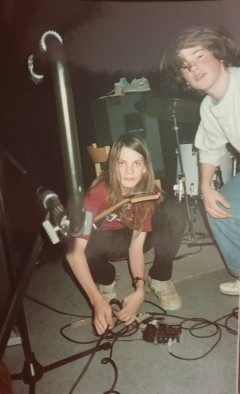
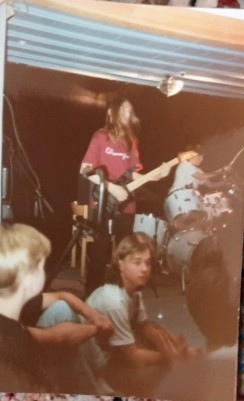
Although Tommie’s musical foundation rests on ‘70s hard rock and heavy metal, it is the thrash, death, and black metal he discovered in the late 1980s that sits at the core of his inspiration.
TOMMIE: SABBATH, MAIDEN, and all those classic acts were important. But what happened in ‘88 was that I started playing and writing music in bands more seriously – which meant I formed a much stronger musical bond to whatever I listened to, drew inspiration from, and worked with at the time.
At thirteen, Tommie and local drummer David Sandström, who went on to co-found REFUSED, started playing together. They were soon joined by Marcus Norman, later known as Vargher of ANCIENT WISDOM.
TOMMIE: At first, we played some kind of hard rock, which soon escalated as we improved as musicians. We had the classic thrash influences, like METALLICA, but also Umeå’s own MESHUGGAH – musically, they were very inspiring to see live. But nothing was ever released. We did maybe two gigs before going our separate ways.
Soon after the demise of his first real band, Tommie found a kindred spirit in Fredrik Mannberg.
TOMMIE: One day, I noticed a guy wearing a CARCASS shirt staring at my MORBID ANGEL shirt. He had long hair, just like me. ‘Do you play an instrument?’ – that question was all it took. Fredrik and I formed NECRONOMIC and made a rehearsal recording, which ended up released in some basic edition.
With “Demo 1990” – a self-released tape in a basic J-card – NECRONOMIC gave Tommie his first recording credit, on lead guitar.
TOMMIE: I’d played almost daily for eight years by then, so I saw myself as a guitarist like Trey Azagthoth (MORBID ANGEL) – just playing fast, Yngwie-style stuff. I wanted to be technical, really going at it. Fredrik, a brilliant songwriter, had the great riffs, but all my overplaying held him back and made the band worse. It became a small musical death, of a kind – the first of many.
In what way?
TOMMIE: Abandoning my primary instrument, letting it go. ‘Okay, you’ve been toiling on this thing since you were seven. Now we drop it.’ Physically, even – I literally handed my guitar to Fredrik. He took over my Marshall stack as well; not as a gift, exactly, but he was the one playing through it now. I bought a drum kit instead and put my energy into songs rather than soloing.
With Tommie on drums, NECRONOMIC became NOCTURNAL RITES. A demo tape titled “The Obscure” followed in 1991 – his first time in a real studio environment.
TOMMIE: We’d recorded NECRONOMIC on a cassette porta, only four tracks to work with. This time it was a professional setup – sixteen-track reel-to-reel, mixing desk, effects. But we didn’t have the faintest idea how to do anything. I’d been playing drums for about six months, and you can hear it. We hadn’t really found our sound yet, either.
What kind of production were you aiming for?
TOMMIE: Sound-wise, we wanted a guitar tone similar to “Slowly We Rot” (OBITUARY). But since neither of us could afford a Mesa Boogie or a Soldano, we ran a Boss equaliser with everything at the bottom except bass and treble at max, at the highest volume. The result is that the guitar is the most insane thing imaginable – just an inferno of buzzing. Which is interesting in itself, mind you.
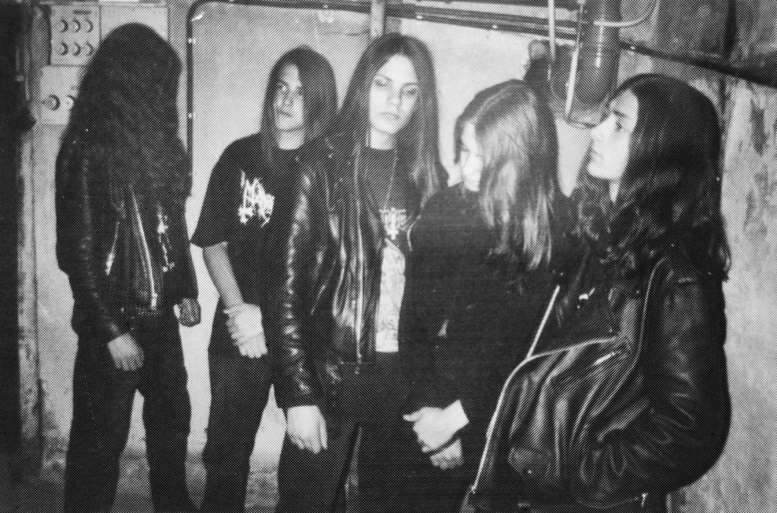
TOMMIE: In Umeå, we had a very active underground promoter: Mats Möken. He brought in all the best bands of ‘90s Swedish death metal – MERCILESS, TIAMAT, DISMEMBER, THERION, and so on. Attending these gigs, Fredrik and I got to know him, and he invited NOCTURNAL RITES to open many of his shows.
Were these shows put on in youth centres?
TOMMIE: No. We were lucky in Umeå to have Galaxen, a fantastic venue – big stage, capacity for several hundred, essentially a medium-sized rock club by continental European standards.
Once they got to know each other, Mats ‘Möken’ Björklund – who today runs the annual indoor festival House of Metal in Umeå – talked Tommie and Fredrik into forming a death metal project with him on vocals. He booked the studio, paid the bill, and the trio recorded a demo under the name LIGAMENT.
TOMMIE: At some point, Mats made a passing remark: ‘The guy from THERION is into sorcery, if you can believe it.’ My ears pricked up at once: ‘Really? Interesting.’ I’d already met Christofer – we’d talked when they played Umeå – but this was news to me. So, I wrote him a letter, asking about occultism and magic.
THERION founder Christofer Johnsson joined Dragon Rouge in 1991, when the order was barely two years old; Tommie followed in January ‘92. The month after that, Christofer stepped in to produce NOCTURNAL RITES’ “Promo 1992” at Sunlight Studios – the Stockholm room responsible for much of the Swedish death metal sound.
TOMMIE: By then, I’d started fixating on combining music and magic. My NOCTURNAL RITES lyrics were already esoteric, but I soon realised the fusion could never be complete without the other members on board – and they weren’t. To merge the two worlds, I’d have to carry on alone.
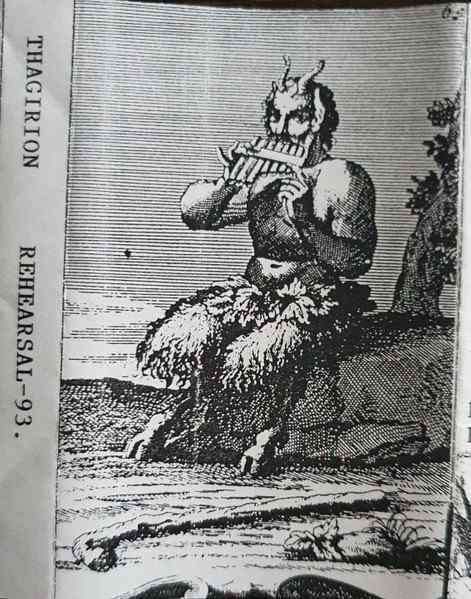
Meanwhile, a new wave of black metal was establishing itself across the Nordic countries. Umeå had THRONE OF AHAZ and ANCIENT WISDOM active as early as 1992; the year after, Tommie added his own project, THAGIRION, playing every instrument himself and leaving vocals to one Lord Grimm.
TOMMIE: I made a demo in ‘93 – what I considered an original form of black metal. Sadly, I don’t have the recording any more, only the cover. Its relevance is that this was where I began consciously trying to make music reflecting my magical experiences with the Qliphoth – Thagirion being the other side of the sun.
Thagirion – the black sun, the inverse of the solar Tiphareth – was one of the concepts Tommie had learned during his time in Dragon Rouge, as were the demo’s other markers: a track named “Sitra Ahra”, a recording credited to Kliffoth Recordings, and a thanks list greeting Thomas Karlsson, the order’s founder, along with Christofer and fellow travellers of the dragon.
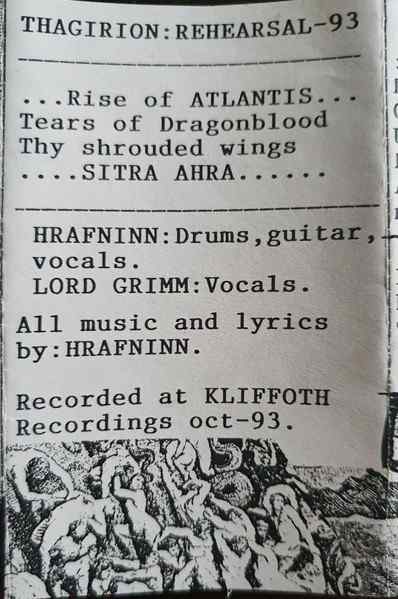
TOMMIE: DISINTERMENT, also named in the THAGIRION thanks list, was a death metal band from Mora, with Johan (Shamaatae) of ARCKANUM on drums. We had a good deal of magical exchange in those days. After I moved to Älvdalen, I joined them on guitar – we even played support for UNANIMATED once, and the local paper interviewed me.
Tommie spent a few months of 1993 in Älvdalen before continuing to Stockholm, the seat of Dragon Rouge. Studying an esoteric tradition by correspondence has its limits, and he had reached them.
TOMMIE: You can learn magic remotely, if you have some ground to stand on – which I felt I had. And it certainly worked. But I knew it would only take me so far; to go all the way, I needed to be closer to the others, working alongside them. Developing my esoteric side came at considerable cost, though – it meant leaving NOCTURNAL RITES.
I take it you were quite emotionally invested by then?
TOMMIE: Absolutely. We rehearsed almost every day, trying to develop death metal in innovative ways, demoing tonnes of interesting ideas that, sadly, survive only as tapes in a drawer. I considered NOCTURNAL RITES a huge part of my life. Musically, it was everything. So yes – it came down to sacrifice.
Leaving NOCTURNAL RITES also served as closure to Tommie’s days as a death metal musician. What deepened in its place was the esoteric practice – and his exploration of how music and magic might potentiate one another.
TOMMIE: I concluded that in order to accomplish a direct channelling to something higher, you must leave behind the mindset of proper musicianship, doing everything ‘the right way’, following scales, or thinking in terms of… I don’t know, making catchy songs. In fact, after 1993, I haven’t been particularly influenced by metal.
Following his Umeå exodus, Tommie burrowed into krautrock and all kinds of psychedelic, experimental music. He had already taken a liking to TANGERINE DREAM, and now went on to discover the likes of CAN, AMON DÜÜL, HAWKWIND, THE DOORS, and THE STOOGES – and, further afield, COIL. I must say, this is surprisingly open-minded for a nineteen-year-old metalhead.
TOMMIE: To me, all fringe music hangs together – I’ve never liked to draw lines between styles. This is one larger counterculture, each genre with its own character. That broader instinct, taking inspiration from anything compelling wherever I find it, has shaped everything I’ve done since.
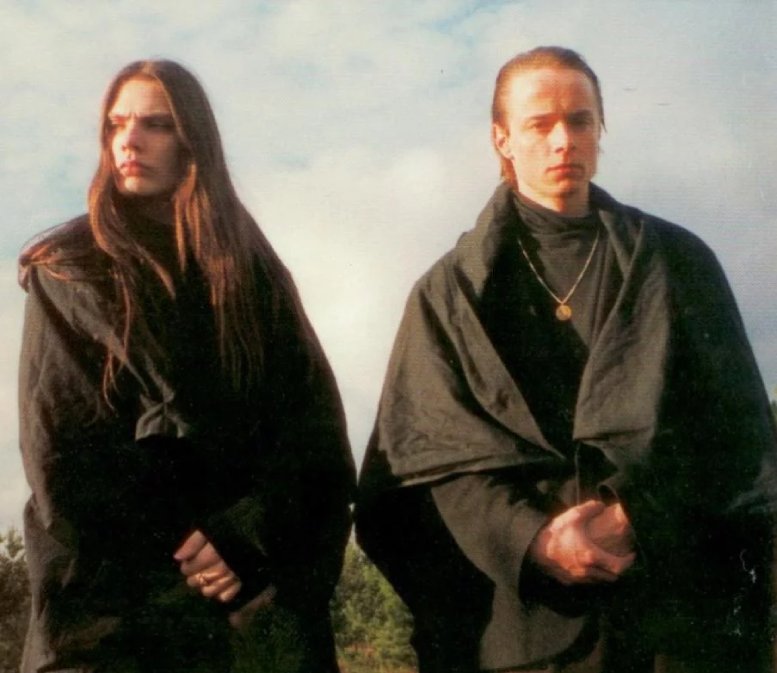

In October 1994, Tommie found himself in Uppsala’s ADM Studio, recording as SHADOWSEEDS – the duo he had formed with Thomas Karlsson. Rather than conventional songwriting, the project grew out of the extended period of shared magical work that followed his move to Stockholm.
TOMMIE: I’d worked that way before, but only alone. With SHADOWSEEDS, there were two of us, both equally dedicated – which allowed for potent results. That’s exactly why I brought Thomas in: ‘Let’s make a wholly magical record.’ I composed and performed the music; he wrote most of the lyrics and was the leading, involved presence in the more ritualistic songs.
log in to keep reading
The second half of this article is reserved for subscribers of the Bardo Methodology online archive. To keep reading, sign up or log in below.
Related reading