Liber Ketola XIII
2026-05-06
by Niklas Göransson
In 2005, Timo Ketola gave form to three contrasting works – Kaamos’ Lucifer Rising, Deathspell Omega’s Kénôse, and the Dauthus Appendix – while he began contemplating a life beyond Sweden.

KOSTA PAPAVASSILOU: Timo and I grew up in Brandbergen, which isn’t exactly the most beautiful place, as you well know. I was blind to it, so I couldn’t quite see what so many others saw. But Timo had glimpsed another kind of world – one he felt far more at home in than Sweden.
During the first half of 2002, Timo lived in Portugal, working with Lisbon-based label and mail-order Hiberica. After returning to Sweden, he began considering a permanent relocation.
KOSTA: Over the years, Timo had come to detest the general atmosphere of Swedish society, which he found cold, oppressive, and stifling. Instead, he’d started longing for the Mediterranean climate and the warmth of its people.
ERIK DANIELSSON: Timo always spoke fondly of countries like Greece, Portugal, and Italy, so I wasn’t surprised when he mentioned his plan to move abroad.
KOSTA: Around the time we were working on the second KAAMOS album, Timo was just walking down a street somewhere in Stockholm. Unemployed artist, poor as a church mouse, as always. But still one of the most carefree people I’ve ever known, despite having nothing. Agreed?
By 2004? Certainly.
KOSTA: So, a car full of hockey-dude types pulled up beside Timo at a red light. They rolled down the window and went, ‘Hey, you there!’ He looked over – ‘Huh?’ – ‘Cut your hair and get a job, you fucking hippie!’ He just thought, ‘What the hell is this?’ To him, it became a perfect illustration of Swedish society.
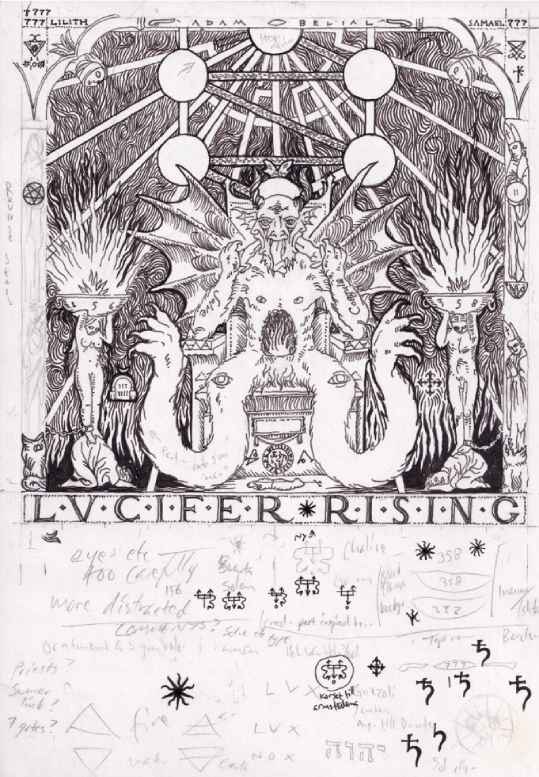
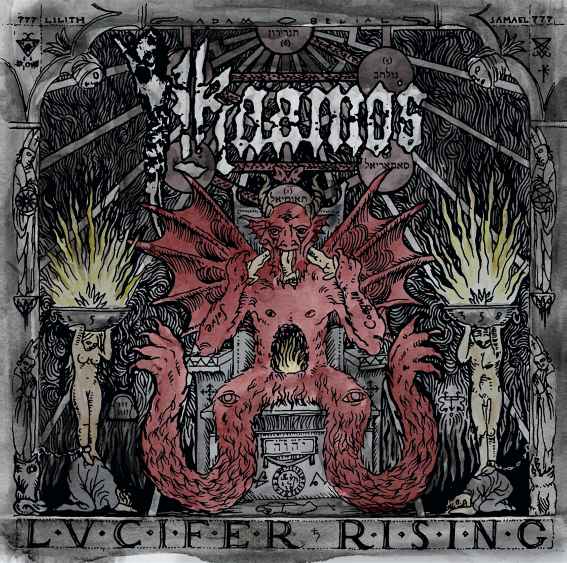
ERIK: KAAMOS’s second album… it must have been around 2005, right? Yeah, so my strongest memory of that one is Timo’s design. He and I had already touched on some of those concepts with “Casus Luciferi”, but “Lucifer Rising” is where they really got to blossom.
Candlelight Records released KAAMOS’ second album, “Lucifer Rising”, in February 2005.
TYLER DAVIS: “Lucifer Rising” was my gateway to KAAMOS; that’s when I started working my way backwards through their discography. Given my fondness for all things Charles Manson – and by extension Bobby Beausoleil and Kenneth Anger – I think the album title caught my attention first.
Kenneth Anger’s 1972 Lucifer Rising is a twenty-nine-minute occult reverie steeped in Aleister Crowley’s Thelemic mysticism, shot across locations in Egypt, Germany, and England, and finally released in 1980. The soundtrack has its own strange history: after Anger fell out with Jimmy Page, initially commissioned to score the film, the job went to Bobby Beausoleil – a former associate of Anger, a so-called Manson Family member, and a convicted murderer serving a life sentence.
KOSTA: Yes – the title absolutely comes from Kenneth Anger. Both the film and Beausoleil’s soundtrack have been incredibly important to me ever since the first time I saw Lucifer Rising. In the world of cinematography, I hold it as dearly as Timo held “Abominations of Desolation” in music.
Beausoleil recorded his haunted, instrumental rock suite from inside Tracy Prison in California, leading a band of fellow inmates called THE FREEDOM ORCHESTRA on instruments built in the prison handicraft shop.
TIMO KETOLA: Bobby Beausoleil composed the soundtrack without having seen anything but fragments of the film – yet in later interviews, he said he was very surprised by how well the sequences fit together. As someone who relishes the challenge of illustrating something I only have a vague idea of, I found this highly inspiring.
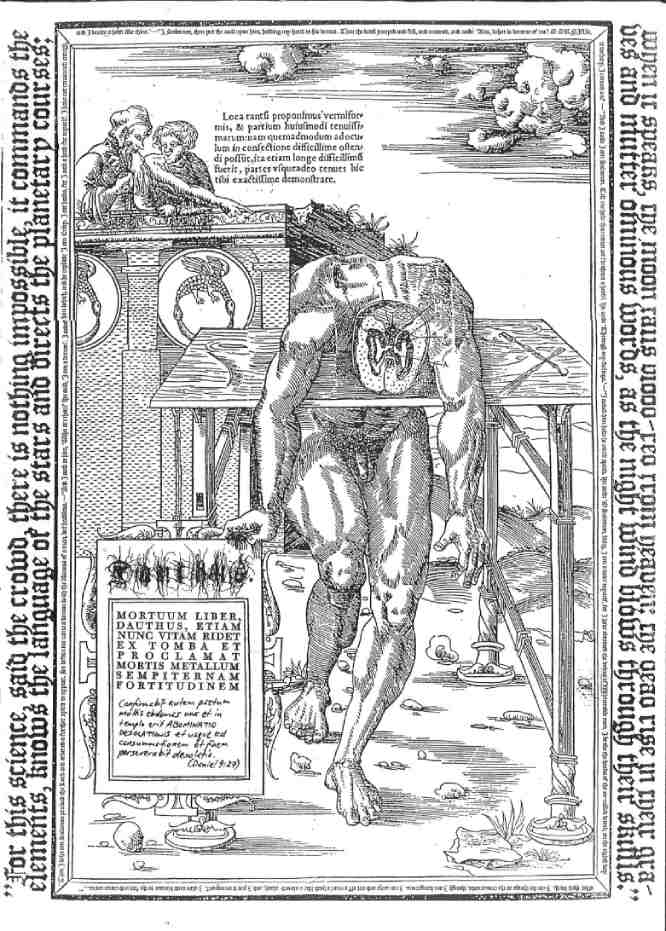
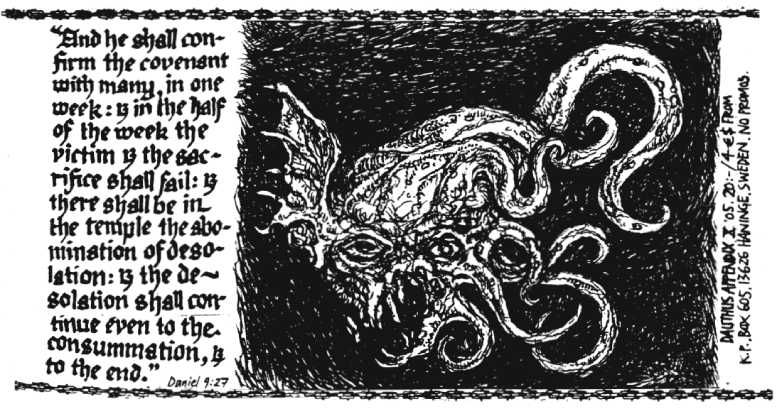
TIMO: Editing a fanzine was the perfect portal into the scene and a way to learn more about this music. I started in 1995 and worked diligently until the third and final issue in 2002. By then, I’d grown quite disillusioned. Although I consider #3 the death of Dauthus, I put together the Appendix three years later.
Described in Liber Ketola as ‘the definitive final nail in the coffin’, the 2005 Dauthus Appendix sealed the fanzine’s fate once and for all. Fittingly, one of the addenda is a posthumous interview with REPUGNANT – the Swedish death metal band Timo had followed closely ever since their 1999 demo “Spawn of Pure Malevolence”.
At the time of the May 2004 interview, REPUGNANT’s debut album “Epitome of Darkness” had already been recorded for two years but remained unreleased. Frontman Tobias Forge explained the decision to disband: as he’d grown older, the narrow confines of death metal started to feel limiting rather than liberating, and the creative well ran dry.
Nevertheless, Timo argued that REPUGNANT and KAAMOS had helped Swedish death metal ‘return from the grave and haunt the living’ and would ‘forever piss into the eyes of those who abuse the term.’ The same fervour surfaces in the NECROS CHRISTOS interview; earlier in 2004, Timo sensed a kindred revival in the German band’s “Black Mass Desecration” demo, and later met its creative force, Malte Gericke, in Berlin during the Rebirth of Dissection Tour.
TIMO: “Black Mass Desecration” is incredible – hypnotic and mesmerising. For me, NECROS CHRISTOS became something entirely foreign once I realised the sound on that demo was a one-off, the result of a limited budget and tight timeline. Given more resources, this German demon cleaned up its act. The albums are cool and great and so on, but the production shuts me out.
NASKO: As soon as I heard “Black Mass Desecration”, I knew it would be one of those truly monumental releases. That demo blew my head away. Revisiting it today, the production feels a bit weak, but the down-tuned riffing and abyssic vocals still sound great.
Originally conceived as a single A4 sheet of updates and errata, the Dauthus Appendix soon outgrew its modest intentions, expanding into twelve A3 pages. Besides albums and demos, it boasts literature reviews ranging from Alexandra David-Neel’s Magic and Mystery in Tibet to Wheresmyskin. Accompanying the REPUGNANT and NECROS CHRISTOS interviews are ADORIOR, NECROVORE, WATAIN, and OFERMOD.
Given how highly Timo spoke of “Si Monvmentvm Reqvires, Circvmspice” in private – especially of its sophistication and the sheer intellectual effort behind it – one might have expected a DEATHSPELL OMEGA interview to follow.
CHRISTIAN BOUCHÉ: In a sense, Timo had first-hand knowledge of everything we were doing; I trusted him completely. An interview, in this context, would’ve been little more than a formal exercise – even from afar, he remained close to the action. We discussed plenty on the side anyway, so whenever curiosity struck, he’d find out soon enough.
CHRISTIAN: Right after “S.M.R,C.”, we recorded “Mass Grave Aesthetics” and “Diabolus Absconditus”. I wasn’t happy with the original sessions, though, and decided to shelve them until we could crack the code behind those songs. It took us almost two more years to get there.
The standalone DEATHSPELL OMEGA epics, both clocking in at around twenty minutes, were eventually released in 2005 – “Diabolus Absconditus” on the “Crushing the Holy Trinity” compilation, and “Mass Grave Aesthetics” on “From the Entrails to the Dirt”, a split with MÜTIILATION, ANTAEUS, and MALICIOUS SECRETS.
CHRISTIAN: The initial sessions were extremely organic – almost rock-like in how we recorded the instruments. Only once the notion of sound manipulation came into focus did we find a way to realise the vision. That idea traces back to Georges Bataille, whose Madame Edwarda formed the backbone of “Diabolus Absconditus”.
First published clandestinely in 1941 under a pseudonym, Madame Edwarda is a slim, feverish novella by the French philosopher and writer Georges Bataille. The story’s protagonist encounters a Parisian prostitute who declares herself God; erotic excess becomes a gateway to metaphysical revelation, dissolving the structures through which reality is normally understood.
CHRISTIAN: We were trying to manifest the vertigo – part ecstasy, part horror – that seizes the narrator as he faces the collapse of every mental category his world depends on, just before the slide toward ruin. Hence the sound manipulations, the effects, the samples. The same approach came to permeate “Mass Grave Aesthetics”.
The combination of an ‘extremely organic, almost rock-like’ recording and sound manipulation makes me wonder: was this why you started using a click track?
CHRISTIAN: It was born out of simple necessity. We needed a tight performance, and that tightness proved essential for samples. The songs were always rehearsed assiduously, but the click still helped. Contrary to popular belief, it is absolutely possible to maintain a certain degree of feeling – even groove – while playing to a metronome. It’s a matter of dancing around it, if you will.
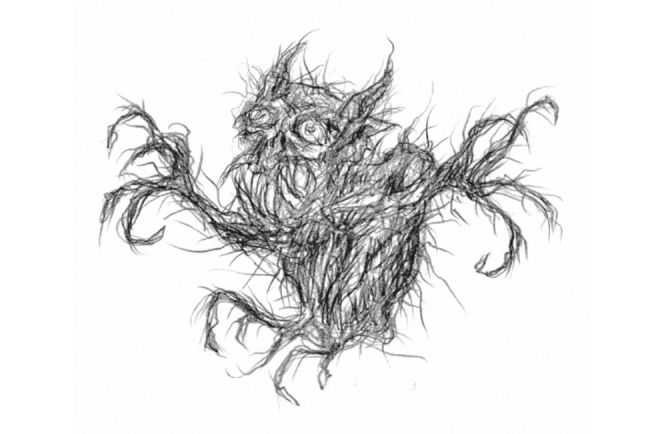
Artwork by Timo Ketola
CHRISTIAN: We’d been rehearsing “Kénôse” for a while when everything came to a screeching halt – Khaos broke his arm during a particularly nasty arm-wrestling match with our drummer. I was on the phone in another room and still heard the bone snap. Surprisingly loud, actually, like the cracking of dry wood.
A few years earlier, another black metal bassist – Mist, who played in OPHTHALAMIA and MALIGN – did the exact same thing at a Stockholm pub. This, too, emitted an impressively audible snap.
CHRISTIAN: Scans showed a clean break, and the ensuing surgery left a scar running across his upper arm. In hindsight, though, it proved a blessing – this delay gave both our songs and the overall concept time to mature.
How long did it set you back?
CHRISTIAN: About six months. Meanwhile, I visited Paris on one of my solitary trips – during which I’d try to absorb as much culture as possible. Living in a small city, access to museums and exhibitions is, logically, extremely limited, so if you’re seriously interested in painting and drawing, there’s no escaping the metropolises.
Christian lives in Poitiers, a historic university city in west-central France with a population of around 90,000, roughly 345 kilometres from Paris.
CHRISTIAN: What happened next was a matter of Jungian synchronicity. By pure chance, I wandered into an art exhibition, and with my head full of notes for “Kénôse”, noticed one connection, then two, then many more – until I stormed out and immediately bought several books by this artist.
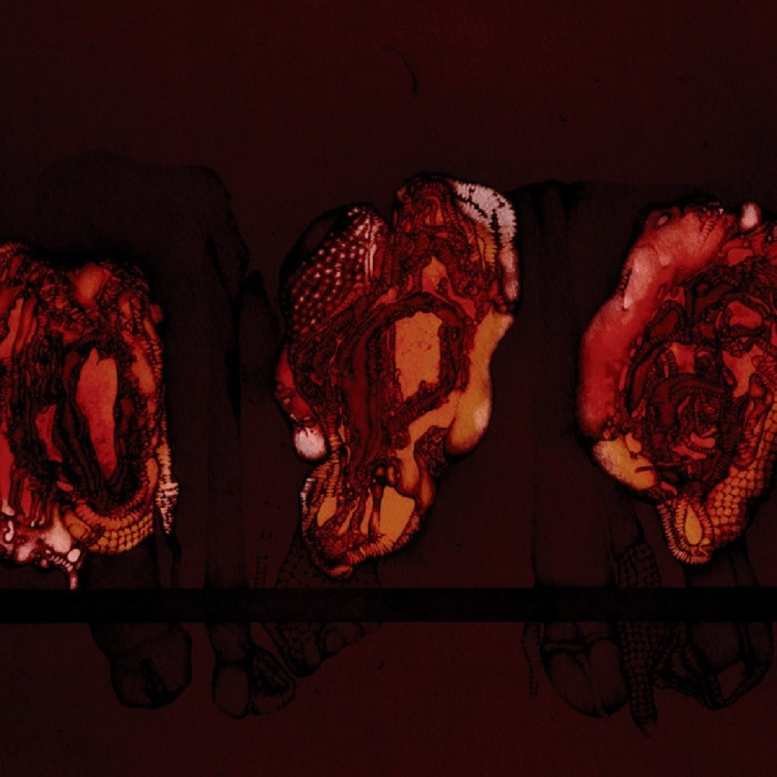
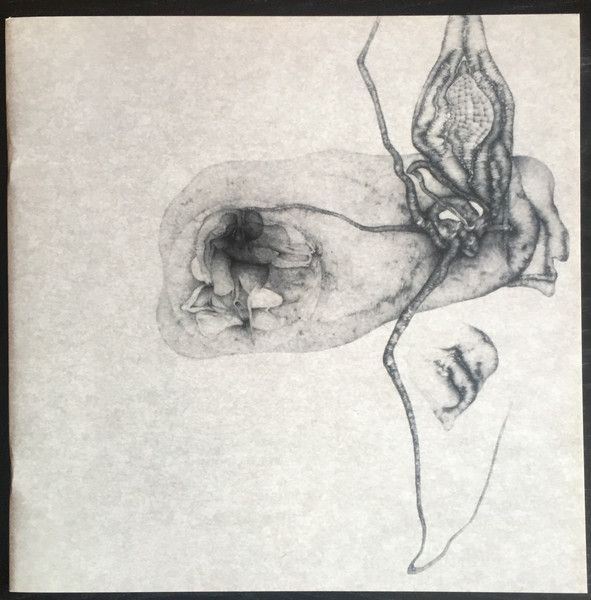
CHRISTIAN: Once back home, I continued to notice correspondences between the lyrical content of “Kénôse” and what the artist had done. It felt surreal, and I still have no rational explanation for that chain of events. The discovery led me to structure the album around his works.
The booklet relied entirely on existing artwork rather than original compositions, making Timo’s role essentially curatorial and structural – sequencing images, establishing pacing, and integrating text.
CHRISTIAN: To be exact, I gave Timo the proper order of the pieces – though I believe we changed a few things following careful consideration and lyrical revisions – so his input was mainly focused on ensuring the overall aesthetic flow and structure were as strong as possible.
Can you think of a concrete example of his contributions?
CHRISTIAN: To put it simply: at the outset, there was a mess of ideas. After Timo’s input, we had a coherent and cohesive whole. He added dirt and piss-coloured stains – a reference to Andres Serrano’s Piss Christ – worked on the placement of the text, shaped both the booklet’s opening and closing, and, of course, came up with the great idea for the back of the sleeve.
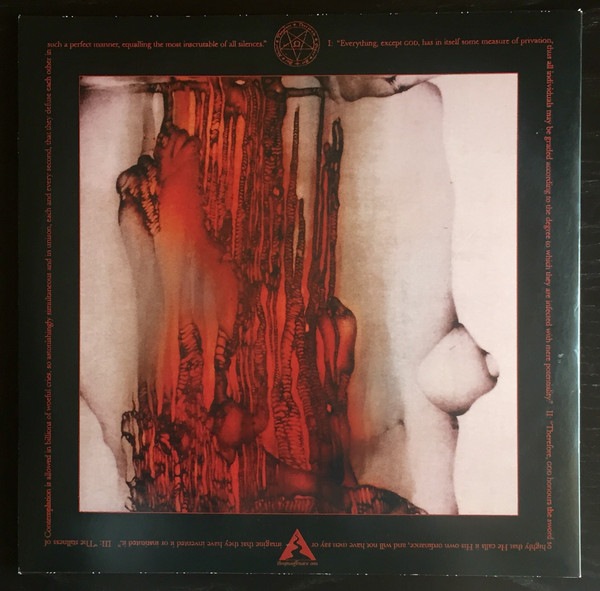
CHRISTIAN: The use of relatively abstract art was part of a deliberate push to take black metal out of its predictable comfort zones. The underlying premise held that the genre possessed a specific spiritual content – but once the core has been secured, the form can become almost anything.
After completing “Si Monvmentvm Reqvires, Circvmspice”, DEATHSPELL OMEGA set out to push much deeper into both the musical and visual dimensions. The latter shift is immediately apparent in the “Kénôse” booklet, which abandons conventional black metal iconography almost entirely in favour of something closer to contemporary fine art.
CHRISTIAN: To put it differently: if this truly is the Devil’s music, then it can tolerate no preconceived limits. I still consider black metal one of the most versatile genres; again, provided the spirit is present, virtually every door remains open, and what’s required is imagination and solid taste.
When sitting with your guitar, working through the riffs that became “Kénôse” – did you already envision something like these fluid, blood-orange abstractions?
CHRISTIAN: If I remember correctly, the idea first came up during a conversation with Franck, our producer – this sense of a specific colour emanating from the songs. The realisation struck us both simultaneously as we tried to pinpoint exactly what was coming out of the speakers. That’s when we moved past objective considerations like bass tone or low-end in the kick and began treating the sound almost as a painting.
The radical visual shift was matched by an equally transgressive leap in the music itself. “Kénôse” is the point where the dissonance DEATHSPELL OMEGA would become known for first rears its head – inspired not by any lineage of guitar-based predecessors, but by 20th-century avant-garde composers like Krzysztof Penderecki.
Timo, as it happens, was a devoted Penderecki listener.
CHRISTIAN: It’s certainly possible that Timo already knew Penderecki. I have plenty of emails in which he asked for recommendations, or even CD-Rs; his curiosity about classical music was constant and formed part of our discussions.
Were you actively studying Penderecki’s scores and recordings, or was it more a matter of internalising his tonal language?
CHRISTIAN: The translation of emotions was very intuitive. I’ve studied Penderecki’s scores out of curiosity, but I must be candid: I’m not enough of a properly trained musician to make real use of them, especially given that he even invented new symbols to transcribe novel playing techniques.
Krzysztof Penderecki – born in 1933 and buried in 2020 – was a Polish composer whose early work pushed classical music into territory so abrasive and textural that conventional notation couldn’t capture it. His 1960 Threnody for the Victims of Hiroshima, scored for fifty-two string instruments, required a new symbolic vocabulary just to indicate the clusters, glissandi, and extended techniques he wanted performed.
CHRISTIAN: Penderecki came first and Wyschnegradsky second, but the latter was equally important, as he changed my understanding of tonality. His quarter-tone works in particular impressed me beyond words; they seemed to open gates onto untapped emotional landscapes.
Ivan Wyschnegradsky, a Russian-born composer who spent most of his life in Paris, devoted himself almost entirely to microtonal music, especially quarter-tone intervals – pitches that fall between the notes available on a standard piano and extend beyond traditional Western tuning.
CHRISTIAN: Arab and Indian music also make use of microtonality, but I can’t say I ever managed to connect much emotionally with either, so Wyschnegradsky remained my lodestar. Starting from “Kénôse” and pushed to further extremes on “Fas…”, the whole songwriting process amounted to imagining something and figuring out how to play it on a normal guitar.
Wyschnegradsky had a custom quarter-tone piano built to his specifications – an instrument that took nearly a decade of collaboration with European piano makers to realise. Christian, by contrast, was translating this tonal world onto a Gibson Les Paul in standard D tuning, run through a Marshall JCM 800. The setup could hardly be more conventional; the sound coming out of it, anything but.
CHRISTIAN: This is, of course, a highly personal and probably very biased reading of Wyschnegradsky’s piano compositions, but to me they remain the most potent revelatory mechanism for a certain malaise – something akin to what Freud described in Civilization and Its Discontents, though in a broader and arguably more mystical sense.

“Si Monvmentvm Reqvires, Circvmspice” was the first instalment of DEATHSPELL OMEGA’s theological album trilogy. Thematically, all releases of this era, including EPs, proceed from the premise that religion and faith must be taken literally as the one and only source of truth and knowledge. Appropriately, the opening line of “Kénôse” binds the entire work to a condition: ‘Si non credideritis, non intelligetis’ – if you don’t believe, you won’t understand.
CHRISTIAN: As you know, I’m a very rational person, and I could make a convincing case for sufficient historical evidence to regard all monotheisms as man-made constructs. Still, recent data indicate that three-quarters of the global population is religiously affiliated in one way or another.
A 2025 Pew Research Center study, drawing on thousands of censuses and surveys, found that 75.8 percent of the world population identified with a religion as of 2020 – down slightly from 76.7 a decade earlier.
CHRISTIAN: The value of religion lies first and foremost in its cultural and civilisational impact, perhaps especially among non-believers. Europe, as an example, is often seen as the product of a Judeo-Christian heritage, no matter how secularised it becomes. And you’ll have noticed that faith is once again on the rise, not least in France, which might seem surprising given how strongly the state was built around the idea of laïcité.
Laïcité is the French principle of strict separation between church and state, enshrined in law since 1905. It goes further than secular governance as most English speakers understand it – religion is not merely kept out of government but actively excluded from public institutions, making France an outlier even among Western democracies.
CHRISTIAN: The viewpoint of the true believer was curiously underrepresented in black metal; most of the posturing amounted to relatively superficial anti-Christianity and adolescent blasphemy. I’d convinced myself that a deep dive into the arcana of faith would yield infinitely superior results, not least because there are contradictions within the creed, and such vulnerabilities make for far more potent weapons.
log in to keep reading
The second half of this article is reserved for subscribers of the Bardo Methodology online archive. To keep reading, sign up or log in below.
Related reading