Liber Ketola XX
2026-06-17
by Niklas Göransson
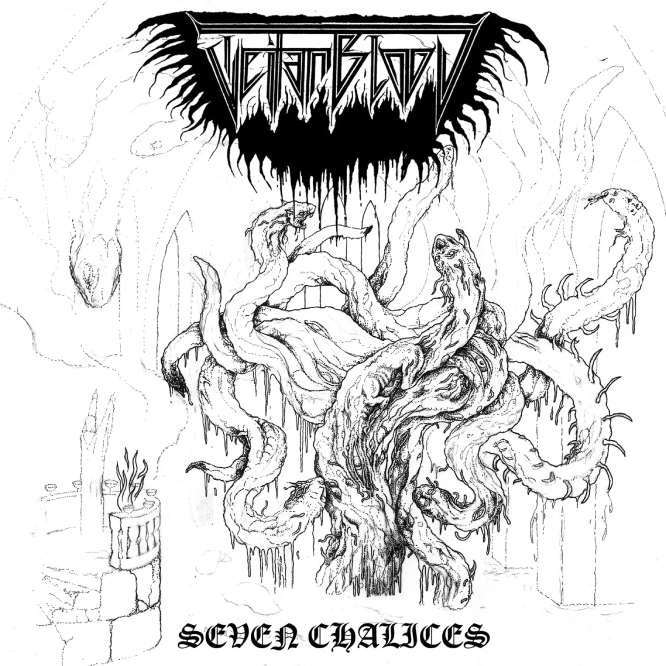
For Teitanblood’s Seven Chalices, Timo Ketola turned a decade of acquired craft against itself. The result was an exercise in doing things wrong in the right way – manic precision placed in the service of deliberate disorder.
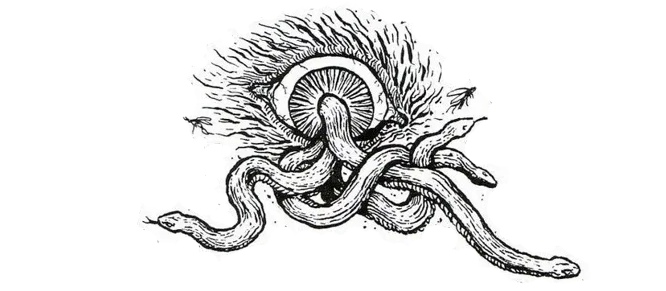
Seven Chalices artwork by Timo Ketola
NASKO: “Seven Chalices” was my first experience working with an artist, so I had no idea whether it would be difficult for Timo to harness our ideas into something solid, or what pace he worked at. At that point, we didn’t even have a definitive vision of the aesthetics.
With “Seven Chalices” committed to tape in November 2007, TEITANBLOOD turned their focus to mixing and musical interludes. Meanwhile, the visual conception pressed forward.
NASKO: There was no fixed date, but I’d definitely imagined a 2008 release. While going through old correspondence for Liber Ketola, I noticed some of the initial deadlines around the whole “Seven Chalices” arc – and they are ridiculously funny in hindsight. Late January, and so on.
The following month, around Christmastime, Timo sent Nasko an email outlining a structured – if characteristically fluid – plan for the cover artwork. He envisioned a potential late-January completion, adding, ‘I prefer to set a deadline early, so as to be able to move it later if necessary.’ But first, he had to handle the already overdue layout of The Ajna Offensive’s US reissue of DEATHSPELL OMEGA’s “Kénôse”.
NASKO: I hadn’t quite realised how unorganised Timo was. Constant distractions came from other commitments – artwork assignments, his studies – whereas we had nothing set in stone for TEITANBLOOD. We were still brainstorming more than anything, sharing a strong will to see progress, both of us extremely enthusiastic.
A few weeks later, Timo adjusted his timeline, turning the tentative late-January target into an early-February delivery.
NASKO: At this stage, postponing the cover deadline for another two weeks felt like no big deal. I mean, we hadn’t even decided how many pieces of artwork the booklet would have. In retrospect, the lack of any real planning and clear vision was one of our mistakes.
By mid-February, more than a month on, Timo warned he would be testing the band’s patience further: work on “Seven Chalices” had yet to begin. He also confirmed having received Nasko’s artwork suggestions, but explained that predefined ideas ran counter to his preferred instinctive working method.
NASKO: I consider myself not intrusive at all when it comes to pushing my suggestions on the artist, as long as I’m happy with the result. I found it fascinating to observe this kind of approach: ‘No, I want to see where my intuition takes me.’ But on the other hand, of course, for me it was like, ‘Well, that doesn’t mean I’m going to accept anything you deliver.’
NASKO: With Juan Carlos Deus out of the picture, I needed someone to handle the intros and effects. Thinking about it, I remembered that my friend C.G. Santos was a pioneer of drone, dark ambient, and atmospheric music in Spain, doing it before anyone else here.
Santos had been active since the late 1990s with LIKE DRONE RAZORS THROUGH FLESH SPHERE, a Spanish project rooted in heavy doom, dark ambient, black metal atmosphere, and early industrial music.
NASKO: I approached him and said, ‘I have this album that’s very cohesive on the musical side, and I want the visuals to match. I’m also looking for someone to provide textures and atmospheres to glue the tracks together, plus add some particular effects during the songs.’
While Santos set to work on the interludes, Nasko turned to post-production. “Seven Chalices” had been tracked in TEITANBLOOD’s rehearsal room on the Tascam Portastudio belonging to guitarist Juan Carlos Deus, who also served as engineer. But the session brought longstanding tensions to a head, and Juan left the band mid-recording.
NASKO: At this point, everything was still on tape. If I remember correctly, we’d recorded the rhythm guitar and drums together, then the leads and solos, my bass, and maybe two or three vocal layers. That’s what I had to work with.
Did you mix it on the Tascam?
NASKO: No, I transferred the analogue recording to digital and mixed it on my laptop, without proper speakers. I knew very, very little about audio engineering… mostly fade-ins, fade-outs, and so on; no frequency manipulation or EQ. I was mainly adjusting volumes to make everything audible and give the most important elements their due protagonism.
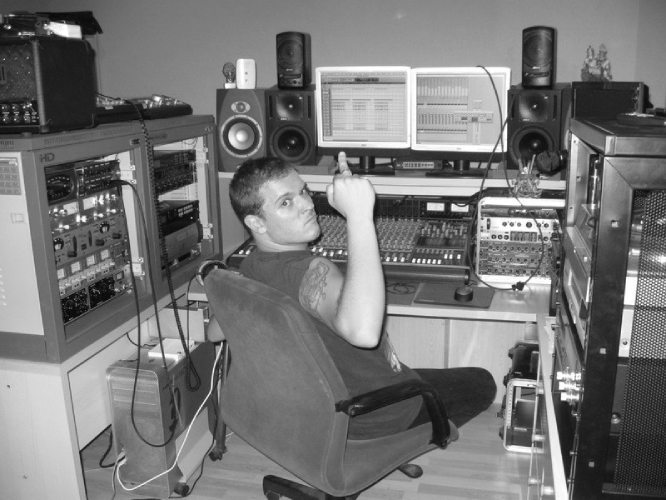
NASKO: I met Javi in the early 2000s, when I lived in Barcelona – we were part of the same group of friends. By the time of “Seven Chalices”, he’d just finished his studies in sound engineering and built the first iteration of Moontower Studios. He understood some of our concepts, and we’d already worked together before.
Back in 2003, after TEITANBLOOD had recorded four instrumental demo songs in their Madrid rehearsal room, Nasko tracked his vocals in Barcelona with help from Javi Felez.
NASKO: When I reached out, I mostly had mastering in mind – boosting all the cracks, dirtiness, and depth of our recording. I also wanted someone who knew what they were doing to look over my amateur mix, because it surely contained a lot of mistakes. So we met, and he booked us some studio time.
What were his first impressions of your laptop mix?
NASKO: Javi seemed a bit hesitant about the possibilities, since it wasn’t recorded in a studio with proper track separation. We mostly worked on effects and textures applied to the vocals, and some reverb here and there. Javi recently pointed out to me that he used Ozone 3 to do the mastering and didn’t take into account different formats, so it was all compressed for CD.
By the spring of 2008, a year after the fateful Walpurgis Night listening session, “Seven Chalices” stood fully mixed and mastered. Given the profound impact of those instrumental rehearsal recordings – and with Timo now both designing the album and releasing it through Dauthus 1899 – one might have expected him to be itching to hear the finished thing.
NASKO: No, Timo refused to listen to it. We discussed this often, and he’d always bring up the incredible Lucifer Rising soundtrack – how Bobby Beausoleil composed the entire score without even having seen the film. I think Timo was completely obsessed with taking that approach for “Seven Chalices”.
Considering Timo’s infatuation with the abrasive sound of the rehearsal tape, was there ever a concern that the final version might disappoint?
NASKO: Music-wise? Definitely not. I felt confident we’d kept the raw energy of the rehearsal but made everything heavier and more obscure – the vocals, all the added layers, enhancing that unfiltered brutality. If anything, I expected him to deepen his appreciation.
Yet for all this, Timo had still not drawn a single line. What he and Nasko shared instead was a constant exchange of artwork concepts and ideas about the physical presentation: format, paper stock, finish, and the overall feel of the packaging.
NASKO: On the lore of “Seven Chalices”, Timo constantly heralded this idea of ‘doing things wrong in the right way’, so to speak. I was fully onboard with the Dauthus-fuelled mindset. Because of our preference for fanzine-oriented aesthetics, we didn’t want glossy paper or any fancy editions like picture discs or gatefolds.
In April 2008, Timo shared a few thoughts on the format of “Seven Chalices”. A gatefold made obvious sense for a double LP – but convenience left him unmoved. Drawn instead to the ‘we don’t care’ gesture of refusing the practical solution, he preferred both records sleeved plainly inside a single regular jacket.
NASKO: Neither of us cared about practicality; we wanted a regular sleeve because it wasn’t what people expected. Besides, I’ve never liked gatefolds, and I really appreciated Timo’s confrontational approach to packaging. That ‘fuck you’ attitude felt perfectly in line with Dauthus.
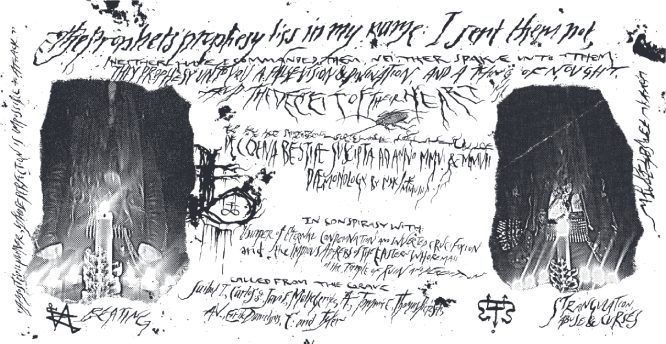
NASKO: Our process could relate to my experience in extreme programming, commonly used during the mid ‘90s in software engineering, where you work through extremely short iterations, constant feedback, and a more developer-centric approach – dealing directly with customers rather than relying on mediators, project managers or a fixed, structured plan from beginning to end. That was very close to how “Seven Chalices” came together: many things evolving at once, some constantly revised, others left unresolved for long stretches.
By October 2008, that lack of finality seemed to be weighing on Timo, who had still made no tangible progress on the artwork. In a rather introspective email to Nasko, penned after revisiting the writings of Carlos Castaneda, he reflected on his growing dissatisfaction with chronically over-rational thinking – particularly in relation to music and art.
NASKO: This is about logical thinking, but also curious thinking: a way of identifying where something comes from, what it connects to, and why one thing relates to another. In that sense, it can unveil secrets as well. And if you are a rational person – maybe because there is less emotional or bodily experience to fall back on – those are the tools you rely on.
Timo also expressed frustration at his tendency to overanalyse: ‘I don’t know how to limit my theoreticism… I hate it.’ This immediately reminded me of something Kosta said about Timo’s early difficulties with magical practice: that he was deeply logic-driven, prone to intellectual doubt, and often got stuck trying to understand metaphysical phenomena rationally.
NASKO: I recognise a lot of myself in this mode of thinking. You try to maintain control by turning thoughts into concepts and merging them with larger structures. The method works – until you’re forced to rely on experience itself: the emotional, physical, or intuitive side. Then the framework isn’t enough anymore. Now you must enter the content directly, and when your whole approach depends on structure, that becomes deeply uncomfortable.
I can appreciate intuitive working methods and would normally respect the artist’s preferences. But in Nasko’s position, months past the original deadline, with the work barely underway, I might have been less patient if Timo still refused to listen to the album.
NASKO: From my perspective, I was convinced he’d find inspiration the moment he heard it, but I had huge respect for Timo’s reluctance. I think we always got along so well because I never pushed him. Sometimes he even wanted me to – due to his chaotic nature, he’d often end up with no direction at all.
TIMO KETOLA: The early, formative metal covers were very simple – most of them designed by professionals at record labels. Through the ‘90s, as the underground matured, amateur designers steadily improved the aesthetics of violent music until quality simply wasn’t enough; it had to be unique, too. Of course, nothing stood out, since everybody shared the exact same ideas about ‘originality’.
Timo’s whole philosophy turned on a deliberate paradox. He’d spent years mastering the professional craft of layout – only to conclude that, when it came to this music, mastery was the enemy. Intuition, once trained, doesn’t return on command. He had to consciously strive for the unconscious, bending every acquired skill against its own instincts.
That approach permeated the entire “Seven Chalices” project, the cover above all. By November 2008, Timo was calling it ‘the most demanding, intricate drawing’ he had ever attempted.
TIMO: First, I transferred the half-page sketch onto a large A3 sheet with tracing paper, copying all the most important movements. Then I made another xerox of it, still A3 – the key features now in place, some already rendered in detail. From there, I kept building the bloody thing, constantly checking that the logo fit without obscuring anything essential.
NASKO: Scorn’s TEITANBLOOD logo – with the flames and blood around it – is killer, but very anti-aesthetic, because it takes up so much space. So now we had a problem. I suggested, ‘Maybe put it in a corner, to avoid ruining the artwork? Or just use the simpler, typeface version.’
TIMO: Combining a big, sprawling logo with psychotically detailed artwork proved a real challenge. I must have put as much time and effort into planning that drawing alone as I’d spent on many other pieces from start to finish.
NASKO: Instead, Timo treated “Seven Chalices” as if it were an early ‘90s Mexican SHUB NIGGURATH bootleg with a crude cut-and-paste layout. ‘This is the solution! I’ll just drop the logo dead centre, like a big blob, straight on top of my drawing. If we consider it part of the artwork, then it’s the correct choice in its own way.’ I was immediately convinced.
Lest the comparison read as a slight, it was anything but. Timo first discovered SHUB NIGGURATH through Thanatography #4 in 1992. From that point, they remained one of his favourite death metal bands.
NASKO: Once I got pulled into this way of thinking, I started to grasp Timo’s reasoning behind choices that initially made no sense to me. From then on, we kept returning to the Mexican bootleg framework, or the Satanic Records version of “Abominations of Desolation”.
Unlike Earache’s official edition, Satanic Records’ bootleg of MORBID ANGEL’s “Abominations of Desolation” used the rawer, early artwork associated with the material’s cassette-era.
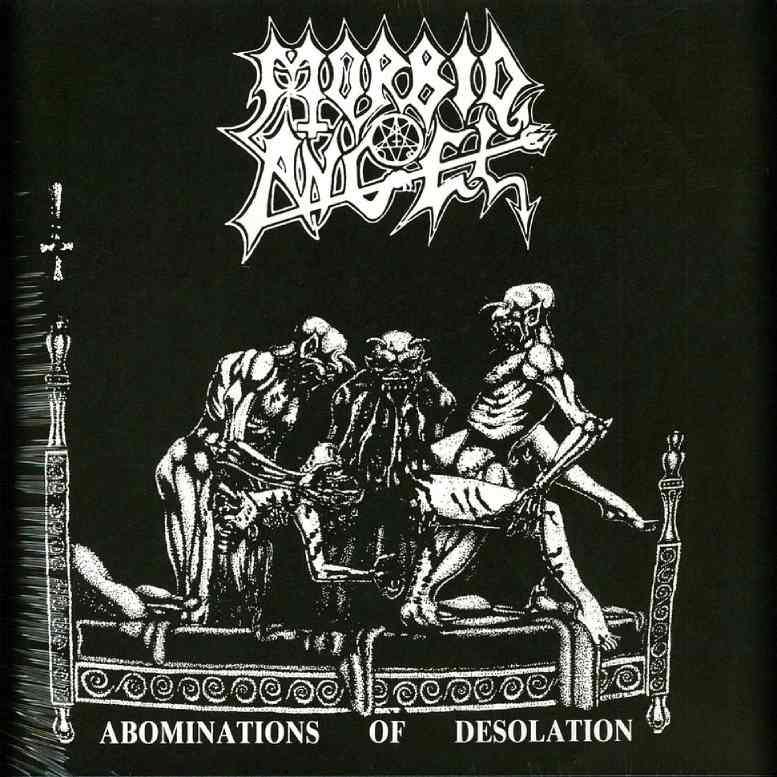
This cover became something of a lodestar for Timo – proof that crude, unrefined imagery could carry a charge no polished version ever would. It reframed how he approached not just art but music itself. A picture which merely hints, Timo argued, gives you room to cast your own nightmare onto it; an image handed over whole leaves nothing to project.
NASKO: Even beyond its cover, I think the overall impact – how truly intimidating “Abominations of Desolation” is in all aspects – is what we always had in mind for “Seven Chalices”. Both of us kept coming back to it as a reference point, a way to defy established standards.
With the cover finally taking shape, had work started on any of the booklet drawings?
NASKO: Oh yes, pretty much all of them – though none were even halfway done. Comically, in the very beginning, I thought Timo would pull off the booklet artwork in a couple of days. Of course, then I was envisioning rough, Dauthus-type drawings.
A few days, it turned out, would prove insufficient. The cover resolved one negotiation – drawing against logo – whereas each booklet page faced three: illustration, composition, and text. The lyrics were not set beneath the artwork but woven into it, becoming part of the design. Nothing could be drawn first and lettered afterwards; image and words had to be conceived together, every line placed to serve both at once.
NASKO: And the illustration timeline wasn’t linear, like, ‘Okay, I’m going to focus on the first page, then move to the second.’ It jumped all over the place. I also remember Timo getting uncomfortable with my constant Dauthus references. I’d scanned and photographed hundreds of details from #3, thinking, ‘“Seven Chalices” needs this!’
TIMO: Nasko’s incessant references to Dauthus #3 while we worked on “Seven Chalices” were actually invaluable. From then on, I’ve tried to cling on to that link – because I never meant to lose it in the first place. Still, it was rather sobering to have him fixate on something I made almost a decade earlier, with complete disregard for everything I’d accomplished since.
NASKO: I’d sometimes say, ‘No, this doesn’t have the #3 energy.’ <laughs> But things get difficult when you’re using abstract rather than technical terms. Instead of ‘More contrast here, less brightness there’, we were debating whether something embodied the Dauthus spirit. Same as going to a studio and saying, ‘The guitars don’t sound cold enough.’ What does that even mean? Are you talking about the reverb, the tuning?
In another email, Timo made clear that while he saw the potential to carry a similar visual language into TEITANBLOOD, he had no interest in ‘copying’ Dauthus – the spirit could transfer, but not the material itself.
This was a roadblock I hit more than once. Timo flat-out refused, for instance, to include his ANTAEUS demon drawing – which I adore – in Bardo Methodology #1, simply because he had already used it in Dauthus fourteen years earlier.
NASKO: Yes, I do recall Timo declining some of my ideas for aesthetic references because they reminded him of a direction he’d explored before. Maybe not so much the artwork itself, but more the line of thinking behind doing something a particular way.
Did you supply specific guidelines or instructions for any of the song-specific artwork?
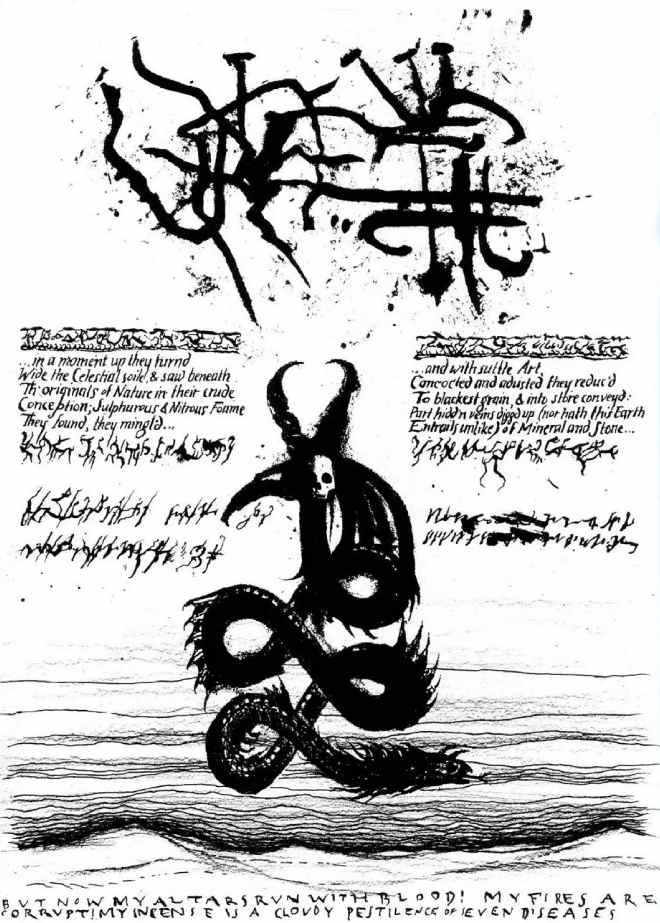
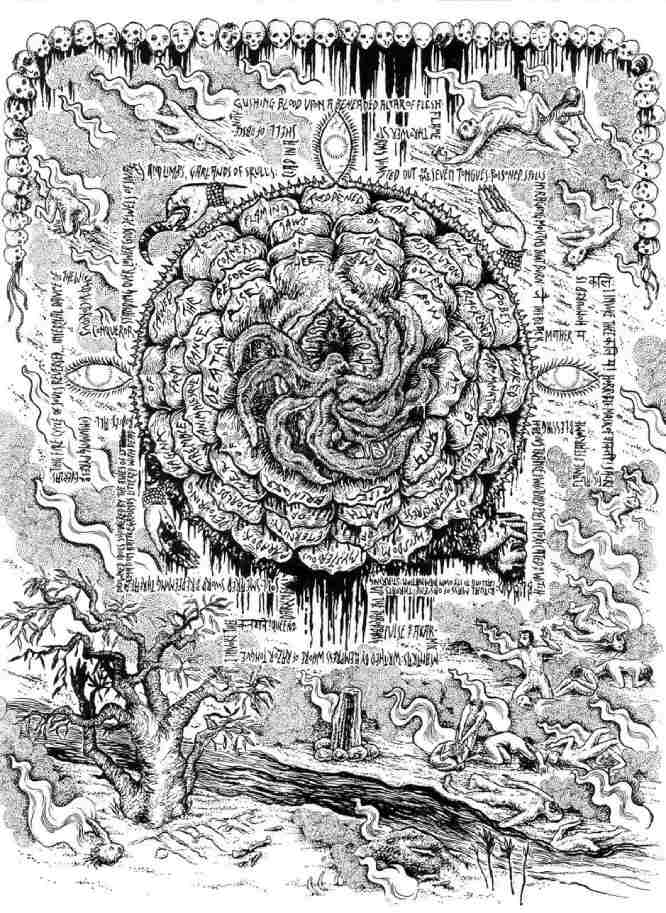
NASKO: A few – for “Morbid Devil of Pestilence”, I’d requested a depiction of Pazuzu modelled on that tentacle creature with outstretched arms from Dauthus #3. And for “Infernal Dance of the Wicked”, we’d decided early on to adopt a mandala and work out how to pervert it.
They certainly captured the perversion angle. The sacred geometry survives – radial, centred, ringed – but everything the mandala once signified is overturned. At the heart, where the deity or generative source belongs, sits a knot of tentacles and gaping jaws; for a containing border, a garland of severed heads. The observant will note how the central maw reprises Timo’s Nuclear Death Appreciation Society sigil from Dauthus #3, while the surrounding figures pay homage to the band’s guitarist and illustrator Phil Hampson.
NASKO: When discussing “Whore Mass”, I remember suggesting a kind of sacrificial shrine. Then, as Timo got started, came details like the hanging corpses, an inscription, and streams of blood. Other than that, he very much improvised. I think the last concept we had to create a motif for was “The Abomination of Desolation”.

NASKO: The final months of 2008 were very frustrating, because “Seven Chalices” had been mixed and mastered since the start of that year – only the artwork remained, and not a single piece was anywhere near finished. It got to me, like, ‘Man, just focus on one thing!’
Did you ever lose your temper during all of this?
NASKO: Yeah, many times, but not over the artwork itself. Let’s say Timo and I had settled on a concept and direction, both into it – after endless email deliberations – and three days later, he’d tell me he wasn’t convinced. On other occasions, something we’d discussed seemed like a great idea… until Timo sketched it. Then I’d push back: ‘No, this won’t work.’
Can you think of an example?
NASKO: While drafting the “Origin of Death” motif, for example, I told him, ‘No, I don’t like the idea of a sun as the artwork’s centrepiece.’ We debated and argued, but in the end I made my position very clear: anything that doesn’t resonate with me, I will be vocal about.
Timo, of course, had a deeper stake in this piece, having written the lyrics to “The Origin of Death”. Sharing words that personal wasn’t something he did casually – as he put it in an email to Nasko, ‘I’d never have allowed a regular band to use them.’
NASKO: I don’t remember asking Timo about his lyrics, and I’m not sure he ever elaborated on them. Maybe we discussed it in a casual conversation, but I couldn’t tell you the inspiration, motivation, or underlying idea behind “The Origin of Death”.
In an earlier part of this series, Timo recounted a 2001 experience with psilocybin mushrooms, and a vision that would return in later trips: looking at his arm and seeming to travel inside it, finding ‘a kaleidoscope of worms’. Not repulsive, he stressed, but as ‘an expression of life itself’ – neutral, almost detached from emotion. The insight reached ‘all the way to the body’s biological origin points’, a cellular depth where living and dying seemed inseparable.
Comparing his testimony to “The Origin of Death” is revealing. The lyrics begin in a fall into the body – tunnels ‘covered with small veins like that of a finger’. What follows is a descent through an underworld stripped of judgement, ‘a horror so tangible as to lose meaning’ where ‘I cannot see Dante’s footsteps’.
NASKO: I’ll have to re-read the lyrics and compare them with the interview testimonial. But I had no idea, no. In every collaboration – and there is a collaboration on every album – I choose someone I trust to contribute whatever they want. As long as it resonates with me, I wouldn’t ask, ‘Why is it like that? What does this mean?
log in to keep reading
The second half of this article is reserved for subscribers of the Bardo Methodology online archive. To keep reading, sign up or log in below.
Related reading