Liber Ketola XXXII
2026-09-09
by Niklas Göransson
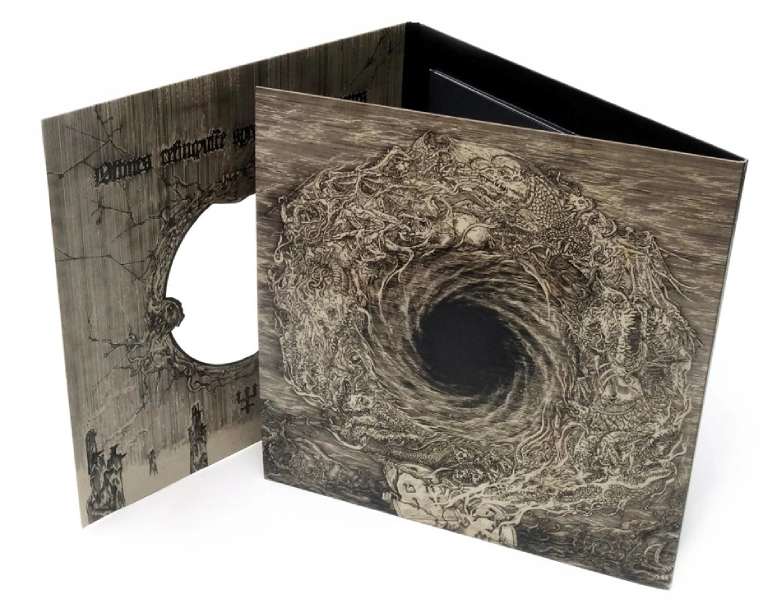
On Lawless Darkness, an architect and an occultist each illustrated the same concept – the shattering of divine law. Zbigniew Bielak’s tablets burst apart by force; Timo Ketola’s crumbled under vegetation, masonry consumed from within.

ZBIGNIEW BIELAK: I lived outside of town, so whenever the office closed at five or six, I’d head home and just sit down to make art for metal. That was the greatest refuge imaginable. In one way or another, this music has always been about escapism to me – exactly the kind of sanctuary I needed after the tedium of everyday life.
By early 2010, work on “Lawless Darkness” was well underway. After reaching out to WATAIN, Polish artist Zbigniew Bielak had been commissioned to illustrate all the song-specific pieces. Erik Danielsson would send him detailed accounts of each track – symbolism, mythology, magical ideas, and reference material – followed by long telephone conversations.
BIELAK: On the outskirts of every artwork-related conversation, Erik and I would talk at length about metal – the most obscure bands, scene history, and so forth. So we were also getting to know each other better, which was great. As a fan, I welcomed that kind of personal connection.
Bielak completed his architecture studies and joined the family practice full-time in 2005. Alongside this, he began working as an illustrator for an encyclopaedic publisher, while remaining immersed in underground metal through vinyl collecting and tape-trading.
BIELAK: At that point, I remember this resurgence of a cult factor in the underground. Everyone had become fed up with Photoshopped death metal on the one hand and plastic symphonic black metal on the other. Then Norma Evangelium Diaboli entered the picture, ushering in all manner of really grim stuff – DEATHSPELL OMEGA, WATAIN, and a plethora of killer bands.
By then, Timo had become central to the aesthetics of NoEvDia, his hand shaping the presentation of several key acts: FUNERAL MIST, WATAIN, DEATHSPELL OMEGA, and TEITANBLOOD. When Bielak joined the “Lawless Darkness” project in late 2009, Timo was already at work on its cover.
BIELAK: I’m not sure if I knew much about Timo as a person; I’d definitely seen many of his NoEvDia covers, as well as KAAMOS and some others. But I was aware of the Dauthus fanzine and had a Xerox copy of either #1 or #2. Timo’s writing reminded me of Isten, which in my eyes is the pinnacle of this sort of journalism – infused with a lot of personal perspective on things, sometimes quite cynical, and often in-depth.
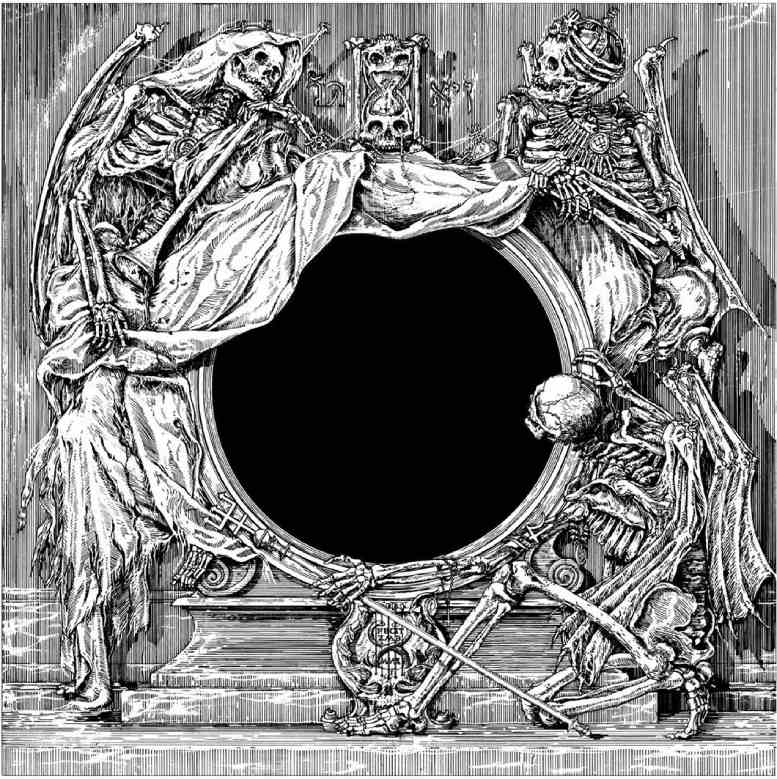
ERIK DANIELSSON: The “Lawless Darkness” cover Timo worked on was based on the album title. But I also had this reference image I wanted to use – a 17th-century Memento Mori motif by Bernardino Genga, depicting three skeletal kings drawing back a curtain. Somewhere along the way, we realised the two could be combined.
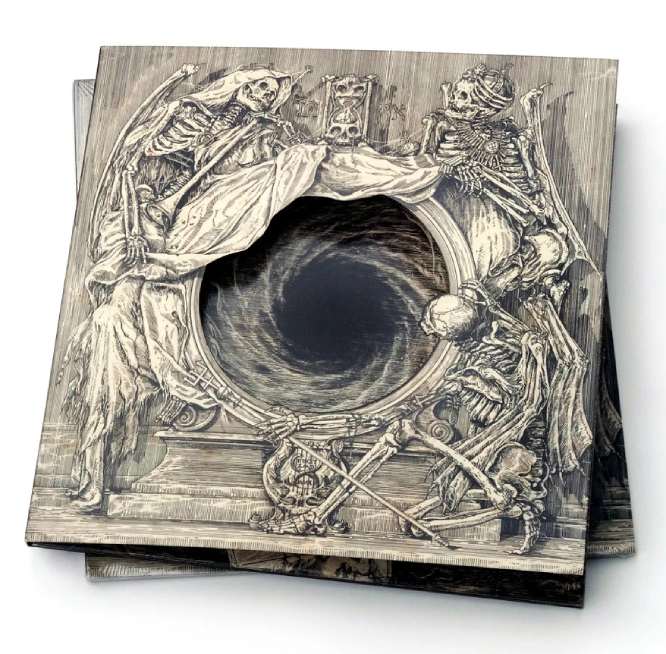
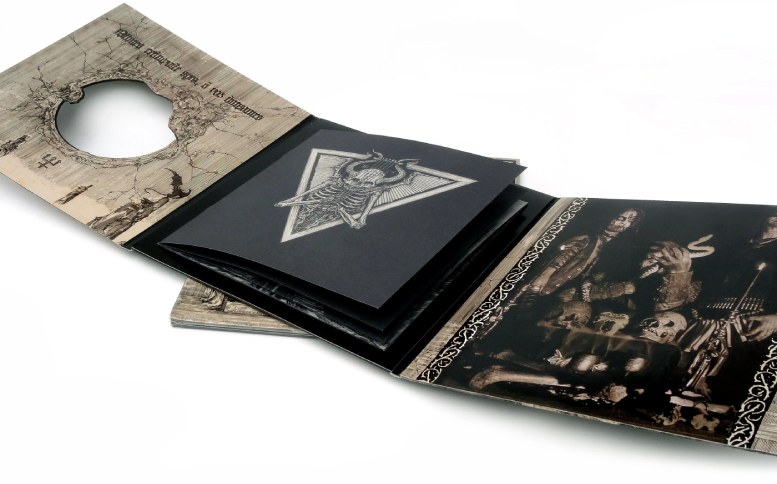
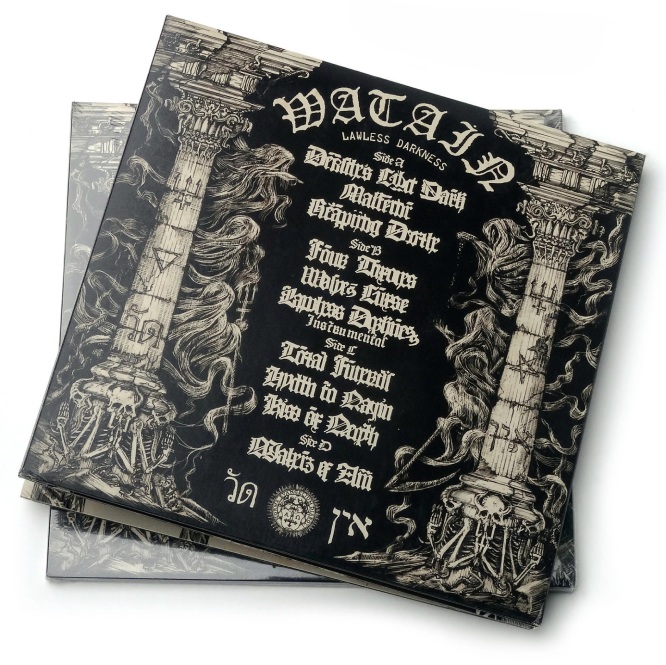
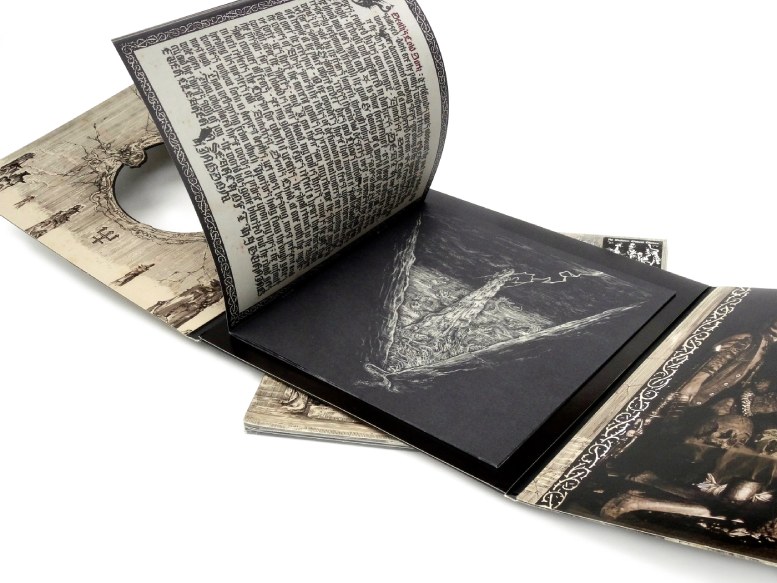
In a February 2010 email, Timo refers to a ‘hole test’ – trying out the two-layer concept later seen on the digipak and vinyl editions. Bielak had supplied Erik’s skeletal kings for the outer panel, while Timo’s artwork would appear through the circular aperture.
ERIK: We tried it, and the mock-up looked… fine, I suppose. But I think this may well have been the point where we realised that what you actually saw of Timo’s image through the hole was basically just a monster – guts, chaos, fangs. Bielak felt the centre needed something that would draw you in differently.
BIELAK: Timo’s centrepiece was this bulky thing, densely populated by demonic entities. Studying the mock-up, it gave me the impression of something clawing its way into our world through the aperture, rather than the jacket sucking you in like a black void. I probably uttered my due concerns to Erik in a very adamant fashion.
ERIK: Now, Bielak isn’t a passive collaborator; once an idea takes hold in his mind, he wants to try it out immediately. He basically said, ‘This could be so fucking good, but then we must do it my way’ – which is how we ended up with the vortex cover.
BIELAK: I don’t recall the exact levels of zeal I had to emanate in order to get my way, but a big part of this whole career thing has been about imposing my will: obtaining the commissions I wanted and pushing my ideas through. I definitely invested a lot of energy and personal charm in shaping “Lawless Darkness” according to my vision – however, I remember it as quite a democratic cooperation.
ERIK: Timo didn’t seem to mind at all; he was his usual pragmatic self and understood what a treasure we’d found in Bielak. Honestly, I think he may even have been a little relieved to hand over the artwork. Timo always had a lot going on, and a unique way of structuring his workflow. He still got paid in full, of course.
BIELAK: Looking back, I must have had a lot of moral quandaries about suppressing Timo in some way. Nevertheless, life is a constant battle – and seen through the perspective of a beginner getting a good slice of the cake on an anticipated record from a killer band, I’m sure you understand why I’d fight for my own work.
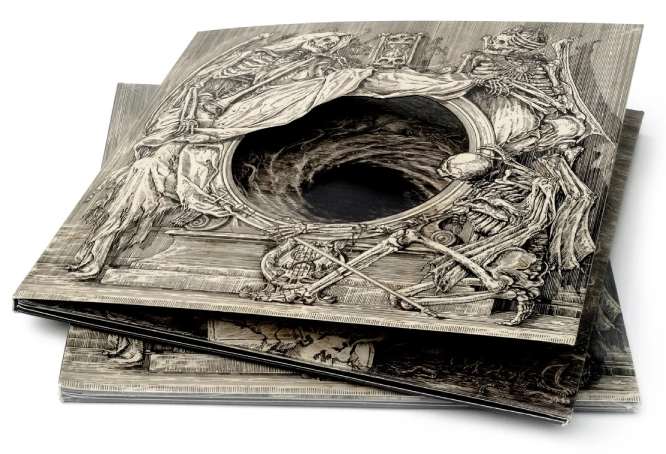
ERIK: Timo provided the artwork for “Sworn to the Dark”, but I put the booklet together – so when I took over the layout of “Lawless Darkness”, it didn’t feel like much of a departure. It made sense, since I was already working directly with both artists and knew exactly how everything should look.
In the spring of 2010, Erik – who’d been building his own design portfolio – assumed responsibility for the packaging and presentation.
ERIK: I’d learned a lot from the layout assignments over the past year: where to focus your attention, what to avoid, and which details actually matter. I thought, ‘Perfect, I can just collect all the material, then sit down at home and assemble everything in peace and quiet.’ Naturally, things didn’t quite pan out that way; it became a monster of a project, with Timo in one ear and Bielak in the other, under brutal time pressure.
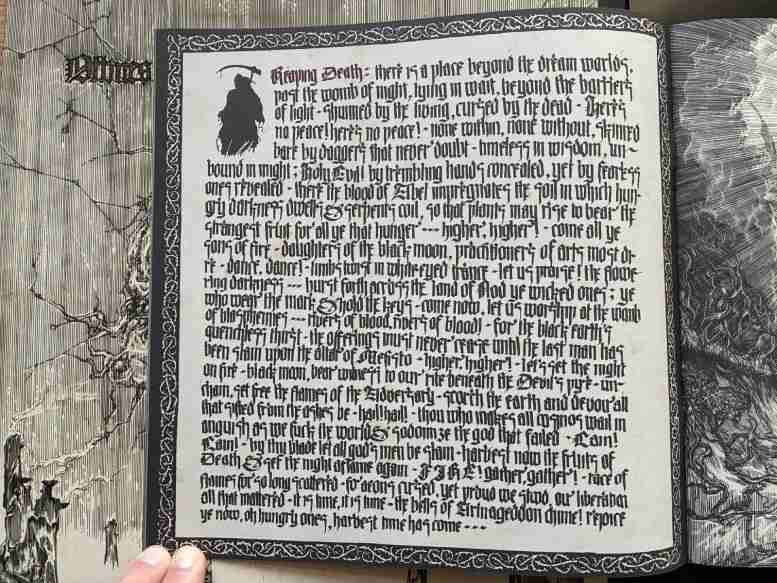
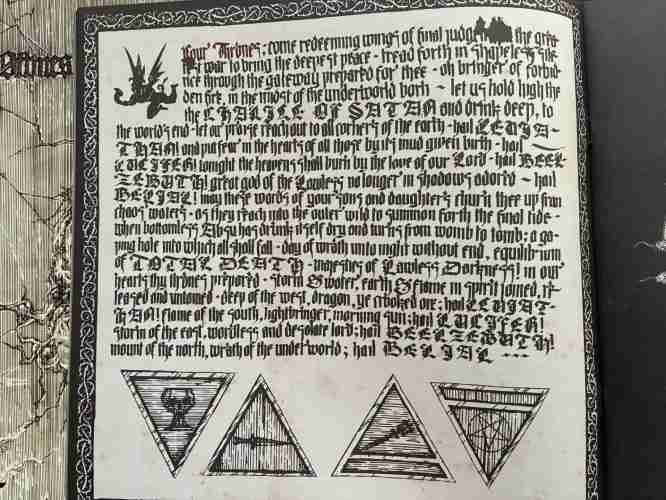
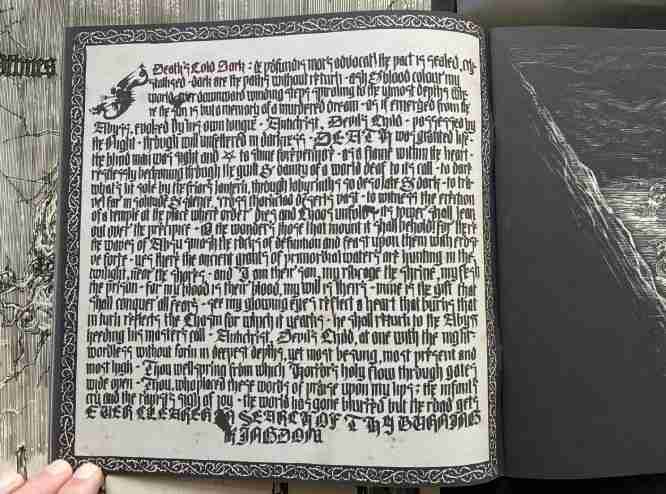
With the song illustrations now in Bielak’s hands, the layout under Erik’s control, and his cover replaced, one of Timo’s responsibilities remained unchanged: handwriting the lyrics.
ERIK: I loved what Timo did for FUNERAL MIST. It was almost dizzying – sitting there looking through a little CD booklet and suddenly realising, ‘Hang on, you can’t do this on a computer. Holy shit, these lyrics were written by hand.’ It gives the whole thing a sense of reverence, knowing that someone genuinely put a lot of care and effort into it.
Timo had previously undertaken ambitious hand-lettering for both FUNERAL MIST albums, “Salvation” and “Maranatha”. Neither proceeded entirely according to schedule – a pattern now re-emerging with “Lawless Darkness”.
ERIK: Somewhere in that final stretch, my laptop crashed. I had the files backed up on a hard drive, but there was no internet at Wolf’s Lair. So, while Timo sat in Italy frantically handwriting the remaining lyrics, I took everything to Sound Pollution and tried to finish the layout on a borrowed computer.
Sound Pollution Distribution – the Stockholm company that had emerged from House of Kicks – handled Season of Mist’s titles in Sweden as part of its Scandinavian territory.
ERIK: I remember Calle von Schewen coming in while I sat there sweating away, and rather timidly saying, ‘We really need to go home for the day now, and Season of Mist want the files. How’s it going?’ Meanwhile, Timo was sending me one scanned paragraph after another, roughly an hour apart. I get fucking stressed just thinking about it.
But you got it sorted before the evening was over?
ERIK: Well, I must have, because I vividly remember walking out of there with this profound sense of relief that the whole thing was finally done. But we were polishing details right up until the last minute.
ERIK: All through the writing and recording of “Lawless Darkness”, I worked on something connected to the record more or less around the clock. Caught up in such an intense period, I probably didn’t give much thought to the fact that we weren’t playing live. But once it was done, I remember being really fucking eager to get back onstage.
In May 2010, more than a year after Kings of Black Metal – WATAIN’s only show of 2009 – the band returned to the stage at Maryland Deathfest. The live line-up suffered, however, when lead guitarist Set Teitan was denied a visa, just as Alvaro Lillo had been before the 2007 tour, forcing Erik to step in on guitar.
ERIK: This time, I borrowed a guitar from INCANTATION at the last minute and hoped for the best. I’d written the songs and tracked many of the lead parts in the studio, so I figured I could manage. But as it turns out, trying to do so standing onstage – while singing – is a different matter altogether. It was fucking chaotic.
WATAIN hadn’t even made it through the first song before the sanctity of their stage was violated by what Euronymous would have called a ‘hardcore pig’.
YouTube footage shows Erik and Alvaro chasing the intruder offstage within seconds. Sadly, it misses the conclusion: he fled straight into Johan Bargebäck of NECROPHOBIC, a real old-school Swedish metalhead, and received a second reprimand.
ERIK: Right. Someone from D.R.I., wasn’t it? He pranced onstage and started dancing around in some kind of orange grindcore outfit. This is a textbook example of something we’ve encountered repeatedly: once things become too serious, too real, somebody has to turn it into a joke because otherwise people get uncomfortable.
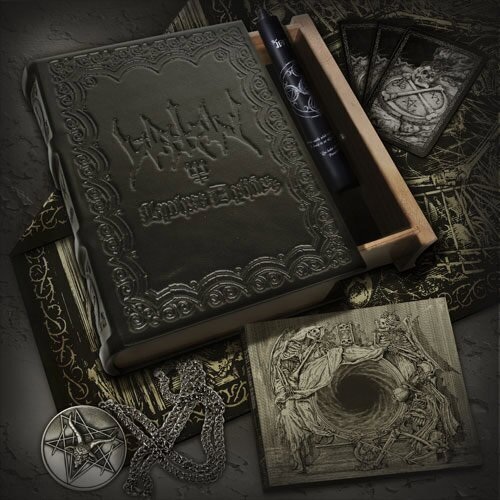
ERIK: We’d worked with Season of Mist before, but “Sworn…” had far fewer moving parts. Then, all of a sudden, there was an enormous amount of press, demands for multiple versions of the album, and so on. They wanted some kind of special edition – which, after a fair bit of back and forth, somehow ended up becoming that box.
Was Timo ever meant to be involved with the box set?
ERIK: Unfortunately not – had Timo been properly involved, it might have turned into something else entirely. I can’t stand the sight of the fucking thing; it’s so plastic-looking. One of many rude awakenings that came with working on larger-scale productions.
Earlier in the series, Erik described a ‘steep learning curve’ after signing with a bigger label, particularly when it came to retaining control over matters such as promotion.
ERIK: A lot was simply going through the label machinery without much thought, and we weren’t really used to that. ‘Okay, shit, I need to be super-clear in our communication here, otherwise we might end up with…’ well, tarot decks and plastic-looking covers.
On June 5, 2010, Season of Mist announced a ‘leather book box set’ of “Lawless Darkness”, including ‘a pendant + necklace, a black candle, a flag and 10 tarot cards’.
During the ensuing press cycle, Erik dismissed the ‘tarot’ description as ‘a clueless misunderstanding by the label’, clarifying that the cards were intended as focal points for experiencing the album – one corresponding to each song – rather than as instruments of divination.
ERIK: To be fair, it really is the band’s responsibility to keep an eye on these matters. Don’t just hand over your work to somebody else and assume it will turn out as intended. If you have a strong preference and a clear vision, you need to articulate exactly what you want and see it all the way through.
The same June 5 press release also promoted the LP edition of “Lawless Darkness”. When WATAIN signed with Season of Mist, the agreement specifically preserved NoEvDia’s rights to the vinyl format.
CHRISTIAN BOUCHÉ: Erik and I had been collaborating since their debut album, which, as you know, we released through End All Life. That shared history fostered a certain sense of alliance and loyalty – even as WATAIN’s situation kept evolving, in terms of both what they aspired to and the means available to achieve it.
By early 2006, WATAIN had been offered the opening slot on KREATOR and CELTIC FROST’s forthcoming tour – an opportunity that required a sizeable investment. Christian accordingly advised them to seek a label better suited to the band’s trajectory.
CHRISTIAN: WATAIN had become a spectacular stage act, and I knew they would progress to increasingly larger tours – ones demanding far greater financing, which we simply weren’t equipped to provide. Frankly, the live dimension of black metal has never interested me much, neither then nor now, so my energy and attention lay elsewhere.
What is it about live performance specifically that doesn’t draw you, when the recorded music so clearly does?
CHRISTIAN: Under ideal conditions, it can become something truly otherworldly. More often than not, however, material factors drag the experience down to the level of any other metal show: the kick drum sits far too loud in the mix and ruins everything, or two-thirds of the audience is utterly insufferable and smothers whatever atmosphere might have developed.
It bears mentioning that these were not idle opinions, but the findings of diligent field study – years spent at underground shows and festivals across continental Europe through the late ‘90s and early 2000s.
CHRISTIAN: In my experience, once the youthful enthusiasm of discovery has faded, the distracting aspects tend to dominate. What you typically witness is a severely degraded version of the record, devoid of the black magic it ought to possess. It takes a band like ANTAEUS to transcend those material limitations: a show driven by such a maelstrom of negative energy cannot be ruined by anything.
ANTAEUS themselves joined the NoEvDia roster for 2006’s “Blood Libels”, followed three years later by a split seven-inch with KATHARSIS. The association stretched much further back: frontman MkM and Christian were longtime friends, and the inaugural End All Life release in 1999 was ANTAEUS’ “Rekordin 2000 – 1”, co-issued with MkM’s own Spikekult Rekords.
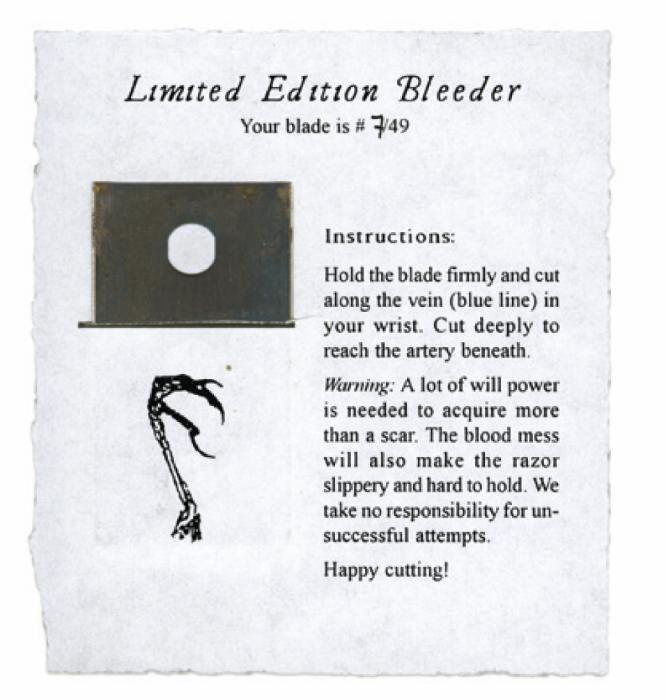
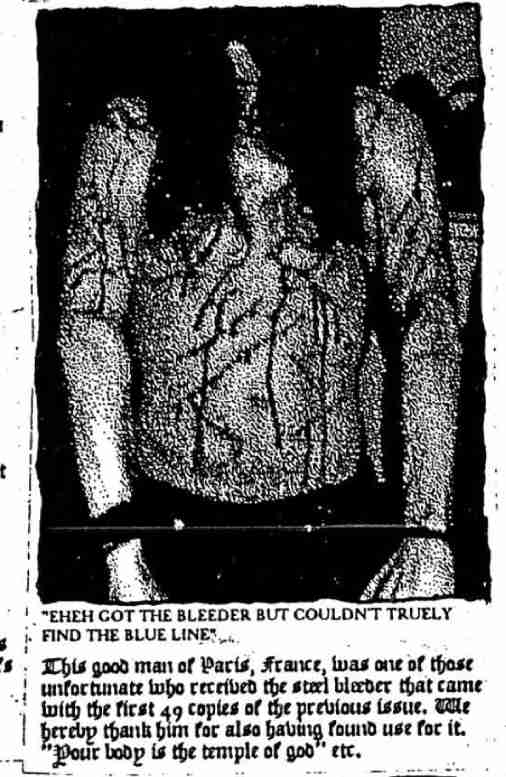
Like Erik and Nasko, Timo had known MkM for almost as long. After Blaash of Wheresmyskin recommended Dauthus #2, MkM obtained one of the first forty-nine copies – complete with the enclosed razor blade and instructions. He subsequently sent Timo a photograph of his handiwork, accompanied by the message, ‘Got the bleeder but couldn’t truly find the blue line.’ Fittingly, their correspondence soon developed into collaboration, as Timo contributed artwork and layout to ANTAEUS’ 2000 debut, “Cut Your Flesh and Worship Satan”.
In December 2001, Timo spent a week with MkM in Paris. The visit proved consequential in a number of respects: he heard DEATHSPELL OMEGA for the first time, while an excursion to Notre-Dame inspired the eventual Dauthus #3 cover. MkM’s most immediate recollection, however, concerns Timo’s prodigious tea consumption – ‘how dark and infused he liked it, and the amount he’d drink’ – which supposedly left several mugs ‘tainted’ beyond recovery.
MKM: I also remember being surprised at Timo’s way of viewing the world and expressing himself with a sense of poetry and sometimes a humour I didn’t always get. Yet he was the kind of unique individual who leaves a big impression even after a short amount of time spent together. Call it aura, I suppose.
During the same stay, Timo shot band photos for ANTAEUS’ 2002 “De Principii Evangelikum”, then handled its artwork and layout. The record also featured lyrics written by Daniel Rostén; in March of the following year, that connection came into play when MkM approached the FUNERAL MIST frontman on NoEvDia’s behalf, once Christian had decided to pursue “Salvation”.

CHRISTIAN: As you know, WATAIN’s initial plans for the “Lawless Darkness” artwork eventually shifted. I received a few updates along the way – mostly from Timo, if memory serves.
Erik said he didn’t seem to mind.
CHRISTIAN: True. Timo wasn’t plagued by the bloated ego that afflicts many artists; he mentioned the developments surrounding “Lawless Darkness”, but in clinical and objective terms. The decision surprised me at first, admittedly, though I was curious to see what would come out of it all.
log in to keep reading
The second half of this article is reserved for subscribers of the Bardo Methodology online archive. To keep reading, sign up or log in below.
Related reading