Liber Ketola XXXVII
2026-10-14
by Niklas Göransson
In the early days of Babylon Whores, Antti Litmanen’s esoteric interests drew him across the Baltic to Stockholm. There, he crossed paths with Timo Ketola, beginning a lasting friendship and artistic collaboration.
ANTTI LITMANEN: Savonlinna is a very typical eastern Finnish town, except we have an opera festival and a decent medieval castle. Like any tourist spot, it’s pretty vibrant in the summertime but completely dead in winter – which means you must take care of your own entertainment.
Born in 1974, Antti grew up in the eastern Finnish Lakeland. Built around the island fortress of Olavinlinna, Savonlinna is home to the world’s northernmost surviving medieval stone castle, founded in 1475 to guard Sweden’s frontier against Novgorod.
ANTTI: My older cousins indoctrinated me into all sorts of music early on, so I was already listening to BLACK SABBATH when I encountered anything resembling a metal scene. By ‘89, we were travelling to Helsinki for shows. In a single year, you could see KREATOR and CANDLEMASS in their prime, plus PINK FLOYD and ALICE COOPER.
Antti was playing guitar in several bands before leaving school – most notably ELINAN SURMA, a punk act named after Finland’s oldest murder ballad. Their seven-inch “Another Cold Day” came out on SHJ Records in 1991.
ANTTI: Music or the arts is your only choice if you don’t want to settle into the sort of normality a small town offers. We didn’t have much of a metal culture in Savonlinna. It wasn’t that any other genre dominated either, but there was a general tendency towards alternative rock – not really hardcore or anything, just weird experimental stuff.
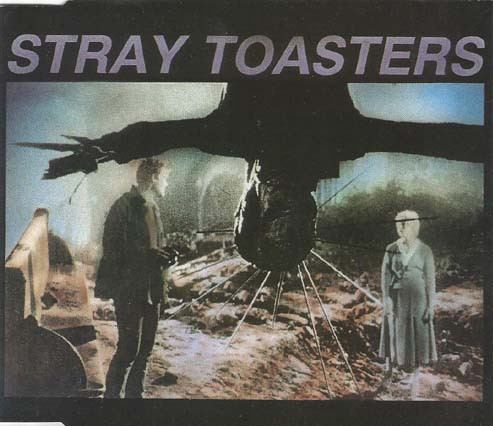
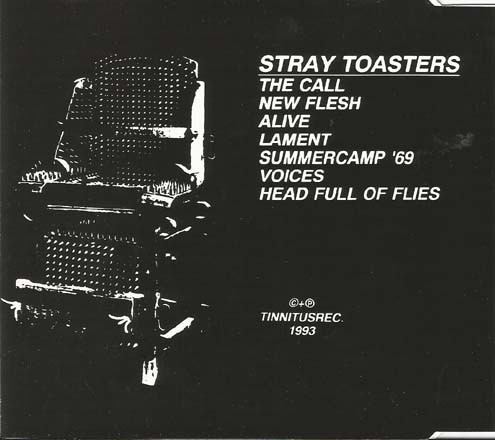
Antti and two of his ELINAN SURMA bandmates then formed the alternative rock act STRAY TOASTERS. In 1993, Tinnitusrec released the band’s self-titled mini-CD. On the other guitar was Tapio Wilska, the future frontman of FINNTROLL.
ANTTI: STRAY TOASTERS was a bunch of misfits who didn’t have much in common musically and ended up doing whatever. At least our tentative early attempts gave us a first taste of working with engineers and producers. Back then, you had to save up money, go to a commercial studio, and perform under pressure, at a rapid pace, and whatnot.
ANTTI: As post-punk bands like KILLING JOKE became an influence – the sheer relentlessness of their sound – the music took a darker turn. Me and a bunch of folks from my immediate circles played four or five gigs under the very imaginative name NOVEMBER COMING FIRE, thus paying homage to our main inspiration: SAMHAIN.
In 1995, the band – named after the second full-length by Glenn Danzig’s post-MISFITS project – put together a suitably themed set of covers for a Halloween party at Olavinlinna. Antti invited Ike Vil, vocalist of BABYLON WHORES, to join them onstage. By then, the Helsinki rock act had self-released two EPs: “Devil’s Meat” in 1994 and “Sloane 313” the following year.
ANTTI: At the time, it was extremely rare to come across people familiar with the darker end of Danzig’s career – let alone vocalists capable of singing like him. So, Ike came over and played the gig, which set a lot in motion once we discovered our shared philosophical and magical interests.
Like what?
ANTTI: I recall us enthusing about the Hermetic Order of the Golden Dawn, W. B. Yeats, William Blake, Dame Frances Yates’ work on Renaissance Neoplatonism, and books of alternative history like Holy Blood, Holy Grail.
How did you even discover the occult in ‘90s Savonlinna?
ANTTI: Finland has a pretty good public-library culture, so you could find all manner of interesting literature lumped together under general headings like ‘paranormal studies’. Actually, our local library had ordered a copy of Aleister Crowley’s Magick from overseas. They wouldn’t let it out of the reading room, so I’d come by every day after school with my notebooks.
Assembled over the better part of two decades, Magick combines instruction in meditation, yoga, and ritual, presenting magic as a means of bringing about change in accordance with the will.
ANTTI: Serious practitioners in Finland were few and far between, and often highly secretive. Unless you’d taken an interest in older schools of thought, such as Theosophy – which has been everywhere forever – there just wasn’t much, even in the very early days of the internet. You could get some information by sending twenty bucks in an envelope to the Californian O.T.O. in exchange for a newsletter.
Ordo Templi Orientis grew out of the fringe Masonry of early twentieth-century Central Europe and was remade by Crowley – its head until his death in 1947 – around the Law of Thelema. At the time of the Halloween show, it would take another two years for a Finnish O.T.O. outpost, the Pohjan Neito Camp, to be established.
ANTTI: Unlike most of my friends, I wasn’t led to occult material through metal. For a long, long while, music and esoteric practice were completely separate things in my life. BABYLON WHORES would’ve been the first time there was some sort of confluence between the two.
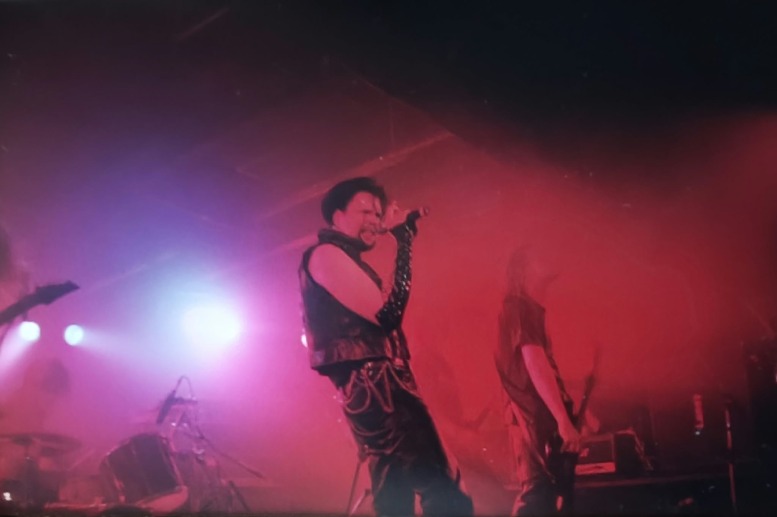
ANTTI: A few months later, Ike started taking BABYLON WHORES in a different direction – perhaps not consciously. He sent me a message saying their guitarist was leaving and asked if I could join. Both of us figured it would be interesting to see what might come of that writing partnership.
In early 1996, Antti relocated from Savonlinna to the Finnish capital, Helsinki.
ANTTI: In the spirit of seeing what would happen, I left pretty much everything behind. At the time, moving to another part of the country to join a band was a serious commitment. Nowadays, I think people miss out on something when they do projects over the internet, you know? There’s nothing on the line in quite the same way.
By June 1996, BABYLON WHORES had recorded the maxi-single “Trismegistos” – named after Hermes Trismegistus, the legendary author to whom the foundational texts of Hermeticism are traditionally attributed. Like the two earlier EPs, it was self-issued through their own Sugar Cult Records, and the band was now presenting itself as ‘deathrock’.
ANTTI: We wanted a new moniker for the band – a suitable term in relation to the music, because BABYLON WHORES were drifting away from their punk and garage-ish rock roots. I think Ike came up with it; he listened to all sorts of West Coast post-punk, which was sometimes called deathrock.
That same year, Antti contributed lyrics to “Forests of Witchery”, the debut album by Finnish black metal band THY SERPENT, who shared BABYLON WHORES’ practice space in central Helsinki.
ANTTI: Sami was pretty self-sufficient, but he didn’t have any inspiration for the lyrics. THY SERPENT had just landed a record deal with Spinefarm, and we happened to bump into each other at the rehearsal room. He asked if I could help out, which I did. All very last-minute, though, as they’d already composed everything.

Arktau Eos caligraphy by Timo Ketola
ANTTI: When it came to marginal culture and esotericism, Sweden always seemed five to ten years ahead of Finland, and things filtered here in trickles. So, whenever you ran into interesting people, you’d forge connections. I’d tape-traded with some Swedish folks and met a few musicians, but Christofer Johnsson (THERION) was the first one I got to know personally.
How did you two come into contact?
ANTTI: I just shot him an email one day – due to a combination of things, really. For starters, THERION’s “Lepaca Kliffoth” was quite left field for a Swedish metal album, and the “Theli” lyrics had overt Kenneth Grant references, which weren’t common in music back then. Christofer seemed equally surprised that I’d caught them.
Were you aware of Dragon Rouge at the time?
ANTTI: Yes, they were rather prominent during that early period. The order was young and vibrant and had a bit of mystique. It wasn’t the old, stuffy business of mere book-learning and pondering in salons <laughs>. With Stockholm being an easy port of call from Helsinki, I started spending quite some time over there.
The Finnish and Swedish capitals were linked by overnight ferries. Slow – roughly sixteen hours each way – but, with fares propped up by tax-free alcohol, extremely cheap.
ANTTI: The first time I visited Christofer, he and Tommie had a rehearsal lined up. I don’t remember anyone else being around, so it must have been a period when THERION was actively looking for a new line-up. I think they ran through some songs from “Theli”, like “The Nightside of Eden”, using backing tapes.
Antti’s account places the visit in late 1996 or early 1997. After touring in support of AMORPHIS, Christofer and drummer Tommie Eriksson were rebuilding THERION ahead of their March dates with SENTENCED and MY DYING BRIDE.
ANTTI: As I recall, Tommie turned up wearing psychedelic leggings covered in eye motifs and carrying his keys and various belongings tucked inside a battered copy of a Carlos Castaneda book. Looking back, early Dragon Rouge seemed to have something of a rave-culture undercurrent beneath its gothic exterior. Makes sense, since Goa trance was huge in both Finland and Sweden.
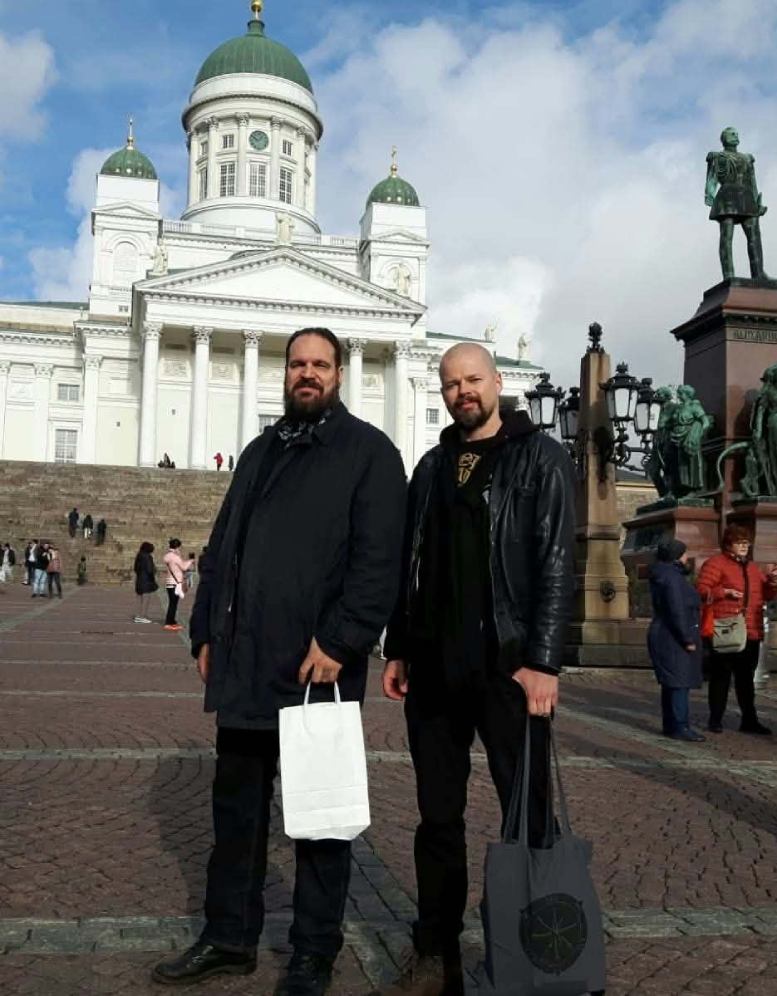
You met Timo on one of these trips. Do you remember who made the introduction?
ANTTI: Sadly, no. I’m pretty sure it was a metalhead – then again, most people I knew from the Stockholm scene were into one magical tradition or another. I’ve tried to reconstruct the meeting, but I only remember it taking place in some sort of café or pub. Timo and I actually spoke English at first, before somebody passing by commented, ‘Hey, since you’re both Finnish, you could just speak your native language.’
Had you already heard of him at that stage?
ANTTI: I couldn’t say. Anyone even marginally involved in tape-trading will know how many flyers one received back in those days. So, I probably saw the name Dauthus somewhere, but I didn’t connect it to Timo. In some ways, his ‘zine actually struck me as a Swedish, more esoteric version of Isten.
How so?
ANTTI: Not in presentation or content, but in the general seriousness and the way both editors invested themselves fully in putting those issues together. There are certainly parallels. Isten was pretty much the paragon of underground fanzines at that point, and remained great for years. I think Timo and Mikko were also in touch quite a bit.
‘Hail Isten, the father of zines’, Timo wrote in 1994, reviewing #6 for Script Infernal. The radiant endorsements continued in Dauthus, where he also interviewed Isten editor Mikko Mattila in the second instalment.
ANTTI: Mikko and I corresponded by letter occasionally. I benefitted from some amazingly one-sided trades, because I don’t think I had much to offer him <laughs>. His recommendations were always solid; he’s a great educator, just like Timo was, and would spread the word whenever he came across an interesting tape.
Mattila also had a hand in getting BABYLON WHORES beyond Finland: according to an interview in Meathooked ‘Zine #1, he sent their material to Misanthropy Records, which eventually led to a deal with the British label’s Heroine imprint.
ANTTI: We hadn’t approached many people ourselves, so Misanthropy’s interest came completely out of the blue. It kind of proved to us that our grand, chaotic master plan would work. We knew there was an audience for BABYLON WHORES – it just had to come to us, because the band’s in-house marketing efforts left a fair bit to be desired.
As someone following black metal, finding your own band under the Misanthropy umbrella – with BURZUM next door in the catalogue – must have been pretty wild.
ANTTI: Yeah, quite a trip. You must understand, though, we had no time for reflection during those years. Everything happened so fast; it all went by in a flash, you know? But Misanthropy really made an impression with the effort they put in. Tiziana’s whole operation was very artistic: thinking outside the box in every respect, unpredictable and interesting.
It was around then that Stephen O’Malley moved to the UK to work at Misanthropy – did your paths cross?
ANTTI: Actually, not long after we signed the deal, Tiziana and Stephen came to Helsinki. And this was another great point of connection: the record label visits your home, and you can exchange music with them and get enthusiastic about obscure demos and stuff. It felt quite special.
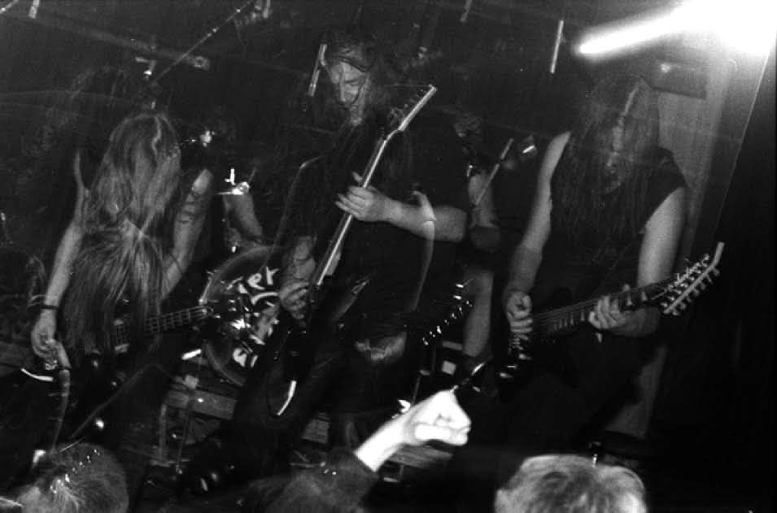
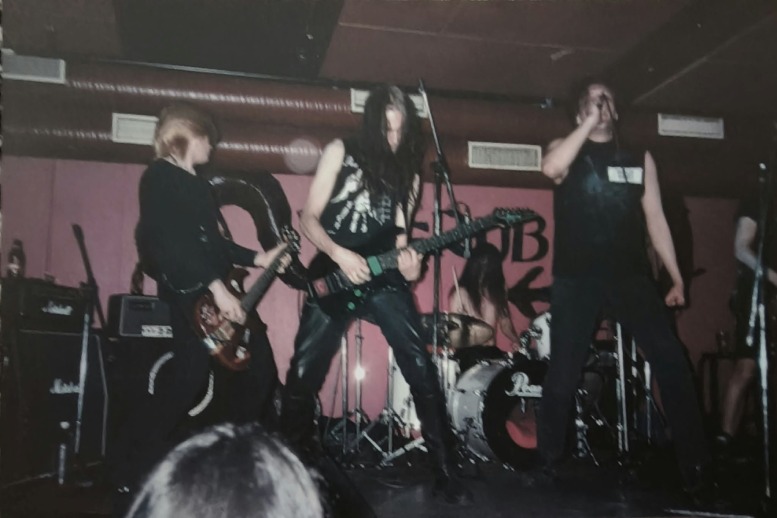
ANTTI: I went on holiday abroad with my family as a child, but getting into bands is what truly started the ceaseless travelling for me. In those years, the world was just opening up to us. The first BABYLON WHORES tour, though short, proved an eventful affair.
In the summer of 1997, barely eighteen months after moving to Helsinki, Antti found himself traversing continental Europe by nightliner to promote BABYLON WHORES’ debut album, “Cold Heaven”.
ANTTI: Teemu Kautonen of NATTVINDENS GRÅT – basically early gothic metal – put most of the tour together, which made for a very mixed bag of bands. I remember quite a bit of excitement because the headliners, WISH, were fronted by the former singer of THE GATHERING.
By 1997, Dutch outfit THE GATHERING had become a prominent name in atmospheric metal. The WISH connection reached back to their heavier beginnings: frontman Bart Smits sang on the death-doom debut, “Always…”.
ANTTI: Our other guitarist, Ewo, was doing A&R at the time and starting to put things in motion at Spinefarm. Remember, this tour happened during the dawn of the Finnish metal boom. He tried to combine travel and work by bringing along a huge box full of demos, hoping the next SENTENCED or DARK TRANQUILLITY – his first signings – waited somewhere in the pile.
Spinefarm Records – a Helsinki mail-order operation turned label – had released SENTENCED’s “North from Here” and DARK TRANQUILLITY’s “Skydancer” in 1993, only to watch both bands move on to competitors with greater international reach: Century Media and Osmose respectively.
ANTTI: Most submissions were so outrageously bad that he eventually lost his patience and dumped the whole box onto the highway in a fit of rage <laughs>. The only tape left on the bus belonged to the keyboard player from NATTVINDENS GRÅT; he went, ‘Oh, maybe you could give my new project, NIGHTWISH, a listen?’ Ewo did and said, ‘Okay, I’ll sign you guys.’ I can’t say anyone quite foresaw the implications at the time.
Did people actually talk about careers and ambitions on those trips, or were you all still operating within an underground mentality?
ANTTI: I don’t think anyone was actively pursuing commercial success so much as just doing our own thing – and if that led to something, great. But career plans? No. We’d also picked up quite a bit of DIY attitude from the hardcore scene.
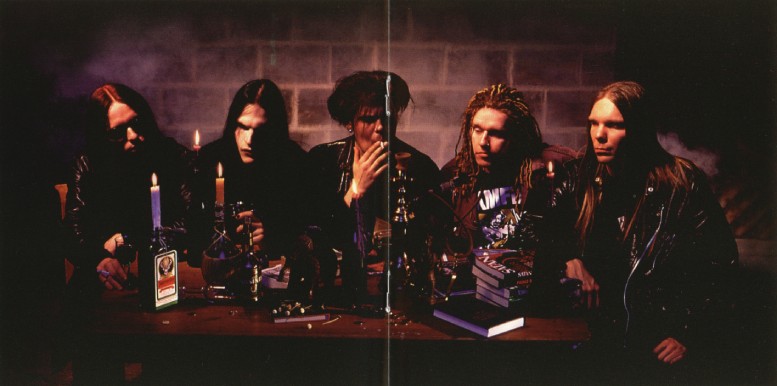

ANTTI: Before I joined, people generally regarded BABYLON WHORES as a rock band, or some sort of underground punk thing. I wasn’t there when they supported acts like PENNYWISE, but two years later we were playing gigs with BARATHRUM and MAYHEM, so go figure.
In September 1998, five months after the Easter Holocaust Tour alongside BARATHRUM, BABYLON WHORES opened for fellow Misanthropy act MAYHEM in Helsinki. Necropolis Records owner Paul Typhon had heard glowing reports of the band and was particularly impressed by their new mini-CD, “Deggael”, released that same month.
In early 1999, Necropolis signed BABYLON WHORES – the second time they had landed on a label primarily associated with far more extreme music.
The band also shared conceptual ground with black metal, their lyrics steeped in occult symbolism and apocalyptic veneration. In “Deggael” songs like “Omega Therion”, philosophical and esoteric references mingle with a plea for ‘someone to bring this shithouse down’. Interviews from the period show them carrying those interests over into songwriting, portraying the musician as a medium – a conduit rather than simply an author imposing his will.
ANTTI: Unlike most black metal bands, when we spoke of channelling – of being a messenger for something else – it had nothing to do with a definite entity like Satan. Rather, it’s an attempt to reach places inaccessible without art or creativity: a sort of liminal state where you can pull things from the murky undercurrents that have no place in the light.
Equally recurrent was the idea that anything of artistic value emerges from the friction between chaos and order – which demands room for improvisation.
ANTTI: That was definitely the BABYLON WHORES method of working. For instance, when Ike wrote his lyrics… some were almost humorous, with plenty of puns, and he’d rework them. But he also put himself under a lot of strain trying to find a sort of unconscious way of just channelling ideas.
log in to keep reading
The second half of this article is reserved for subscribers of the Bardo Methodology online archive. To keep reading, sign up or log in below.
Related reading