Liber Ketola XXXVI
2026-10-07
by Niklas Göransson
With Paracletus, Timo Ketola left the security of a mastered discipline and ventured into painting on panel. At much the same moment, Kosta Papavassiliou heeded the call of a new musical lodestar: Head of the Demon.
CHRISTIAN BOUCHÉ: A major shift occurred when Timo began moving away from drawing – a medium he had fully mastered – towards painting in oils, acrylics, and watercolours. It’s interesting to observe how his dialogue with art history evolved: in a nutshell, Albrecht Dürer and Gustave Doré gave way to Eugène Delacroix and Gustave Moreau.
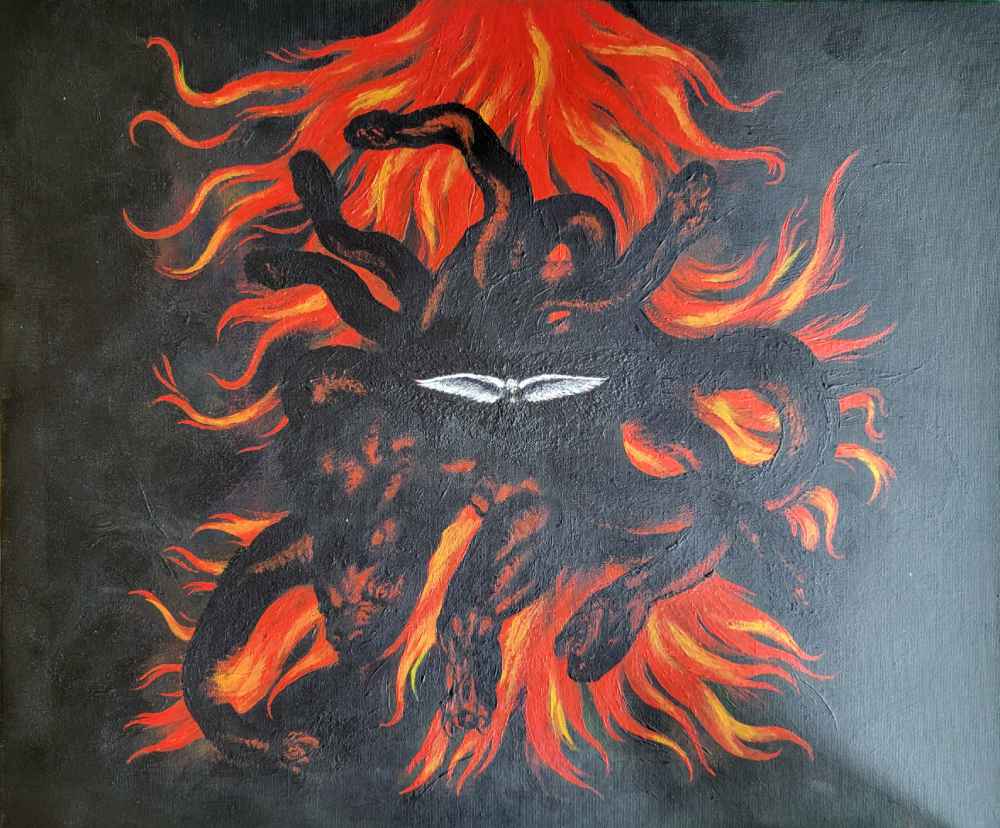
Every previous cover Timo had created for DEATHSPELL OMEGA – “Si Monvmentvm Reqvires, Circvmspice”, “Fas – Ite, Maledicti, in Ignem Aeternum”, and the first-era reissues – was executed in pencil, ink, and watercolour on paper. “Paracletus” is acrylic on panel and, as far as Liber Ketola indicates, the first such painting of his career.
CHRISTIAN: I actually requested a drawing initially – at least as the basis for the cover, which was always intended to follow the colour scheme it eventually assumed. But after a lengthy discussion, Timo convinced me that what we had envisioned would work better as a painting, and I could see his point.
Was that because he wanted to move on from drawing?
CHRISTIAN: Obviously, my answer should not be taken as the definitive truth regarding Timo’s state of mind – but yes, I got the impression that he felt he had reached a certain point with illustration in general. He was keen to explore new artistic territories: an attitude I could only support.
When did you get started on the “Paracletus” visuals?
CHRISTIAN: I no longer remember the exact timing, but I suppose everything was ready on our end when Timo received the commission. After all, without the lyrics, work on the cover would have been impossible: it is necessarily an emanation of the text.
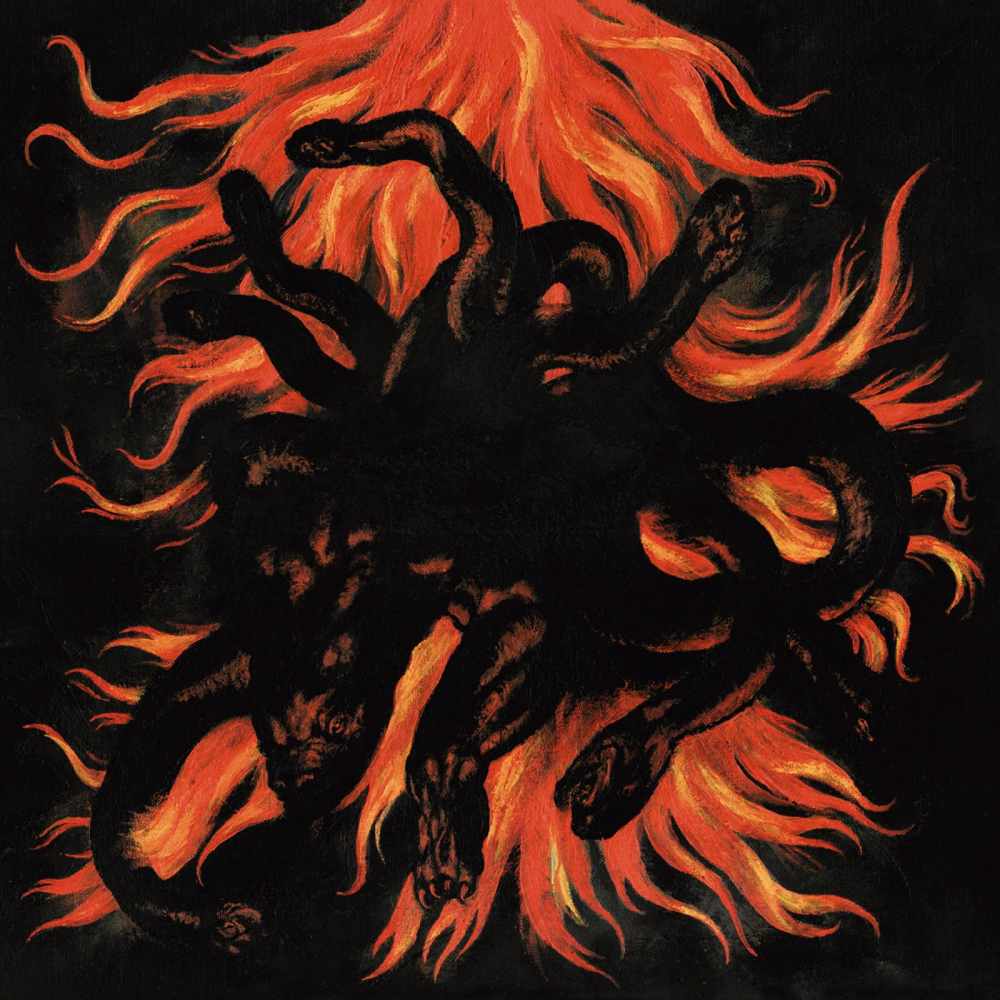
The cover is generally assumed to depict the Beast of Revelation engulfed by the lake of fire – though I’m sure you’ll refrain from commenting.
CHRISTIAN: Correct: there will be no explanations. Timo had several main themes to develop into a cover, and the design underwent a fair amount of experimentation along the way. What people cannot know is that at the very centre sits a dove – ultimately covered over in black, but still lurking beneath the surface.
Discussing Léon Bloy’s importance to the thematic content of “Paracletus”, Christian referred to the Catholic polemicist’s theological thinking: the more monstrous something appears, the greater the possibility of an unfathomable mystery concealed within it. A dove – the traditional emblem of the Holy Ghost – blacked out at the very centre of the artwork sounds remarkably close to that principle.
CHRISTIAN: Painting the dove mattered because it gave material form to this incarnation of the Holy Ghost. Then obscuring it beneath black carried immense symbolic weight. The decision was executed digitally – I’m not entirely sure why Timo chose that route rather than applying another layer by hand. Presumably, being among his earliest works in the medium, he acted out of caution and didn’t want to risk ruining the original.
Considering Bloy’s ideas about the inadequacy of familiar representations, to what extent was the viewer’s instinct to see the Beast in that figure part of the design?
CHRISTIAN: An illustration can have several layers of meaning and, sometimes, the initial interpretation only serves as a gateway to what lies beneath.
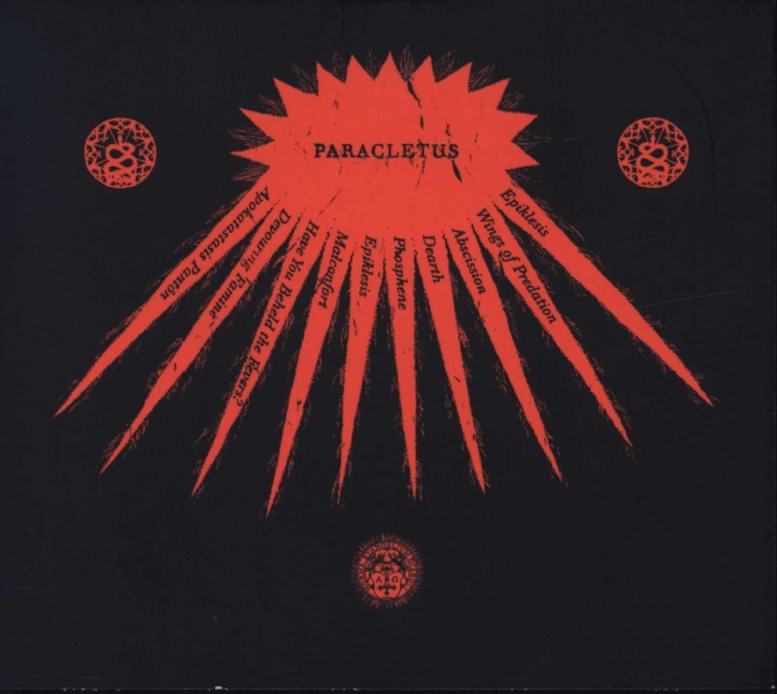
The back cover reprises an important principle used on both earlier instalments of the trilogy: the tracklist forms the artwork rather than merely being placed over it. “Fas…” maps a closed circuit – a central node, four songs at the cardinal points, arrows tracing the paths, everything occurring at once. On “Paracletus”, a jagged corona serves as the point of origin, with the titles radiating downwards.
CHRISTIAN: I sent Timo the structure I had in mind – it was based on a centuries-old drawing – and he turned it into reality.
On “Fas…”, the “Obombration” pair occupies tracks one and six, converging on a single node and closing the loop by folding the record back towards its origin. “Paracletus” places the corresponding “Epiklesis” pieces in the same positions, yet gives them separate rays.
CHRISTIAN: Look at the etymology of the word epiklesis, and a lot becomes self-explanatory.
Epiklesis derives from the Greek epikalein, ‘to call upon’; in Christian liturgy, it denotes the invocation of the Holy Spirit. Paracletus, meanwhile, is the Latin form of paraklētos, itself built on parakalein: ‘to call to one’s side’.
Fittingly, “Paracletus” was also the first DEATHSPELL OMEGA album on which Timo summoned a fellow artist from the metal underground to his side.
CHRISTIAN: We had planned the album meticulously, but Timo soon realised the volume of visual material would make it impossible to finish everything – layout included – to his satisfaction. He was still close to Manuel Tinnemans, whose PENTACLE piece had impressed him deeply years earlier, and suggested inviting him to contribute to the booklet.
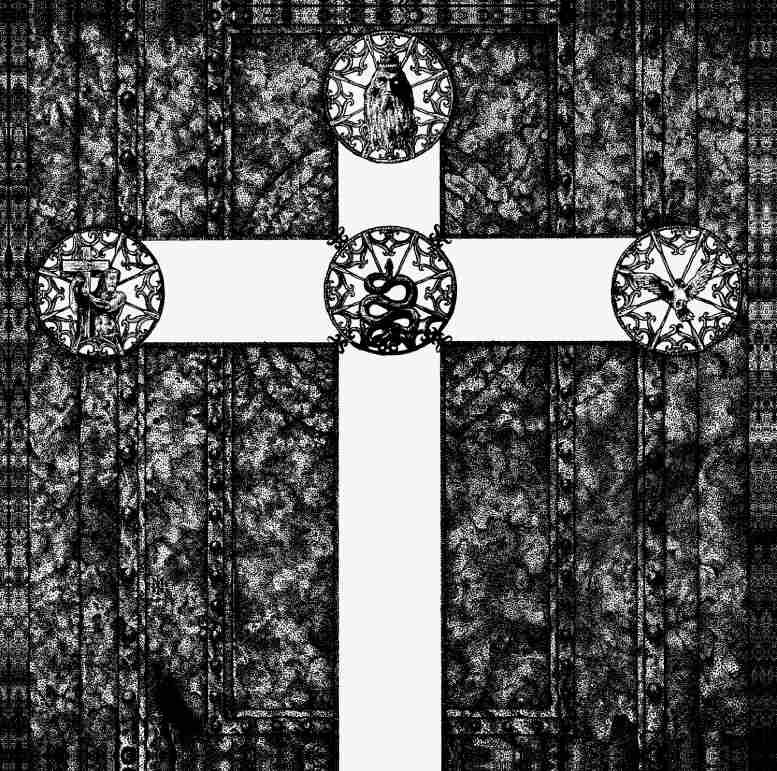
During discussions surrounding the Season of Mist edition, someone remarked that the “Paracletus” cover lacked the vibrancy of other modern releases – which, in fairness, is objectively true.
The painting does very little of what a commercial cover is expected to do. It neither explodes with colour nor offers legible detail at thumbnail size; the entity is compressed into an almost indecipherable black organism, while the flames appear as flattened, curling forms rather than spectacular digital fire.
CHRISTIAN: Michael Berberian (Season of Mist) sent me a couple of covers as examples of what he considered suitable record artwork. To me, they looked more like imagery from products such as video games – sterile, plastic, and devoid of soul. I had to explain that our references were not rooted in the here and now, but in museums filled with paintings by the likes of Gustave Moreau.
Much later, after Timo’s death, you mentioned having bought the original “Paracletus” painting, which he’d been meant to ‘retouch’. Was this due to physical deterioration, or had you found yourself agreeing with Season of Mist a decade on?
CHRISTIAN: Are you joking? No, the paint was fading, obviously. Timo hadn’t yet mastered every aspect of painting, so some of those early pieces aged badly. With the oils, part of the problem was the lack of protective varnish; as for the watercolours, I assume the works weren’t sufficiently shielded in storage.
TYLER DAVIS: I can attest to that: many of Timo’s works lacked the final protective treatment. A lot of his chalk and crayon drawings, for instance, were never fixed or otherwise coated – which is understandable, since spraying them requires space, drying takes time, and so on.
During the years spent assembling Liber Ketola, Tyler became more than the monograph’s principal archivist. He has had continuing access to Timo’s physical archive and helps manage it from afar; the works themselves are currently in Kosta’s care.
TYLER: I mentioned something similar in the book’s foreword: think about it, how many artists actually sign every drawing and painting they make? The same goes for varnishing and other protective treatments. And Timo living in a small apartment with limited ventilation certainly wouldn’t have made that kind of work any easier.
That apartment was a relatively recent acquisition. By 2010, after more than three years at the Capuchin monastery, Timo had finally secured a home of his own in Sansepolcro, Tuscany – and quite possibly, with it, the room to paint on panel.
TYLER: For someone producing as much, and as quickly, as Timo did, it would be unusual to protect every single thing. You can look back at the old masters too: many were living hand to mouth and weren’t necessarily thinking in archival terms – whether each painting might survive for centuries.

Three commissions, three refusals to hear the music. Timo clung to the instrumental, two-song TEITANBLOOD rehearsal tape for nine months while working on “Seven Chalices”. He awaited the vinyl edition of “Fas…”, then sat on his floor following it with the lyrics. And on November 15, 2010 – a week after release – he received “Paracletus” in the post like any other customer.
CHRISTIAN: Timo had what was paramount, meaning the lyrics, at hand. The written content is not only meant to convey concepts, metaphors, and images that can be translated into visuals, but also to work in tandem with the music and, as such, communicate a sense of the album’s purpose – its soul.
In an email sent the following day, Timo told Nasko that he had already played “Paracletus” half a dozen times. His initial reaction was enthusiastic, particularly towards the closing track: ‘Bloody hell, those guys pulled off an emotional string with “Apokatastasis Pantôn” – it’s incredible!’
He added that a new DEATHSPELL OMEGA release – from ‘the only modern technical band that I really enjoy’ – always required patient listening. In fact, he was apparently ‘still working’ on “Kénôse”.
CHRISTIAN: I wasn’t really following Timo’s listening process beyond whatever he felt like sharing with me – I never asked. We had millions of things to talk about, and revisiting old DEATHSPELL OMEGA recordings was hardly at the top of the list.
Familiarity soon bred a more hostile response: Timo objected violently to the clean-vocal passage near the end of “Phosphene”. What truly seemed to outrage him was the unprecedented indignity of having to ‘skip a DEATHSPELL OMEGA song’.
Christian had already explained that those vocals were designed to sound wrong; Timo remained wholly unconvinced, calling this the only time the band had ‘failed outright’. No more than a few minutes on a full album, he conceded – ‘but still’.
CHRISTIAN: I have no precise recollection of his reaction to the album, beyond the fact that he didn’t connect with it. Completing “Paracletus” was exhausting: the studio process means confronting the perfect abstraction of your ideas with a material, down-to-earth – and therefore limiting – reality. By the end, I had no energy left to devote to anyone’s feedback, not even Timo’s.
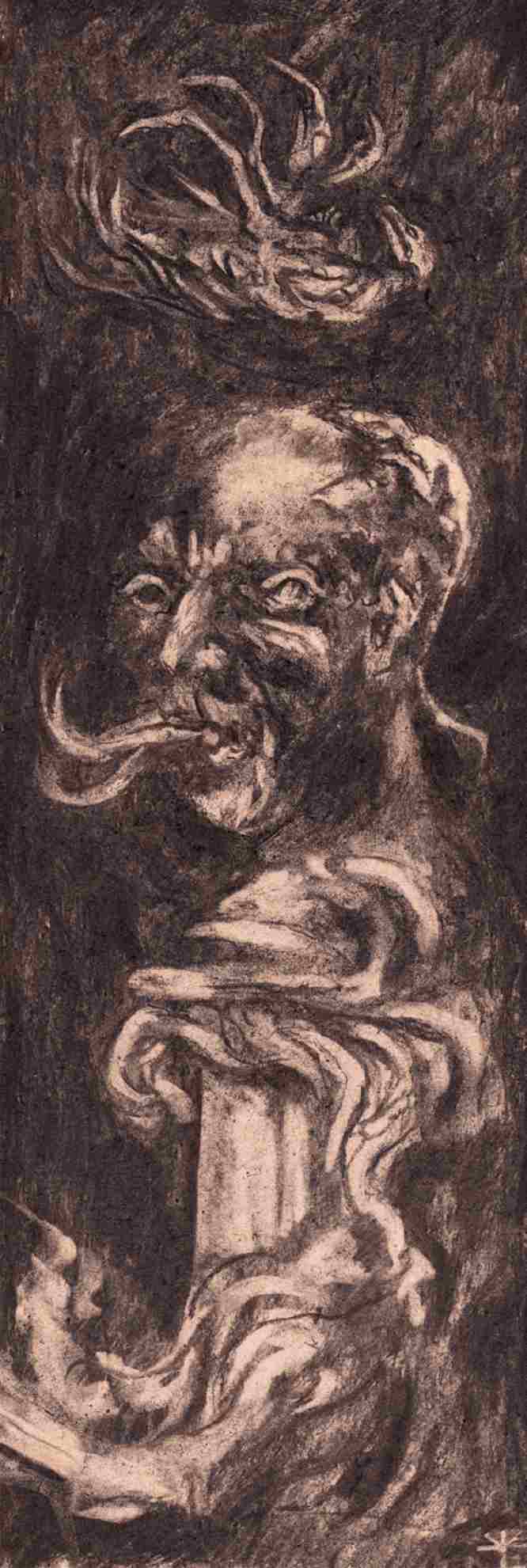
KOSTA PAPAVASSILOU: I love plonking away on my guitar. And when I do, it’s typically not to practise scales – I’m just playing around, seeing where my fingers take me, until I stumble upon a sequence of notes I can develop into a riff. I’ve had this drive since my teenage years, but I was so fed up with everything that I suppressed it for almost a year.
In late 2008, Kosta left SATURNALIA TEMPLE as its magical experiment began taking on the obligations of a touring act. KAAMOS, meanwhile, had briefly stirred from the grave; three further shows in 2009 only confirmed the sense that they were trying to resuscitate something already dead. Wearied by both experiences, he resolved to give up playing in bands altogether.
KOSTA: Band or no band, I’ll record the riffs worth keeping. It’s not a case of, ‘Now I have material for this or that project’; rather, they’re outpourings of some deep-seated creative urge, the same impulse behind Timo’s doodling. It didn’t much matter what he drew, as long as he got to draw something.
Doodling – drawing without purpose or plan, the hand moving ahead of the mind – was one of Timo’s most constant habits. Give him a restaurant table and a few minutes’ wait for his meal, and the serviettes would soon be covered in whatever images happened to emerge.
TYLER: You can see evidence of this in Liber Ketola, which features coasters, napkins, and serviettes covered with Timo’s drawings – things he would simply have left behind if someone hadn’t asked, ‘You’re not keeping that?’ and grabbed them, thereby preserving the artwork.
KOSTA: That’s precisely how I’ve always related to making music: both as artistic expression and as a vital outlet for whatever is stirring inside me. But after the KAAMOS reunion, I thought, ‘Fuck this – I’m done. I’ll let it go and move on.’ Obviously, that didn’t work. The urge came back with a vengeance, almost like: ‘You cannot ignore me!’
One night in late 2010, around the release of “Paracletus”, the impulse Kosta had tried to silence returned abruptly.
KOSTA: I woke up with a ferocious pull: ‘I must play guitar.’ I simply couldn’t find any peace in body or mind until I did. So, I got out of bed, sat down on the couch, and started plonking away. Almost immediately, I thought, ‘What the fuck? My fingers have never gone here before. Where is this coming from?’
Have you answered that question in retrospect?
KOSTA: I truly believe it was the backlash from suppressing that drive. Being creative is always an emotional and mental struggle – and the need doesn’t just disappear because you’re not in a band. The spark of inspiration is a volatile thing; in a sense, you have a love-hate relationship with it. My lesson was basically, ‘There’s no escaping this’, so I accepted it.
If these riffs came to you fully formed, how did you even know what to do with them?
KOSTA: I didn’t. I just went with the flow.
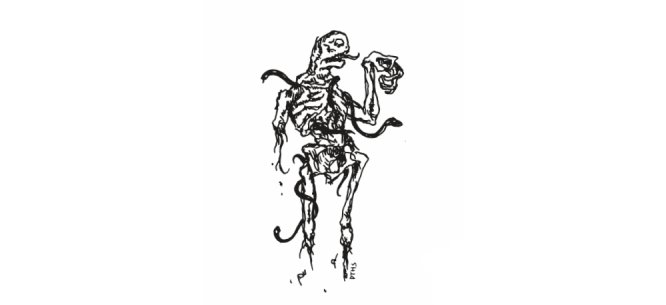
The first call was to Thomas Åberg, a drummer whose musical history with Kosta stretched back nearly two decades: GODS OF GRIEF, A MIND CONFUSED, and finally the original KAAMOS line-up.
KOSTA: Those first rehearsals were really about finding the right conditions for the material to reveal itself. My guitar was still tuned down to B, as it had been in both KAAMOS and SATURNALIA TEMPLE, but we quickly realised, ‘Fuck, this just sounds muddy.’ Played acoustically, the riffs worked beautifully; once we added distortion at that tuning, all the definition disappeared.
The breakthrough came when Kosta tried a guitar tuned to E instead. Compared with the low, heavy register of B, the higher tuning tightened the sound and allowed the individual notes to separate.
KOSTA: From there, we built the temple stone by stone: ‘This works; that doesn’t.’ Even so, it came together quite quickly. Before long, both Thomas and I felt we’d found the right language for what we were trying to express. I also remember some early uncertainty around the vocals; I wanted the voice to function as another instrument rather than as oration laid over the music.
For vocals, Kosta turned to another longtime collaborator – albeit from a very different sphere. Saibot was the fellow metalhead who brought him into Dragon Rouge in late ‘98 and later supplied the Arabic and Akkadian for TEITANBLOOD’s “Seven Chalices”.
KOSTA: Saibot is a guitarist and has always played in bands – but back in the day, he also had a habit of singing along while drunk, so I’d noticed his incredible range: clean vocals, growls, shrieks, and everything in between. I thought, ‘Recruit a death metal singer and you know exactly what you’ll get; the same goes for a black metal singer. With Saibot, at least the unexpected is guaranteed.’
Did you give him any kind of instructions?
KOSTA: Not much. I told him to aim somewhere between Cronos, Tom G. Warrior, and maybe even Tom Araya. Rather than screaming or growling, I wanted a heavy, aggressive delivery with every word clearly discernible. I arranged the lyrics and how they sat in the songs; beyond that, Saibot had free rein.
There is an obvious symmetry here. Saibot was Kosta’s point of entry into initiatory magical practice; twelve years later, his voice became the human outlet for something Kosta experienced as an autonomous creative force demanding manifestation.
KOSTA: It was primarily his musical qualities that made me choose him. But in hindsight, of course, you can wonder whether other processes were playing out somewhere in the background – certain cycles coming full circle without my being aware of them. Not consciously, at least.
In an interview with Scrolls of Darmoth, Kosta recalled searching for a name that was ‘not of this world’ and becoming fixated on Algol – the so-called Demon Star in the constellation Perseus. Roughly every three days, for around ten hours, it visibly dims as one star in the system passes in front of another. Its reputation is darker still: Greek astrologers, Arab astronomers, Chinese stargazers, and later European occultists all read something baleful into it.
KOSTA: It’s a fascinating phenomenon. If I could explain why all these different traditions came to regard that one particular star as ominous or dangerous, I’d probably answer a great many related questions as well – concerning religion and spirituality, but also art, psychology, and all sorts of other fields.
Kosta briefly considered the moniker ‘Alghoul’, but soon discovered that variants had already surfaced repeatedly in underground metal. Instead, he turned to the etymology behind Algol: raʾs al-ghūl, ‘the head of the ghoul’, referring to the shape-shifting demon of Arabian folklore. HEAD OF THE DEMON had its name.
When I interviewed Kosta in 2016, he described the band as something that had arrived and now guided him – a spirit being, an intelligence acting out of its own will. Appropriate, perhaps, for an entity with Algol as lodestar.
KOSTA: Sure, but mostly in reflection; it wasn’t a connection I made at the time. With this band, major undertakings have come together almost effortlessly, while trivial matters that ought to be a walk in the park can prove impossible, as though something simply refuses to let them happen. HEAD OF THE DEMON has a life of its own. It exists on its own terms and, to some extent, dictates those terms to us.
log in to keep reading
The second half of this article is reserved for subscribers of the Bardo Methodology online archive. To keep reading, sign up or log in below.
Related reading