
Liber Ketola XIV
2026-05-13
by Niklas Göransson
After years of silence, Ofermod resurfaced in 2004. Still incarcerated, Mika ‘Belfagor’ Hakola began reaching out to old contacts from the Swedish underground – among them Timo Ketola.
NASKO: “Salvation”, then “Kruzifixxion”, “Casus Luciferi”, and “Si Monvmentvm…” – these were all albums where you’d find that end-to-end cohesion, with obsessive attention to detail across every aspect: the music, arrangements, lyrics, artwork, and the way everything connects.
All but one of the first four Norma Evangelium Diaboli titles were designed and visually interpreted in close collaboration with Timo Ketola. The lone exception, KATHARSIS’ “Kruzifixxion”, featured layout and artwork by the band’s frontman, Drakh.
NASKO: At the time, the overall mood was, ‘We’re witnessing this incredible black metal scene take shape’ – FUNERAL MIST, KATHARSIS, WATAIN, DEATHSPELL OMEGA, MALIGN, ANTAEUS… so many bands putting out amazing material. Then, on top of that: ‘So now OFERMOD are on NoEvDia as well?’
CHRISTIAN BOUCHÉ: It’s simply a historical fact that many of the most relevant black metal bands of the 2000s ended up working with us in some capacity – and by ‘us’, I mean both End All Life and NoEvDia. WATAIN would eventually outgrow them all, though.
NASKO: As WATAIN grew more popular, you’d often hear this piece of underground lore: ‘If you like them, check out MALIGN.’ But for those who kept digging, there were even deeper layers. First, FUNERAL MIST, which I discovered through “Salvation”. The ultimate obscure band, though, was OFERMOD.
Swedish black metal duo OFERMOD, founded and led by multi-instrumentalist Mika ‘Belfagor’ Hakola, released an EP titled “Mystérion Tés Anomias” in 1998. The following year, they signed with Shadow Records and began preparing their debut album, “Mystery of Iniquity (Luciferian Evangelium Cantata)” – a project that came to an abrupt halt when Mika was incarcerated for several years.
NASKO: Even though OFERMOD had nothing out besides “Mystérion…”, people spoke of them reverently. I heard all these stories about Mika being insane, dangerous, with a criminal record, blah blah blah. I finally got hold of the original seven-inch, but I can’t remember how – maybe Ynas (MALIGN) helped me.
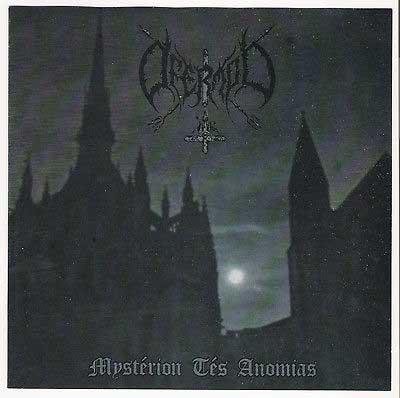
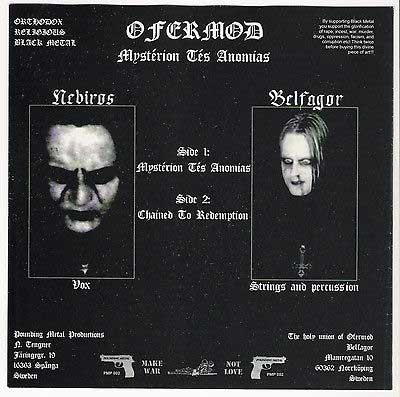
“Mystérion Tés Anomias” was released by Pounding Metal, a small Stockholm-based label run by OFERMOD vocalist Jonas ‘Nebiros’ Tengner, who also co-founded MALIGN.
NASKO: What I do remember is being totally blown away. I thought, ‘Okay, the OFERMOD legend is true – this music really matches the mythos.’ Honestly, it was the closest thing I’d heard to “De Mysteriis Dom Sathanas”, and those are big words coming from me.
CHRISTIAN: “Mystérion Tés Anomias” was truly ahead of its time – undoubtedly one of the most important recordings of that era, fully deserving of all the praise it received. Mika had embodied something genuinely otherworldly. As such, when we began corresponding, I regarded him as someone destined to build upon the legacy of this extraordinary potential.
In early 2004, between prison sentences, Mika began reaching out to old contacts who hadn’t heard from him in years – among them Jonas Tengner and Timo Ketola.
CHRISTIAN: It’s possible Timo connected us, but I can’t confirm it. I don’t recall much beyond the fact that there was quite a bit of correspondence with Mika through letters at a time when many, if not most, had already switched to email.
OFERMOD’s first recruit was FUNERAL MIST drummer and Necromorbus Studio owner Tore Stjerna, who served as both band member and producer. After a few months of irregular rehearsals, Mika began filling the remaining line-up with individuals from the Swedish underground he considered musically and ideologically aligned.
In December 2004, after drafting members from DÖDFÖDD and MORTUUS, OFERMOD entered Necromorbus Studio to record two new tracks – “Khabs am Pekht” and “Rape the World” – intended as bonus material for the upcoming NoEvDia reissue of “Mystérion Tés Anomias”.
NASKO: I thought “Khabs am Pekht” was amazing – a natural continuation of the EP. Tore’s production sounds fantastic, too. You can hear his drumming clearly: very dynamic, especially for this kind of fast-paced yet intense black metal. It matches the shifts in the song extremely well.
CHRISTIAN: “Khabs am Pekht” is a great song. I took “Rape the World” as a tribute to 1980s bands – perhaps a nod to early influences, which would make sense given Mika’s age. It wasn’t uncommon at the time to invoke CELTIC FROST, KREATOR, or SODOM as precursors to black metal.
NASKO: The second one… I think I enjoyed “Rape the World” at the time, even though it didn’t really feel like OFERMOD. A bit strange. Maybe the song grows on you, but with the clean vocals and so on, it doesn’t have the same atmosphere as the other material.
Following the recording, work began on the visual presentation of the reissue, with the layout handled by Timo Ketola.
CHRISTIAN: Timo was the obvious choice when you were active in that corner of the black metal scene, wasn’t he? No other artist could have felt more relevant. He and Mika already knew each other.
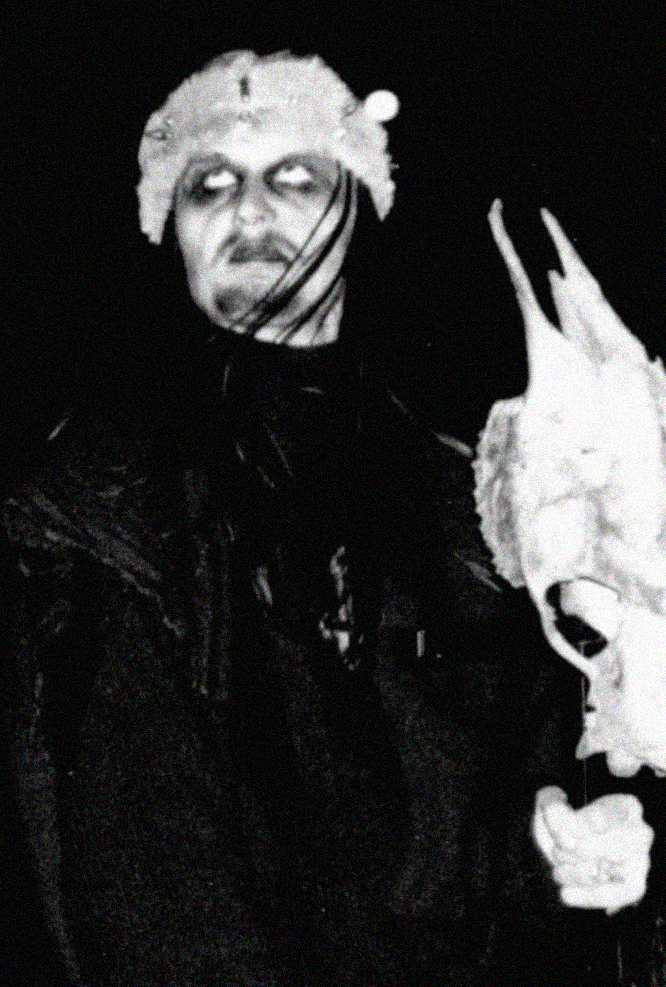
MIKA HAKOLA: I’m not sure exactly how Timo and I became friends, but I clearly remember the first time I laid eyes on him. Around ‘98, while crossing that bridge leading to the Spånga train station, I saw a black-clad, long-haired man walking toward us, who then stopped to greet Rostén. Naturally, I started wondering, ‘Who was that?’ And he explained, ‘That’s one of the wisest men on this earth.’
Mika – who grew up in Norrköping, 160 kilometres southwest of Stockholm – first met the members of FUNERAL MIST and MALIGN at the Hultsfred Festival in the summer of 1996.
MIKA: Rostén more or less forced me to buy the “Havoc” tape for twenty kronor. Not in a threatening way, but with a serious look: ‘You really want this. You’ll miss out on something truly important if you don’t get it.’ I was so impressed by his intensity that I knew I’d found a kindred spirit.
As in a fellow fanatic?
MIKA: Sure. People talk down fanaticism these days, but I believe you need a touch of it to create something truly remarkable. Those who’ve made a real impact on the black metal scene – who turned the tides, as they say – all possess a kind of inner flame. You can see it in their gaze: ‘Damn, this guy is serious.’
After befriending the Stockholm bands, Mika began visiting the capital regularly, which is how we first met. He made an immediate impression – not only through his ability to explain Satanism, but above all because he seemed to believe wholeheartedly in what he was preaching.
MIKA: Yes, you could say that. I kept some of my ideas to myself, but I preached in good faith according to what I felt was the right kind of Satanism – as I understood it at the time. Of course, I’ve since evolved in various directions through the study of occult teachings; I didn’t know much about Kabbalah and the Qliphoth back then.
At this stage, Mika’s esoteric practice was almost entirely confined to crude forms of black magic, while his theological studies focused on Christian literature. He spent long hours immersed in the Bible, having concluded that scripture must itself be a work of the Devil, given the evils committed in its name.
MIKA: Besides Christian theology, I’d studied some rhetoric and a bit of psychology – all of which helped me become more persuasive and wield greater influence. The Satanists in our circles appreciated that I could articulate something coherent about their own faith, providing an intellectual framework for convictions they already held on an intuitive level.

“Mystérion Tés Anomias” caught Timo’s attention – as did the presentation of ‘the holy union of OFERMOD’ as ‘orthodox religious black metal’. While working on Dauthus #3, he bombarded Mika with four full pages of snide interview questions about his interpretation of the Bible.
MIKA: Yes, what a fucking ordeal. I got maybe halfway through the interview but never sent it off – I wasn’t satisfied with how I’d worded my answers. I was such a perfectionist back then that even letters to underground pen pals would take me several hours to write.
Despite receiving no answers, Timo went ahead with an OFERMOD feature for Dauthus #3, calling the 1998 EP ‘one of the finest and most perverse black metal releases of the late 90s’. He writes that ‘Nebiros’ dead voice floats and howls over the streaming vertigo’, citing MAYHEM’s “De Mysteriis Dom Sathanas” as the closest comparison.
MIKA: What appealed to Timo about OFERMOD? The esoteric, the mystical, the darkness, the classicism. The fact that we weren’t just another black metal band – we drew on symphonic music, with guitars imitating the orchestral sweep of a Wagnerian opera.
Were you actively listening to classical composers like Richard Wagner?
MIKA: Sure. I don’t know whether he influenced OFERMOD directly, but I did enjoy Wagner quite a bit. I discovered the beauty of his operas in ‘97 – one year prior to “Mystérion…” – while in police custody. I was nineteen at the time and had never been locked up for any extended period before.
What prompted the occasion?
MIKA: These jock types – football lads or something – spat in my friend’s face. I pulled a knife and chased the bastards until they reached a nightclub, where the bouncers let them in and started staring me down. I put the blade away and went back to the others. Soon after, the cops turned up and arrested me.
How long did you spend in custody?
MIKA: About a month – twenty-seven days or so – under full restrictions, standard pre-trial procedure back then. If you received a prison sentence, you’d remain on remand. I was convicted of carrying a knife but acquitted of attempted aggravated assault, so at least I walked out of the courtroom a free man.
How did you discover Richard Wagner in custody under full restrictions?
MIKA: I had an old radio in my cell. One of the stations aired Wagner’s operas now and then, and I really took to them. I couldn’t name any specific pieces, though; it wasn’t something I kept up with after getting out.
Do you remember what you listened to first when you got home?
MIKA: No, because I had a massive panic attack the moment we arrived at my apartment. In custody, they’d put me on antidepressants for anxiety – something like Zoloft. When I was acquitted, I wasn’t sent home with any medication. So, after a month on those pills, my body must have become used to the serotonin.
Zoloft is an SSRI – I don’t think you’re supposed to quit it cold turkey.
MIKA: Yeah, I noticed. Tengner and Fog from MALIGN attended the trial and came back to my place to drink a few beers afterwards. But then I had this meltdown, without understanding what the fuck was going on, so they called an ambulance. It passed, though, so the paramedics didn’t really do much.
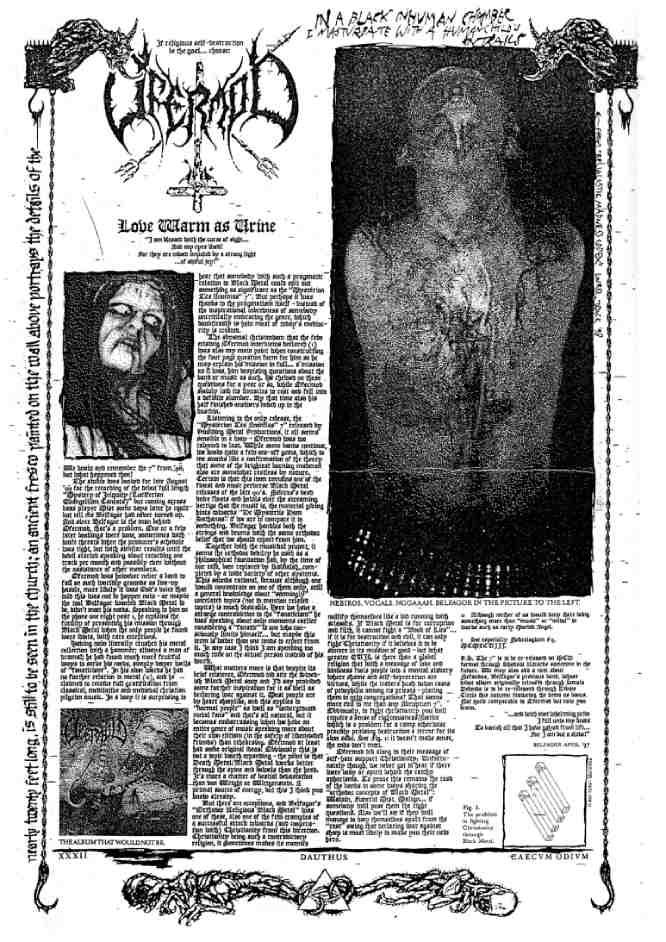
After the EP, Shadow Records signed OFERMOD and announced the upcoming debut album, “Mystery of Iniquity (Luciferian Evangelium Cantata)”. In Dauthus #3, Timo cites bass player Mist’s account that studio time had been booked for August 1999, but Mika never showed up. ‘And since Belfagor is the man behind OFERMOD’, Timo notes, ‘that’s a problem.’
MIKA: That’s just made up – no studio time was ever booked. Mist and I had only casually discussed whether he might join OFERMOD on bass, but he never rehearsed with us and didn’t even know what the material I’d written sounded like.
In October 1999, Mika stepped in on drums when MALIGN performed with WATAIN and DARK FUNERAL in Uppsala. A memorable evening on several counts – not least because it was the last time I’d see him for many years.
MIKA: I’d started hating all these so-called Satanists popping up everywhere and thought, ‘Fuck this, the whole thing is just make-believe – a façade.’ Meanwhile, after extending my occult studies into Hermetic Kabbalah, I had two powerful revelations. I’ve already told you about the first: the one I based “Khabs Am Pekht” on.
The vision came to Mika as a lucid dream: emerging out of a formless black dragon in primordial chaos, he descended emanation by emanation until becoming flesh. The imagery mirrors the Kabbalistic passage through the Sephiroth – the ten stages by which divinity transforms into matter.
MIKA: The other revelation came as a nightmare of Jesus Christ – three kilometres tall, surrounded by millions of angels singing His praise in voices of heavenly beauty. Truly the most horrifying sight I’ve ever witnessed; I woke up drenched in sweat and absolutely terrified.
When was this?
MIKA: Probably in 2000? Towards the end of my time in Stockholm, anyway. I told Robban (WEREWOLF) about it, and he got all paranoid and asked, ‘You’re not becoming Christian, are you?’ – ‘On the contrary, it was a dreadful experience.’ Nevertheless, an extensive dry spell followed during which I wrote no music whatsoever.
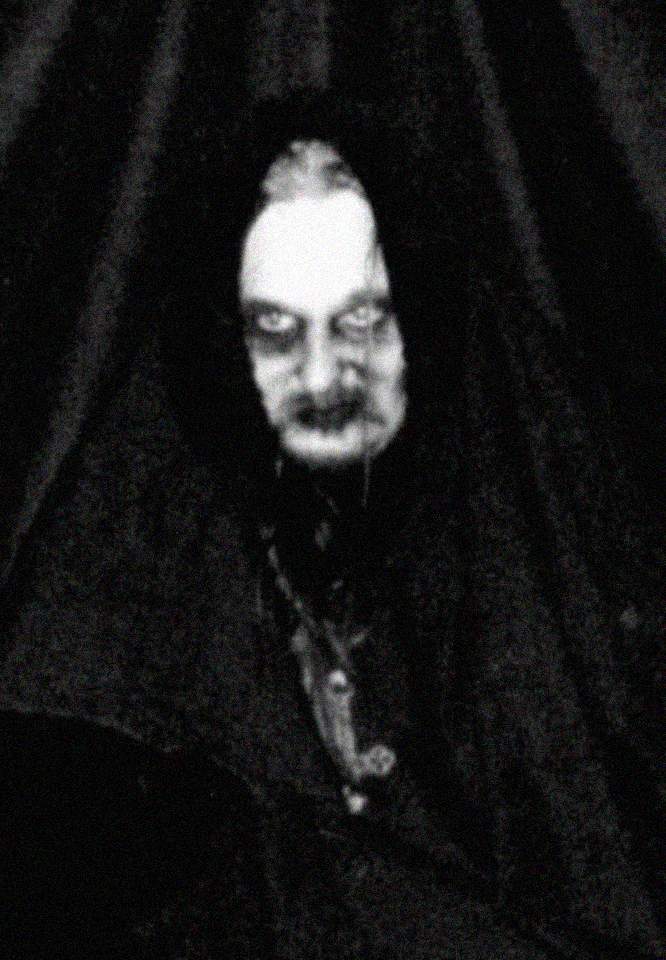
After the millennium shift, pretty much everyone I knew lost touch with Mika. However, according to the Dauthus #3 piece, he and Timo spoke over the phone in 2001.
MIKA: Did we? In 2001? Honestly, I have no idea what we would’ve talked about.
At a guess, Timo was probably inquiring about the Dauthus feature. He had a track record of hounding musicians who failed to answer his interview questions – Garm of ULVER being a notable early example.
Timo writes that Mika’s withdrawal from both the interview and black metal came down to disillusionment, describing him as ‘always a man of drama’ who had ‘now literally crushed his metal collection with a hammer’.
MIKA: <laughs> True. I piled my records on the floor and smashed them until nothing but shards remained. Pure spite, really. I’d poured heart and soul into creating sacred art – dark music dedicated to the Devil – only to watch lesser acts aping some mediocre band outsell OFERMOD a thousand times over.
It’s hard to imagine now, but “Mystérion Tés Anomias” went largely unnoticed for years. Recognition only came once the next generation of bands, such as WATAIN and ONDSKAPT, began citing OFERMOD as an influence.
MIKA: Obviously, getting rid of everything related to black and death metal carried symbolic weight – severing myself from that world. I spared “A Blaze in the Northern Sky” (DARKTHRONE) on LP and “De Mysteriis Dom Sathanas” on CD, though. Those two stayed with me the longest. Eventually, they disappeared as well.
For Timo, the band’s collapse made a certain kind of sense: ‘OFERMOD was too talented to last.’ It confirmed a theory of his, that ‘some of the brightest-burning madmen are also somewhat restless by nature.’
MIKA: He does have a point – take a band like VON. They came out of nowhere with that 1992 recording, only to vanish again… I think? I haven’t heard anything newer than “Satanic Blood”, “Blood Angel”, or whatever it’s called. Is there more?
Nothing worth hearing, trust me.
MIKA: On the other hand, look at FUNERAL MIST. Rostén only improves over time – constant innovation, where you find yourself thinking, ‘How the hell did he come up with that perverted riff? What inspired him to write this?’ Very few artists pique my curiosity about the origins of their art.
Before losing touch with the Stockholm circle, Mika wrote a lyric for FUNERAL MIST’s “Salvation” – “Across the Qliphoth”, his first text to draw thematically on Hermeticism.
MIKA: I was locked up when “Salvation” came out, so I only heard it afterwards. I felt immense pride in having made even a modest contribution to FUNERAL MIST; that’s how highly I regarded the band.

MIKA: Drugs entered my life as a young adult – immature in every respect apart from being well-versed in religion, philosophy, and so on. Meanwhile, I… I’m entirely impulse-driven, and the impulses driving me leaned more toward making a name for myself as an outlaw than as a musician. I simply embraced a criminal lifestyle full-time.
During the late ‘90s, in interviews and private conversations alike, Mika staunchly echoed Euronymous’ decree that ‘drugs’ were for the weak-minded. Yet while scene disenchantment and theological reorientation certainly played their part, pharmacology would profoundly shape the trajectory of both OFERMOD and his personal life.
Mika pursued this new fixation in characteristically ardent fashion. He began experimenting with cannabis, amphetamine, and cocaine in 2000; barely a year later, he’d developed a heroin habit.
MIKA: Once addiction enters the picture, you have to commit crimes simply to afford staying reasonably functional. And the whole heroin experience brings plenty of new acquaintances and opportunities to ruin yourself – but also to be happy, in a way.
Be happy?
MIKA: I mean, every now and then, if you come into some money, there are stretches where you have so much dope you don’t need to hustle. Calm, pleasant days without a care in the world – when your entire existence revolves around heroin, nothing else matters.
Were you back on the SSRIs during this?
MIKA: Doctors tried every antidepressant going, but nothing worked. They wanted to medicate the violence and aggression out of me. It wasn’t until I got onto things like benzodiazepines and Imovane, shit you get a bit woozy on, that I could find a kick in something other than hurting people. Don’t ask me why, though – I suppose it stems from the way I grew up.
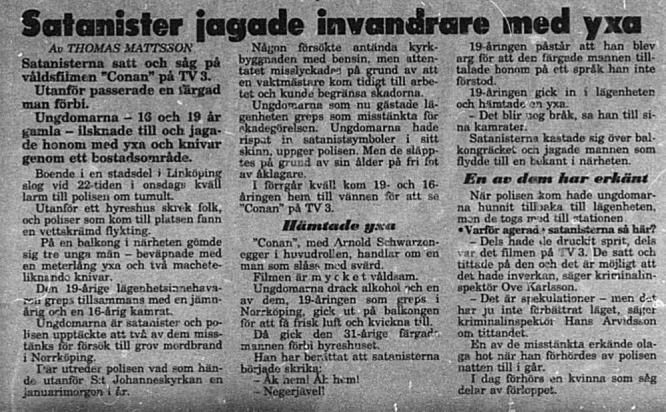

Mika’s childhood was permeated by violence both at home, courtesy of an abusive stepfather, and on the streets outside.
Born in Sweden to Finnish parents, Mika spent his early years in Navestad, a multicultural housing district – not unlike Brandbergen, where Timo grew up – of Norrköping, known for high crime and ethnic tensions. He struggled to make friends and spoke no Swedish until starting school.
MIKA: It wasn’t all bad. When I came of age, there was still some honour among thieves – they left kids out of it. These days, gangs recruit twelve-year-olds. Involving children in anything, whether transsexuality or criminality, crosses a line for me. Either way, I don’t follow other people’s moral frameworks; I use my common sense.
Which is, in no small part, shaped by formative years spent taking ‘90s black metal seriously, right?
MIKA: Yes, absolutely; that’s how I first got started as an outlaw! <laughs> Before I matured from those early years of shady business into a more serious criminal, Satanism was central to everything I did – deeds carried out in the name of black metal.
While the 1997 arrest marked Mika’s first extended stay behind bars, he was certainly no stranger to law enforcement.
In February ‘95, one such intervention was covered by Swedish tabloid Expressen under the headline ‘Axe-wielding Satanists hunted immigrant’. The story noted that the young men – both bearing Satanic symbols carved into their skin – were already being investigated for church arson. Earlier still, Mika had been convicted of grave desecration alongside members of MARDUK.
MIKA: Once I rid myself of those guiding principles that dictated my every step, I became open to impressions from all kinds of cultures and individuals. Even negroes who dress in women’s clothes in the calm seclusion of their homes, unseen by the outside world.
What?
MIKA: <laughs> I’d befriended my Somali neighbour, and he wore a yellow dress when I came over. It looked like women’s clothing but was actually a traditional African men’s garment. My point is that I didn’t lose respect for him and still saw him as a decent guy. Especially after he saved me from being axe-murdered by his own cousin.
Come again?
MIKA: To be fair, I did attack the cousin in question with an axe first. These three Somali gangsters broke into my apartment… or rather, opened the front door using my spare key – which I’d given them. It was a complicated situation.
Feel free to start with the decision to give them your key.
MIKA: That was to make them trust me not to waste their money on anything other than what they’d ordered. See, I went to Stockholm to pick up two hectos of hashish from another group of Somalis – but I got ripped off. Instead of hash, they handed me some fucking piece of wood wrapped in foil.
I’m guessing you lacked the funds to reimburse your associates back home.
MIKA: Exactly. So, I spent the last of my own money on heroin, which I injected in a public toilet. I didn’t know what to do, because these Somalis were dangerous fuckers. Coming back without their drugs, after giving them my house key… I just couldn’t face it. Four or five days passed, and eventually I had to go home.
log in to keep reading
The second half of this article is reserved for subscribers of the Bardo Methodology online archive. To keep reading, sign up or log in below.
Related reading