Liber Ketola XIX
2026-06-10
by Niklas Göransson
With Fas – Ite, Maledicti, In Ignem Aeternum, the second era of Deathspell Omega took its most radical expression. Timo Ketola gave visual form to an album that opened itself only to those willing to pay the price of patience.
TIMO KETOLA: The best artworks are made fast and focused. “Fas…” came together in more or less two weeks; I sketched and coloured about ninety percent of the front cover during Easter week in Athens, 2007. I told Christian I was going to Greece, to which he said, ‘Finish it on Mars if you want, as long as it’s ready by April 10!’
For all Timo’s otherworldly gifts – as the DEATHSPELL OMEGA “Fas – Ite, Maledicti, In Ignem Aeternum” cover attests – punctuality could hardly be counted among them. The tone of Christian’s reply gives me the distinct impression that April 10 was less the original deadline than a last-ditch one: the immovable point past which further delay had become untenable.
CHRISTIAN BOUCHÉ: It’s possible, but I honestly couldn’t say. The recording and mixing sessions for “Fas…” were among the hardest we ever went through; my exchanges with Timo took place alongside that gruelling process, which is why I don’t have many specific memories of them.
This toiling was the culmination of a trajectory set in motion five years earlier. By 2002, the first era of DEATHSPELL OMEGA had run its course – a transition abrupt enough for an entire album’s worth of recorded material to be discarded in favour of “Si Monvmentvm Reqvires, Circvmspice”. Its song structures remained relatively simple and riff-based, but the character of the riffing shifted, as did the interplay between guitars, bass, and drums. Chants, choir passages, and tape-manipulated textures were woven into the music’s architecture.
CHRISTIAN: I would describe “Si Monvmentvm…” as DEATHSPELL OMEGA’s tipping point: once we’d stumbled past it, the fall only accelerated. It took me ten years to go from writing a single hesitant riff on the HIRILORN demo to conceiving and composing “Fas…” – a journey marked by a series of accelerations and metamorphoses.
After “Si Monvmentvm…” came “Mass Grave Aesthetics” and “Diabolus Absconditus” – two standalone epics of roughly twenty minutes each, both shelved once the band concluded it had not yet found the means to realise them. The missing element proved to be sound manipulation. Where “S.M.R,C”. threaded liturgical fragments through the music, these pieces used effects, samples, and warped textures to push the compositions further. “Kénôse” marked the next stage: the material grew more expansive, and the dissonance DEATHSPELL OMEGA would become known for first surfaced.
On “Fas – Ite, Maledicti, In Ignem Aeternum”, the most radical expression of the band’s second era, that dissonance moves to the centre. The listening experience is as overwhelming as it is paradoxical: the music sounds like a vortex of chaos, yet every collision is deliberate, scored with cold precision.
CHRISTIAN: People ask me whether some of the material on “Fas…” was improvised, and no: every second of it underwent obsessive rehearsals. I assume that impression arises because the songs’ internal architecture is hard to discern, but we left nothing to chance. Those with a musical background broader than rock will have less difficulty tracing the structures and variations.
“Fas…” seems designed to bewilder the listener and suppress any sense of orientation. The riff-and-repeat approach is almost entirely abandoned: passages rarely recur, and there is little to hold onto rhythmically or melodically. Diminished and minor-second intervals fall deliberately on the strong beats – the ones the body counts along to – precisely where the ear least wants them. The guitars often appear to carry five or six independent lines at once, colliding before they snap into alignment.
CHRISTIAN: A simple rock or metal song is typically built around some variation of an A–B–A–B–C–B structure. Classical music, by contrast, tends to bring themes back only after transforming them – harmonically, rhythmically, texturally. We approached “Fas…” the way we intuitively imagined the classical 20th-century avant-garde composed their works.
CHRISTIAN: Late in the songwriting process, I realised there was still room to include another voice. We were trying to reach a suffocating density, so I wanted to take one more step into extremism by bringing in an additional guitarist – someone who wouldn’t share my grasp of composing, or the instinct behind it.
“Fas…” introduces something rare for the genre: actual guitar solos, built from harmonised dissonant lines rather than conventional scales. These were the work of T.T., drummer and guitarist of Austrian black metal veterans ABIGOR. He and the late co-founder P.K. had shaped the band’s characteristic sound with densely layered, interlocking guitar parts – precisely the sensibility “Fas…” drew on.
CHRISTIAN: I vividly remember how confused T.T. was at first because, as he put it then, he could seemingly play just about any random note over the riffs. This is what happens when you leave traditional scales behind and lose your bearings. I will not speak too much on his behalf, but he described it as a transformative experience – one that made him grow as a musician.
At the time, ABIGOR’s eighth album, “Fractal Possession” – their first new material in six years – was about to appear through End All Life Productions. T.T. had drifted from black metal around the turn of the millennium, but has cited Christian’s work with NoEvDia and DEATHSPELL OMEGA as a decisive inspiration for his return to active musicianship.
CHRISTIAN: I should also mention that I invited Iskandar of ELEND to contribute arrangements to a couple of songs. The logic was the same: bring in another voice with a distinct personality, adding density and depth while nodding further toward classical music.
By the time of “Fas…”, orchestral, neo-classical, and industrial elements had begun working their way into DEATHSPELL OMEGA. Unlike the dungeon-synth-style intros that prefaced so much ‘90s black metal, these interludes were fully realised passages: out-of-tune pianos, layered choirs, drones, and processed soundscapes.
CHRISTIAN: Franck, our producer, helped me arrange many of the experimental elements. I would provide samples, recordings, and precise instructions; he then did what studio engineers are often condemned to do: repair technical missteps and make something clumsily assembled appear professional. All under my supervision – which, I suspect, wasn’t always the most patient.
After DEATHSPELL OMEGA discarded a second fully recorded album in succession – the original version of “Si Monvmentvm Reqvires, Circvmspice” – Christian reached out to an old friend, Franck Hueso, who hauled his equipment into the band’s rehearsal room and set up an impromptu studio. Their collaboration continued through “Mass Grave Aesthetics”, “Diabolus Absconditus”, and “Kénôse”, with Hueso helping give tangible form to Christian’s increasingly specific ideas about sound, colour, and atmosphere.
With “Diabolus Absconditus”, Georges Bataille’s Madame Edwarda had shown how literature could shape DEATHSPELL OMEGA at the level of method. When the composition reached an impasse, the solution lay in the narrative: the story dictated the musical structure. “Fas…” returned to Bataille, drawing on several writings – including Inner Experience, My Mother, Theory of Religion, and The Solar Anus.
CHRISTIAN: His works weren’t linked as directly to the music on “Fas…”, no. The lyrics draw on many more things – and so we had it at heart to incarnate the whole conceptual experience rather than a few excerpts from Bataille. The thematic content is labyrinthine, and there’s a coherence in how composition and text interact.
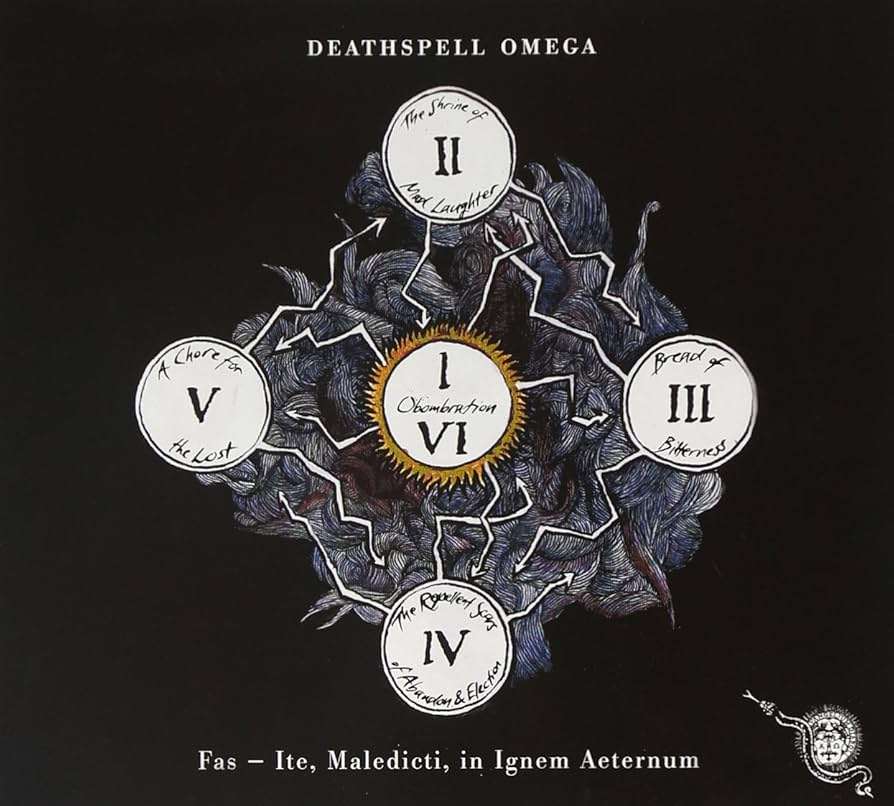
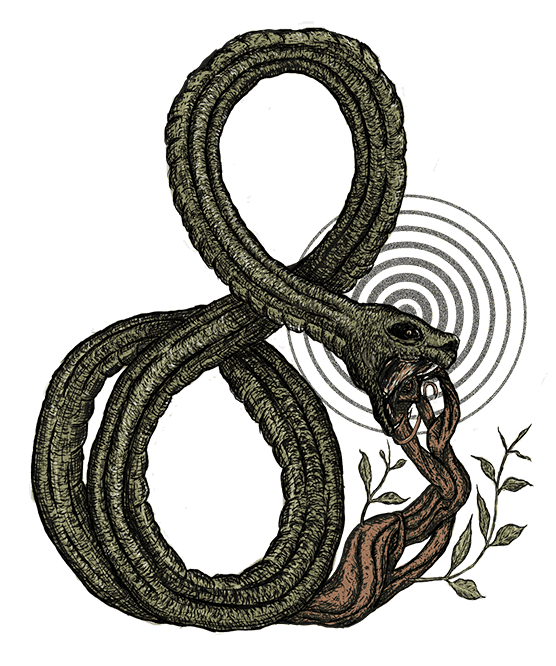
That serpentine quality is made visible in the album’s back-cover design. Although streaming services tend to list the opener and closer – both titled “Obombration” – as “Pt. 1” and “Pt. 2”, the physical edition tells a different story. Tracks I and VI fuse into a single node at the centre, with the four remaining songs set around it at the cardinal points and white arrows tracing the paths between them.
This is no mere graphic conceit. The opening riff of “Obombration” was the first Christian wrote for “Fas…”. From there, the album moves outward through the surrounding compositions before folding back to its point of origin, closing the circuit.
CHRISTIAN: There were many moving parts, and the structure on the back cover proved one of the harder aspects to resolve. It was meant to suggest simultaneity: everything described in the lyrics occurring at once, rather than unfolding in the linear fashion we usually associate with time. We had to think long and hard to solve that aspect and eventually found a way forward in the works of Jacob Böhme and Dionysius Andreas Freher.
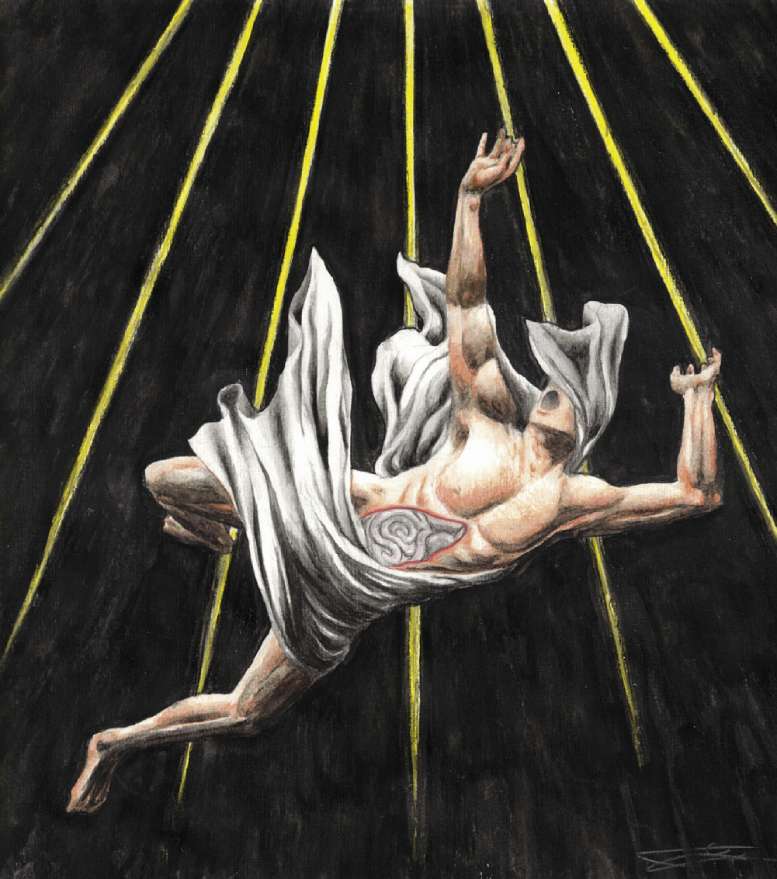
The “Fas…” cover depicts humanity’s condemnation by an all-powerful God – mankind defined by perpetual falling, fragility, and a doomed yearning for redemption. It is a direct visual translation of the album’s theological framework.
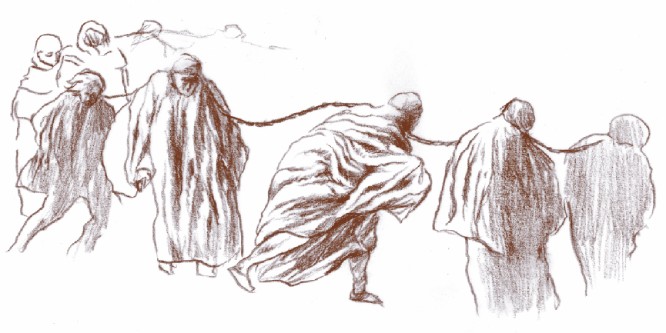
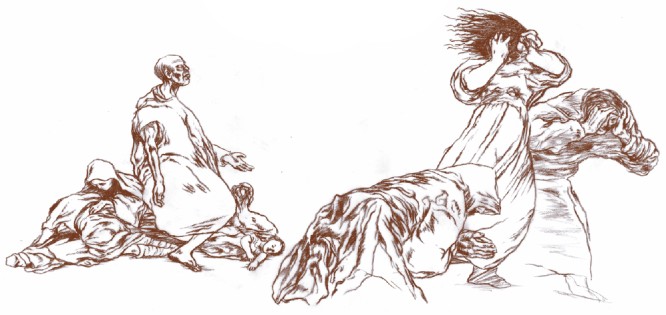
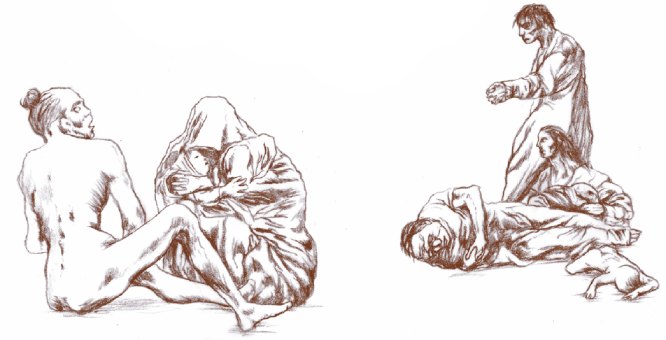
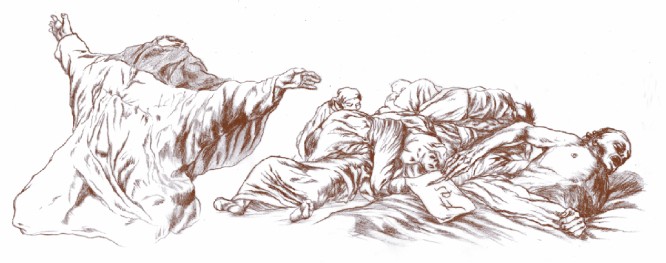
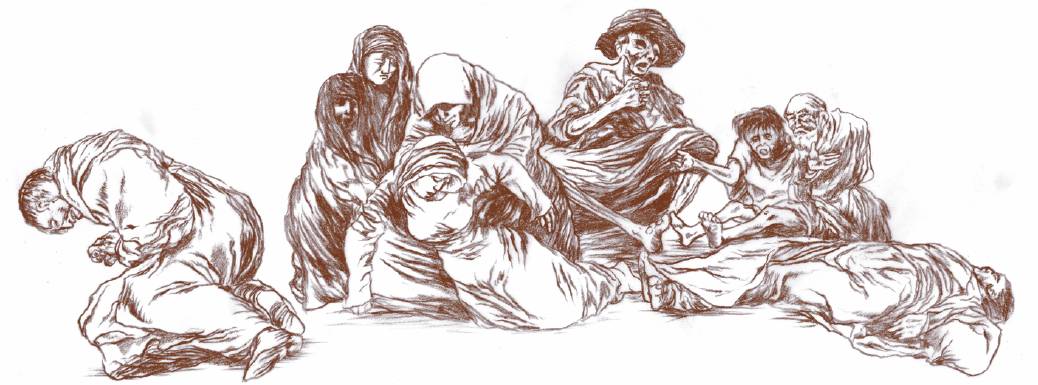
TIMO: The circular gatefold frames were drawn by me, but the band provided the artwork itself. The illustrations inside I hand-copied from Francisco Goya’s Caprichos – not a solution I was entirely happy with, yet preferable to the low-quality reproductions we originally had available.
CHRISTIAN: I sent Timo a selection of Goya’s work: The Caprichos, The Disasters of War, and perhaps Los Disparates as well, though I’d have to check. He used tracing paper, which was probably something of a compromise for him, yet I found it interesting to reference Goya not by reproducing his works directly, but by reinterpreting them slightly.
TIMO: Since we’d agreed there would be no credits, I allowed myself the misstep of copying someone else’s work. That said, our working methods have fortunately evolved over the years – we wouldn’t do this today. The boundaries between designer and artist were blurry back then, and the album always came first.
CHRISTIAN: Timo’s iterations are close enough to the originals that anyone familiar with Goya would recognise them immediately. Those lightly reworked pieces were always intended, at my request, to form the backbone of the booklet – though I don’t remember what additional work Timo may have had in mind. We probably discussed other designs, ones only worth keeping if they added something meaningful to the overall visual narrative.
I’m assuming there were extensive deliberations about both the artwork and thematic content – but did you and Timo discuss the music itself?
CHRISTIAN: The concept and visual side? A lot. The music itself, not much upfront. I tried to describe my ambitions, just to give him a sense of what the album would sound like – but I don’t recall any substantial feedback from Timo until later, when he finally had the vinyl in his hands.
TIMO: I grabbed the LP, sat down on the living room floor in front of the speakers, and listened through the whole album while reading the lyrics. I was sceptical when Christian said it would be even faster than “Kénôse” – but lo and behold, it worked. The music opened like a flower, one that keeps opening with time. In fact, “Fas…” remains among my favourites.

Timo’s description will likely ring true to many who have spent time with “Fas…”. The first encounter is meant to defeat you – that is the point. Too fast, too chaotic, too dissonant: an overload of information arriving all at once. Yet repeated listening reveals nothing arbitrary about it.
CHRISTIAN: Music doesn’t necessarily have to be a series of immediately memorable hits. It can serve almost any purpose, sometimes opening gates to other dimensions for those willing to put in the effort. “Fas…” was always meant to be a world of its own – one you’re granted access to only after paying, in most cases, some price in patience.
Beneath the hostile crust runs an order closer to concert halls than a rehearsal room. What first strikes the ear as a single wall of squealing distortion gradually separates into independent guitar lines, each moving with its own purpose – and once you have learned to follow them, buried melodies rise to the surface.
CHRISTIAN: I wouldn’t say I followed any kind of system, at least not in the academic sense – more what I’d call a colour. It came from sensation rather than theory: certain chords or harmonies vibrate in a particular way, which makes them appropriate for expressing a given emotion.
Leading up to “Fas…”, Christian immersed himself in contemporary classical composition with single-minded focus, listening to certain recordings twenty or thirty times in succession until their internal logic began to disclose itself.
CHRISTIAN: I could name a number of composers who influenced that album – Ligeti and Schnittke among them – but really, everything comes down to Penderecki and Wyschnegradsky. There is no “Fas…” without those two fine gentlemen; they opened all kinds of doors for me.
Krzysztof Penderecki gave Christian a way of treating dissonance as texture and atmosphere, rather than mere harmonic tension. Ivan Wyschnegradsky, in turn, opened his ears to microtonality – the expressive potential of notes falling between the fixed pitches of conventional Western tuning.
CHRISTIAN: It took no effort on my part to focus so monastically on their work – it is simply so fascinating, so dense, and so appropriate to the state of mind I was in at the time that everything else felt comparatively uninteresting. I’ve always tended to fixate on certain records; whether it’s “Hvis lyset tar oss” (BURZUM), “Köhntarkösz” (MAGMA), or “Leichenlinie” (GENOCIDE ORGAN), each listening experience remains as rewarding as the first.
You described your understanding of noise and industrial music beyond Cold Meat Industry and GENOCIDE ORGAN as fairly rudimentary around 1998. Had that changed in any meaningful way by the mid-2000s?
CHRISTIAN: It’s a constant process of discovery, and I was certainly further along by then, yes. Even today, I lack the encyclopaedic knowledge of the industrial scene that Mikko and Mikołaj (MGŁA) possess, partly because I’m quite selective in my tastes. Let’s put it this way: most noise does nothing for me, whereas I could speak endlessly about a record like I.R.M.’s “Closure”, which I consider a masterpiece.
“Closure” appeared in 2014 as the concluding part of an I.R.M. album trilogy. By then, the Swedish project had moved beyond direct power electronics into something more theatrical and psychologically charged: layered drones, atonal bass, agonised vocals, and a strong sense of narrative dread.
CHRISTIAN: I also tend to obsess over the bands I find relevant and ignore the rest, simply because I prefer returning to those that truly impress me. And if there absolutely must be a hierarchy, I know far more about classical composition than I do about industrial music.
It occurred to me that the three records Christian mentioned – “Hvis lyset tar oss”, “Köhntarkösz”, and “Leichenlinie” – each seem to occupy one corner of “Fas…”: BURZUM at the blackened core, MAGMA in the progressive structural ambition, GENOCIDE ORGAN in the noise manipulation.
CHRISTIAN: I wouldn’t call any of them a direct influence, no. If I had to sum it up, it’s Wyschnegradsky and Penderecki, plus what I’d absorbed from more than a decade of absolute black metal devotion and fanaticism. That really was the core of our work in 2007 – the abominable spirit lurking over it all. The rest rank infinitely lower.
CHRISTIAN: Franck needed a little time to grasp what we were doing on “Fas…”, but the three of us had rehearsed the material for months on end. During tracking, we could immediately sense when the intensity reached its apex and judge whether our interpretation felt radical enough. Then we’d listen back to each take in complete focus; that was always the moment of truth.
You mentioned the mixing as even more brutal than usual – why was that?
CHRISTIAN: Mainly due to the huge and perhaps even excessive number of tracks. Guitars alone, counting rhythm, lead, and effects – a vast category in itself, since we experimented a lot – ran to no fewer than three or four dozen per song, if memory serves. The basslines, too, were rich and creative, deserving room to be heard. The drums proved especially difficult: we wanted to preserve their natural dynamics while giving them power and presence. I was particularly focused on that instrument, which shows in its prominent place in the mix.
That prominence makes it clear how unusual the drumming is, moving between intense but sophisticated percussive carnage and overtly prog-inflected patterns.
CHRISTIAN: It became clear early in rehearsals: the drums had to sit high in the mix. One moment, our drummer was bestially demolishing his kit in physically violent blast beats, the next all jazzy finesse – and that contrast felt like the thing meant to define the album.
This defining dynamic would also become one of the album’s main technical ordeals. In that sense, the mixing process was almost an extension of the compositional challenge: the sudden movement from annihilating force to intricate, almost delicate playing had to survive the studio without being flattened into a single texture.
CHRISTIAN: Drums can convey a great deal of musicality and intention. Of course, that capacity vanishes when they’re entirely sterilised with triggers and samples, as is sadly customary in modern metal. It’s an instrument rarely used to its full potential in our genre, so we tried to let it breathe – and at some distant point, we finally found the right equilibrium.
How long did the mixing take?
CHRISTIAN: A full month. Throughout, I remember waking each morning with my heart racing – as if I’d been running, despite having slept only moments earlier. That sensation would then follow me through the rest of the day. Toward the end, I had to consciously focus on my breathing just to regain some measure of control.
“Fas – Ite, Maledicti, In Ignem Aeternum”, Latin for ‘Divine Law – Go, accursed ones, into the eternal fire’, exacted a heavy toll. Just as it demands a price of listeners, the music asked no less of its composer – and this cost feels inseparable from the record’s later standing. “Fas…” became one of DEATHSPELL OMEGA’s defining works, praised by critics and fans alike, and named album of the year by Terrorizer.
CHRISTIAN: You have no control over an album’s reception, so I never spent much time thinking about it. Sometimes a work of art just meets its audience, I suppose. But “Fas…” making album of the year in Terrorizer – ahead of MAYHEM and NEUROSIS – is one illustration of something we most assuredly weren’t expecting.
log in to keep reading
The second half of this article is reserved for subscribers of the Bardo Methodology online archive. To keep reading, sign up or log in below.
Related reading