Liber Ketola XXI
2026-06-24
by Niklas Göransson
In 2008, Timo Ketola served Deathspell Omega in two directions at once: the new Chaining the Katechon and the unreleased Manifestations 2002. One looked forward, the other consecrated a chapter the band had long since closed.
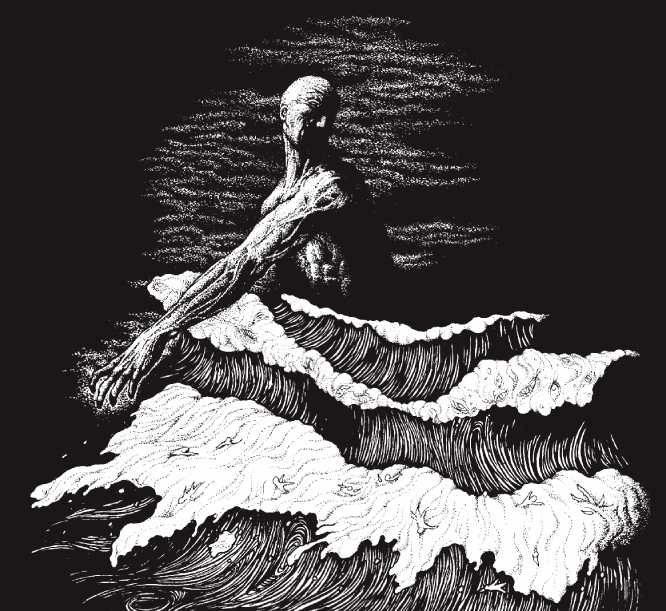
Deathspell Omega artwork by Timo Ketola
TIMO KETOLA: “Fas…” stood out as one of the most exhaustive commissions to date, and I was duly compensated – it covered more than two months of rent and marked an important episode in turning this into a full-time job. Then, the first clients who turned me down for being too expensive felt like confirmation of having ‘arrived’: finally putting a proper price on my work.
CHRISTIAN BOUCHÉ: The question of fair compensation came up many times over the years. Timo regularly asked me what to charge for a given job, and my answers were always sobering: never as much as he deserved, considering how generous he was with his time.
TIMO: Distracted-artist characteristics aside, I had a fair clue. Keeping rates low was never a matter of lacking self-confidence, but partly a strategy for getting my work out there. Once it becomes a day job with taxes to pay, you either need to be inhumanly fast and efficient, or simply charge what you’re worth.
CHRISTIAN: Once Timo agreed to a commission, he’d treat it as something of genuine artistic importance – not a task to rush through simply to collect payment. The difficulty was the precarious economics of underground projects, with some exceptions. Had he worked in more mainstream musical spheres, his financial life would undoubtedly have been easier.
Norma Evangelium Diaboli released “Fas – Ite, Maledicti, In Ignem Aeternum” – DEATHSPELL OMEGA’s fourth studio album and the second instalment of their theological trilogy – in July 2007.
By underground standards, it was a genuine success – commercially as well as critically – on both sides of the Atlantic. Terrorizer named it album of the year, while Decibel Magazine ranked it eleventh in its Best of 2007 issue and later placed “Fas…” at number forty in their Top 100 Greatest Metal Albums of the 2000s, between CONVERGE’s “You Fail Me” and PRIMORDIAL’s “The Gathering Wilderness”.
CHRISTIAN: Working on the label side, I was necessarily aware of what the attention brought – you cannot overlook the increased volume, the new distribution demands of outlets that had previously ignored us. But I lacked the mental bandwidth, and frankly the interest, to look up reviews or anything of the sort. Now and then, friends would forward a worthwhile response, not least from musicians I admired.
By this point, DEATHSPELL OMEGA had achieved what many artists spend decades pursuing – critical acclaim, strong sales, wider distribution, and recognition from musicians far outside the underground – while remaining entirely faceless.
CHRISTIAN: Everyone involved with DEATHSPELL OMEGA’s albums deserves credit for their selfless efforts and incredible commitment of time, energy, and focus. But our reason for doing it was entirely intrinsic: we believed that what we did mattered above all else. Perhaps the best way to describe this approach is as autotelic work.
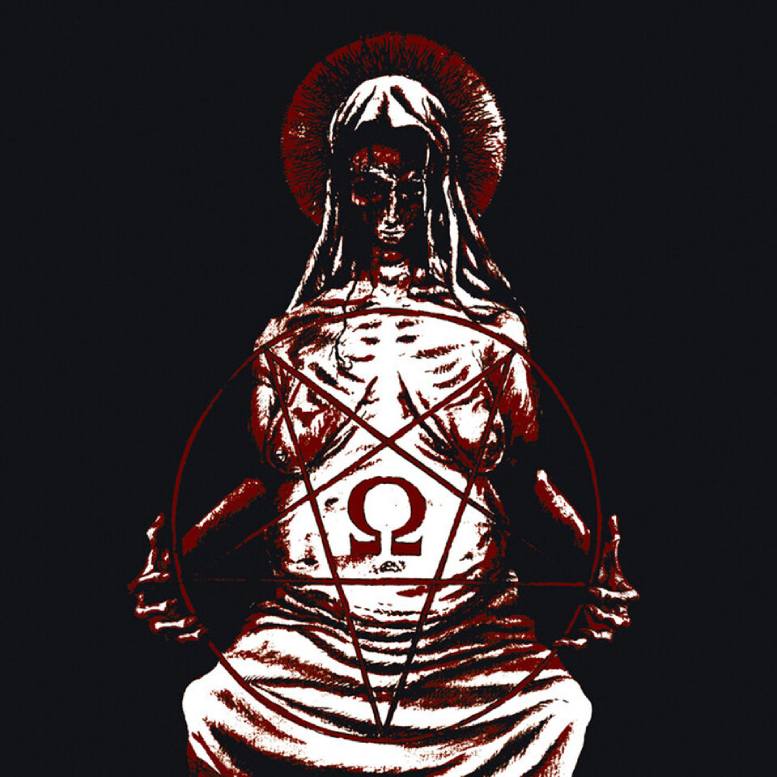
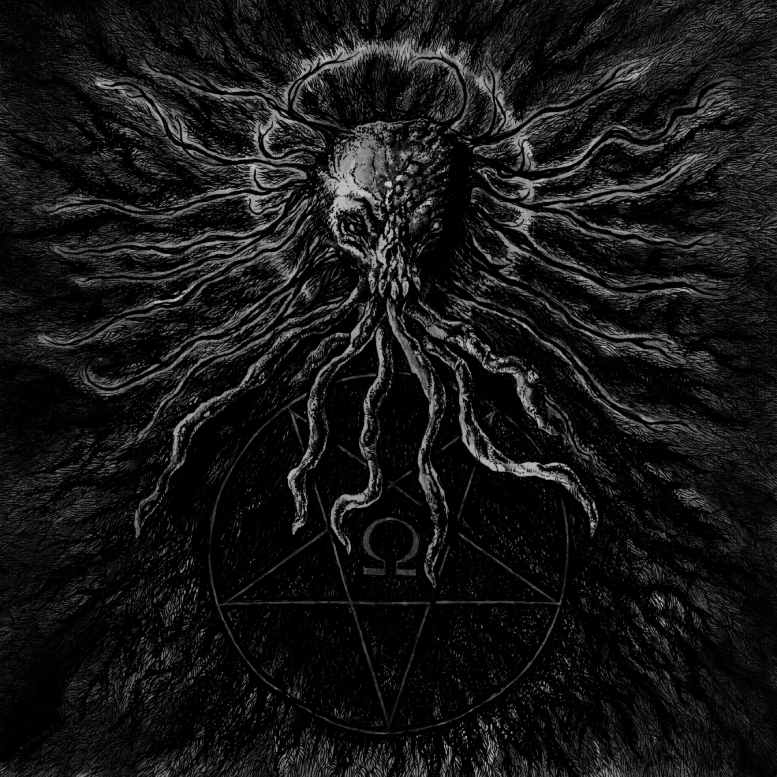
Alongside that rising prominence came curiosity about the band’s first era. Northern Heritage had already reissued the once vinyl-only “Infernal Battles” and “Inquisitors of Satan” on CD and kept them in print. In March 2008, the same Finnish label issued “Manifestations 2000–2001”, gathering DEATHSPELL OMEGA’s contributions to the MÜTIILATION and MOONBLOOD splits, along with “Black Crushing Sorcery” from the “Black Metal Blitzkrieg” compilation.
CHRISTIAN: Each release is part of DEATHSPELL OMEGA’s past, of our evolution, and all of them were necessary to make us what we are today. As such, while I do maintain a critical approach – which is healthy – acting as if this material did not exist would’ve been contrived and unnatural.
I remember you referring to the MOONBLOOD split in particular as almost regrettable.
CHRISTIAN: Not regrettable per se; rather, it is the one part of our discography with an objective flaw: the drumming, and the way it dragged down songs that, in hindsight, could have been better. The two tracks from the MÜTIILATION split, by contrast, are among my personal favourites of the first era – which balances things out.
“Manifestations 2002” arrived the same day, and this one is a different story altogether. I assume most listeners had no idea there was completed, unreleased DEATHSPELL OMEGA material from the first era.
CHRISTIAN: I have no specific recollection of the reception, sorry. When those compilations came out, I was entirely focused on work, very reclusive, spoke to few people, and probably didn’t even read emails that weren’t of direct relevance to my activities at the time. Timo liked “Manifestations 2002” a lot – this I do remember, however.
Originally recorded between “Inquisitors of Satan” and “Si Monvmentvm Reqvires, Circvmspice” for splits that never materialised, the “Manifestations 2002” material occupies the seam dividing DEATHSPELL OMEGA’s first and second eras.
The old malice still lingers: Shaxul’s rasp, chilling tremolo-picked riffs, and the DARKTHRONE-derived austerity of the early records. But the songwriting has begun to drift from that template; the songs stretch longer, leaning on drone and repetition to build atmosphere. While the leap to “Si Monvmentvm…” would be massive, the trajectory was already drawn.
CHRISTIAN: We came to terms with the material only after completing several further recordings – ones embodying the ambitions we carried and defining far more clearly who DEATHSPELL OMEGA were. In a sense, once we’d driven the point home, it felt entirely natural to revisit what was, by then, a closed chapter. It is a valuable part of our history, and arguably the apex of the band’s first era.
There is an interpretation of “Fas – Ite, Maledicti, In Ignem Aeternum” as a terminal statement: that dissonance and formlessness had been driven about as far as they could go before the music stopped being music at all, leaving nowhere to go but back.
CHRISTIAN: I have an analytical mind when it comes to music, and I knew the formula behind “Fas…” – but not how to surpass it using the same instrumentation. So, in a sense, yes: that road felt as though it had reached its logical end. Penderecki, after leading the avant-garde for fifteen or twenty years, moved to a more neo-Romantic, historical idiom.
Krzysztof Penderecki spent the better part of two decades at the head of the postwar avant-garde, writing music so abrasive it required new notation to capture it. Then, with the “Violin Concerto” of 1976, he turned back towards tonality – a shift many in the new-music world read as capitulation, even betrayal. Penderecki saw it otherwise: having pushed sonorism as far as it would go, the genuinely creative move was to reopen doors he’d once sealed.
CHRISTIAN: Don’t get me wrong: I am drawing no comparison between this absolute master and ourselves. However, as a younger man, I spent a fair amount of time pondering Penderecki’s career moves. Ultimately, it comes down to what holds the most profound meaning, and what you need to express at a given point in your life.
The December 2008 split “Veritas Diaboli Manet In Aeternum: Chaining the Katechon” united DEATHSPELL OMEGA and S.V.E.S.T., a French black metal band with roots in the End All Life Productions catalogue.
CHRISTIAN: Spica of S.V.E.S.T. is a close comrade of mine going back a quarter of a century. He is exceptionally intelligent and comes from a scientific background, so our perspectives tend to differ, but that makes for fruitful discussions – of which there have been many.
DEATHSPELL OMEGA’s contribution, “Chaining the Katechon”, runs twenty-two minutes and plays almost like three linked movements. The track admits several elements that “Fas…” had largely kept out: recurring passages, groove, slow doom-like heaviness, rare flashes of catchiness, and discernible melody.
CHRISTIAN: Why does the music sound the way it does, exploring territory the previous recording didn’t? The answer is in the question: we don’t like to repeat ourselves. We obviously work within our own musical world, but we adapt the songwriting to what the lyrics and concept demand. And the longer the song, the more room there is for unexpected combinations while still holding a common narrative thread.
On “Chaining the Katechon”, the production balance shifts away from the drum-forward sound of “Fas…”. The bass sits unusually high, even taking the lead in places, and often fuses with the guitars into a single mass.
CHRISTIAN: We tend to conceive of the bass as a hybrid – somewhere between its traditional role and that of a second guitar. Since we rehearse as a trio, there’s room for it to fill this function, which is quite a stimulating way to approach the instrument.
This song is sometimes referred to as a musical bridge between “Fas…” and “Paracletus” – would that be a fair assessment?
CHRISTIAN: I suppose there’s both an element of evolution and a sense of continuity from one recording to the next. Certain guitar techniques first used on “Kénôse” resurfaced, in altered form, on “Fas…”. Ideas introduced in “Chaining the Katechon” were further developed in “Paracletus”. At the same time, we consciously forbade ourselves particular patterns and chords we knew worked well – precisely because they had come to define the identity of an earlier record.
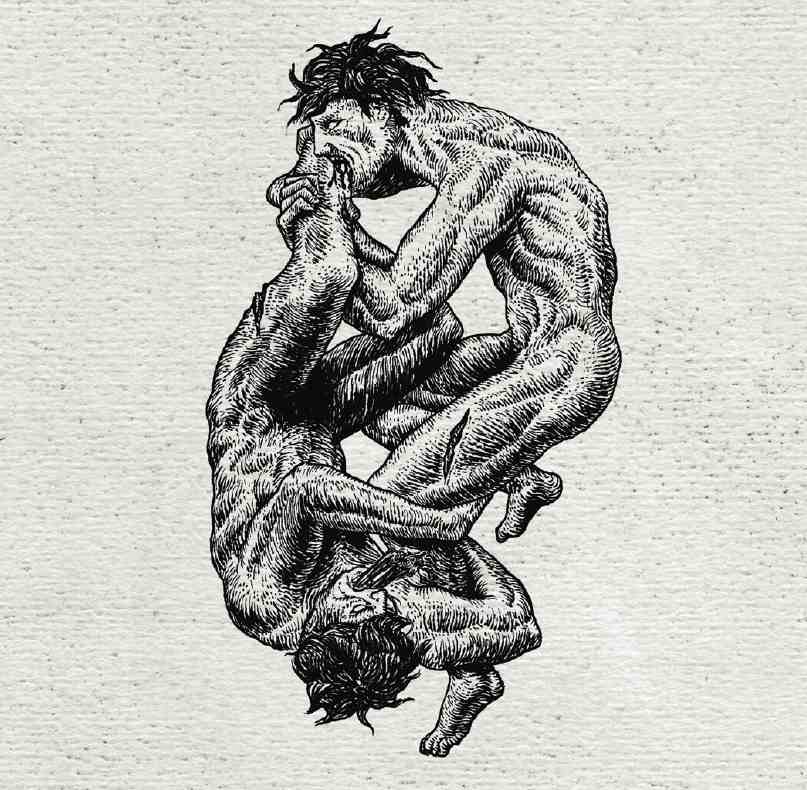
Timo’s cover depicts two emaciated figures locked head-to-foot in a vertical loop. The upper one bites down on a leg; the inverted body beneath tears a strip of flesh from its counterpart.
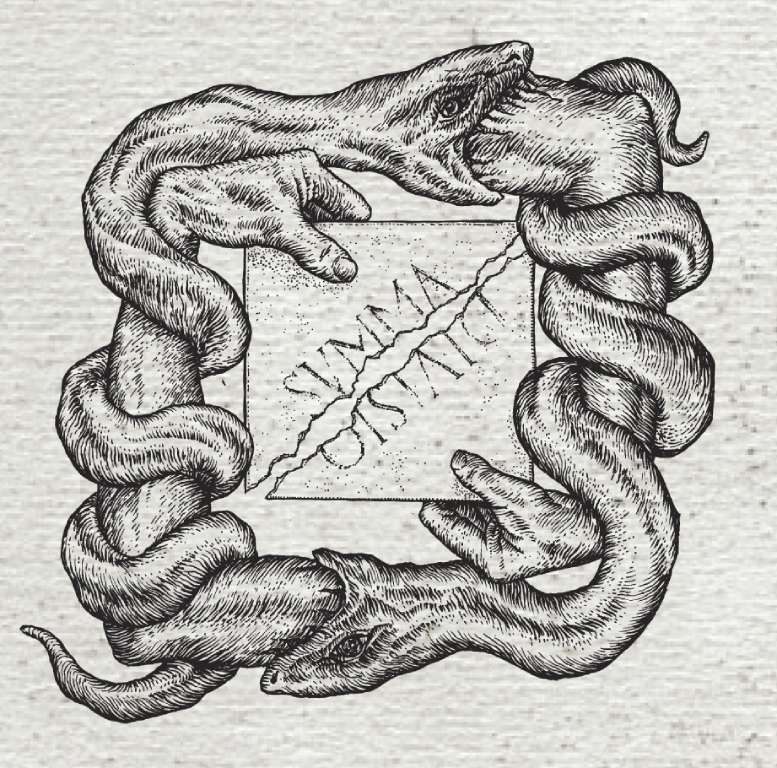
CHRISTIAN: The front concept came from a sketch drawn by Spica, then reinterpreted by Timo. The back referenced a structure by Escher, although I don’t remember who first brought it up – I suspect Timo. Conceptually, my main request was grounded in the idea of the summa divisio, the fundamental division, applied to the domain of theology.
Rendered in the same dense engraving style as the front, the back cover sets twin serpents and two human limbs into a rough square. Each serpent bites down on one arm while its body coils around the other; both pairs interlace, elbows bending at the corners, hands reaching inward to grip a stone tablet split clean apart by a jagged fracture that tears the words ‘summa divisio’ asunder.
The summa divisio, originally a term in Roman law, is the primary division within a system – the irreducible binary from which all subordinate categories descend. Applied to theology, it sits at the threshold between divine and diabolical.
The Latin part of the title, ‘Veritas Diaboli Manet In Aeternum…’, inverts a line from the Vulgate psalter – replacing Domini with Diaboli so that it reads ‘the truth of the Devil remains forever’. The Katechon itself is a contested theological concept, but DEATHSPELL OMEGA’s interpretation appears to draw on the eschatological dimension of 2 Thessalonians: the force restraining the Antichrist’s manifestation.
CHRISTIAN: I won’t be explaining any of the lyrics in detail; this is one of my red lines. We’ve already given a number of interviews that added what I feel is sufficient contextual clarity. Over the years, people have risen to the challenge of making sense of them – a great deal of impressive writing can be found online, which only vindicates our approach.
As anyone who’s researched DEATHSPELL OMEGA will know, no other black metal band has anywhere near such a massive body of fan-written work delving deep into the lyrical and visual references. There is an argument to be made that if all meaning had been spelt out when the albums were released, none of this labour-intensive research would have taken place.
CHRISTIAN: Since we’re discussing “Chaining the Katechon” – by sheer coincidence, someone just sent me a Substack link to an in-depth analysis by one Death Verified. It’s a fine example of the impressive writing I mentioned and shows what can be achieved once you’re willing to put in the patience and effort.
Was Timo still reviewing your lyrics?
CHRISTIAN: Yes. With one exception, Timo was always my first reader. On “Kénôse”, I initially asked Tyler Davis of The Ajna Offensive to check the lyrics for obvious mistakes and only brought Timo in a little later. His comments rarely led to changes, but whenever he pointed something out, I knew I had at least to take a second look.
Did he ever contribute thematic ideas of his own?
CHRISTIAN: No, not really. He reacted to my lyrics as an editor: analysing the language and punctuation, occasionally flagging a passage that came across as unintelligible. We did, however, have in-depth discussions on the side, sometimes sparked by what we were working on.

Meanwhile, Timo and Christian were weighing how to release TEITANBLOOD’s “Seven Chalices” across their two labels, Dauthus 1899 and NoEvDia – a question that set artistic priorities, ideological positioning, and practical constraints against one another. At its core lay a single disagreement: whether the LP and CD should appear simultaneously. Timo favoured pressing the vinyl first, arguing it could build momentum and promote the CD to follow.
Christian countered that this logic only held if “Seven Chalices” were treated as a purely underground title, with no expectation of wider recognition. But given the talk of media outreach and impact beyond the underground’s core, issuing the vinyl and promo CDs while delaying the commercial CD made no sense, not least because both discs had to be manufactured together or pressing the former alone would have been distinctly uneconomical.
CHRISTIAN: What troubled me most was the contradiction between the aim and the means. You cannot set out to conquer the scene with one foot on the brakes – and that is precisely the effect of releasing the vinyl alone. Mounting a full promotional campaign, dispatching several hundred CDs, and then withholding the CD from sale until some later date? Strange, and inefficient for no good reason.
NASKO: I try not to express opinions on topics I am neither competent in nor properly informed about – release formats and marketing logistics included. In this discussion, I suppose we could have taken Timo’s approach based on wishful thinking, but perhaps that isn’t grounded in the practical realities of running a commercial operation.
CHRISTIAN: Timo was a pure idealist. I’ve retained my fair share of idealistic dispositions to this day, but long experience in these matters has taught me there are certain necessities. His idea would not have worked.
NASKO: Conceptually, “Seven Chalices” was always meant for vinyl, but I also understand the business side. Of course, with the album being a Dauthus release, it’s like, ‘Oh, so the underground spirit will be branded into everything we do.’ But at some point, that attitude has to give way to the person actually putting up the money to manufacture it.
By this point – after nine months of clinging to the two-song instrumental rehearsal tape – Timo had relented in his refusal to hear the finished album.
NASKO: We’d been stuck on certain artwork ideas for a while. Each piece had countless iterations, and I could feel myself growing impatient, considering everything else was finished almost a year earlier. So, I suggested once again that Timo listen to the music to help him unlock his creative blocks.
And listen he did. For Timo, TEITANBLOOD embodied ideas he had been advocating for over a decade: the abandonment of clarity, structure, and conventional musicality. ‘I must say, “Seven Chalices” makes real all the ranting about DEATH METAL I have seemingly done in vain for years’, he wrote back. ‘This album is not music.’
Given how much of that ranting had played out through Timo’s own writing, it seems Nasko did succeed in his ambition of capturing the Dauthus #3 spirit.
NASKO: Definitely. Dauthus was a huge inspiration, and the way those death metal rants connected with my music felt like the greatest thing that could have happened. But it wasn’t really a matter of heeding Timo’s call – more an organic meeting between his ideas and my total disregard for any standards when I envisioned “Seven Chalices”. It turned into a great match, and that’s why all of this is now a story worth telling.
log in to keep reading
The second half of this article is reserved for subscribers of the Bardo Methodology online archive. To keep reading, sign up or log in below.
Related reading