Liber Ketola XXVII
2026-08-05
by Niklas Göransson
Thirteen years after Timo Ketola and Funeral Mist first joined forces, Maranatha brought their artistic covenant to its final extensive undertaking. The form had evolved, but the underlying devotion remained absolute.
CHRISTIAN BOUCHÉ: I am a pragmatic person who nevertheless keeps encountering Jungian synchronicities. The developments within black metal during the early 2000s cannot be explained in purely rational terms, not least because there was a significant element of irrationality in much of what we were doing, professing, and – of course – believing.
With FUNERAL MIST’s 2003 debut, “Salvation”, Norma Evangelium Diaboli inaugurated a catalogue that would come to define much of what serious black metal looks like. By the time NoEvDia appeared, the album had already spent the better part of a year in label limbo – timing Rostén described as ‘uncanny, almost predestined’.
DANIEL ROSTÉN: I’m not entirely opposed to the concept of fate, predestination, and the like – certain events truly feel as though they were meant to happen. But ‘feel’ is the operative word here, and since there is no real way to substantiate such claims, I typically don’t spend much time contemplating them.
CHRISTIAN: Throughout history – especially where ideas, mystical currents, and the arts are concerned – there have been moments when individuals with related intuitions suddenly converged. A particular city, institution, or crisis would bring them together, allowing what had previously existed in isolation to coalesce into a school, a movement, or a recognisable spiritual atmosphere.
Can you name an example?
CHRISTIAN: One might think of the German Romantics in Jena, the occult and Decadent circles of fin-de-siècle Paris, the Surrealists between the wars, or the Vienna Actionists of the 1960s. In a sense, the emergence of that particular current within black metal belonged to the same pattern; FUNERAL MIST and NoEvDia were therefore meant to work together. Call it fate, by all means – I would not contradict you. It was certainly an honour.
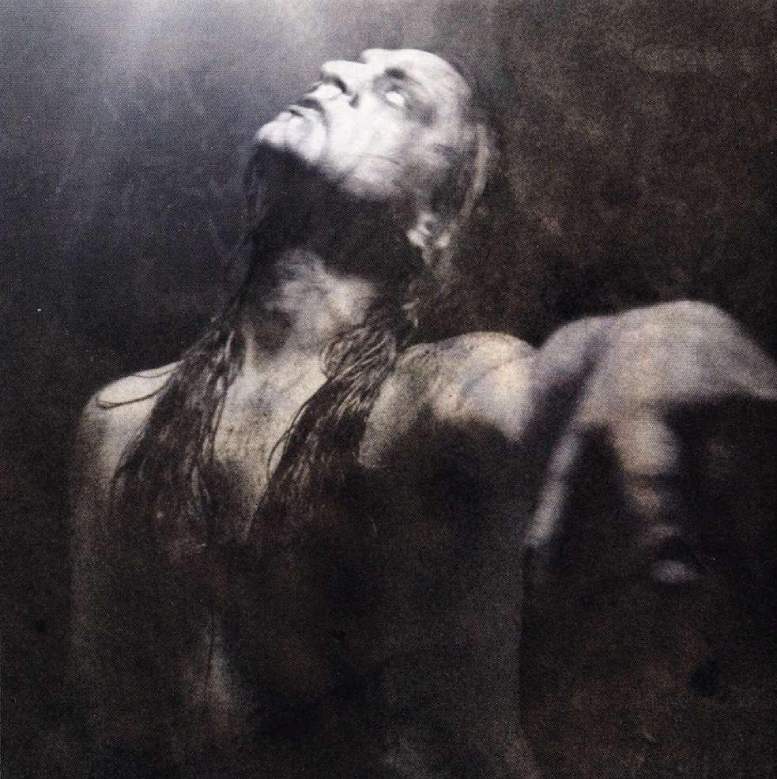
ROSTÉN: The layout process for a FUNERAL MIST album usually begins after the songwriting is finished. Even so, I often start experimenting with the aesthetics – the cover above all – at an early stage, as it helps keep the music and artwork conceptually aligned.
By autumn 2005, email deliberations over the visual direction of FUNERAL MIST’s second album were underway. ‘Of course we’ll handwrite the lyrics again’, Timo commented in the first exchange, writing from Italy. ‘And this time I probably won’t need to write each title three times – I’ve got a better grip on the pen since “Salvation”.’
ROSTÉN: “Maranatha” was among the first album layouts I handled entirely on my own, from beginning to end. Besides the lettering, Timo mainly oversaw the process and scrutinised my drafts to make sure I hadn’t messed up too badly.
Rostén had picked up the fundamentals of Photoshop during the “Devilry” and “Salvation” sessions in Brandbergen, then spent the intervening years working out the rest for himself through trial and error.
ROSTÉN: The never-ending tribulation of using such tools – be it Photoshop or recording software – is how you spend half your time designing or composing or whatever, and the other half crawling the internet for solutions to whichever obscure problem besets you today, invariably described in utterly alien-sounding technical terms. Most frustrating when all you want to do is… create!
In November 2006, Rostén sent Timo an advanced version of the cover for a second opinion. The response was unequivocal: ‘Bra skit. Ser fan inte klokt ut’ – ‘Good shit. Looks fucking mental.’
ROSTÉN: I don’t recall that exact exchange – but with roughly fifty different versions of the “Maranatha” cover in my archives, it’s highly unlikely to have been the final one. The underlying design was certainly in place, though.
Timo followed up by asking whether painting the motif might be an option, or if it ‘had to be Photoshop’. Rostén declined the offer of analogue artwork.
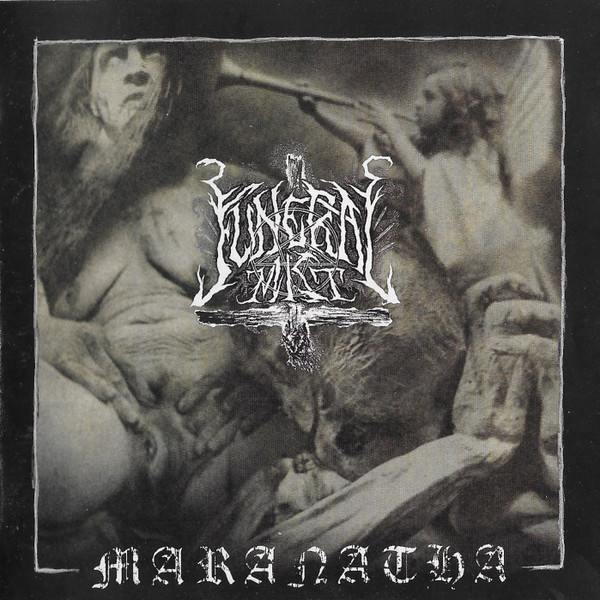
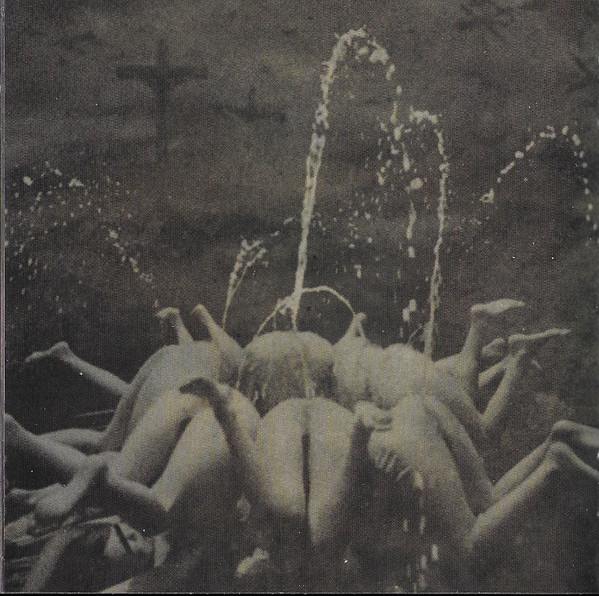
ROSTÉN: Firstly, I had already found a number of photographs that worked perfectly well as they were. Beyond the usual manipulation, I saw no need to alter or reinterpret any of them. This alone would’ve settled it. The second, and perhaps greater, reason was – and remains – continuity: I wanted a clear thread running through all the covers.
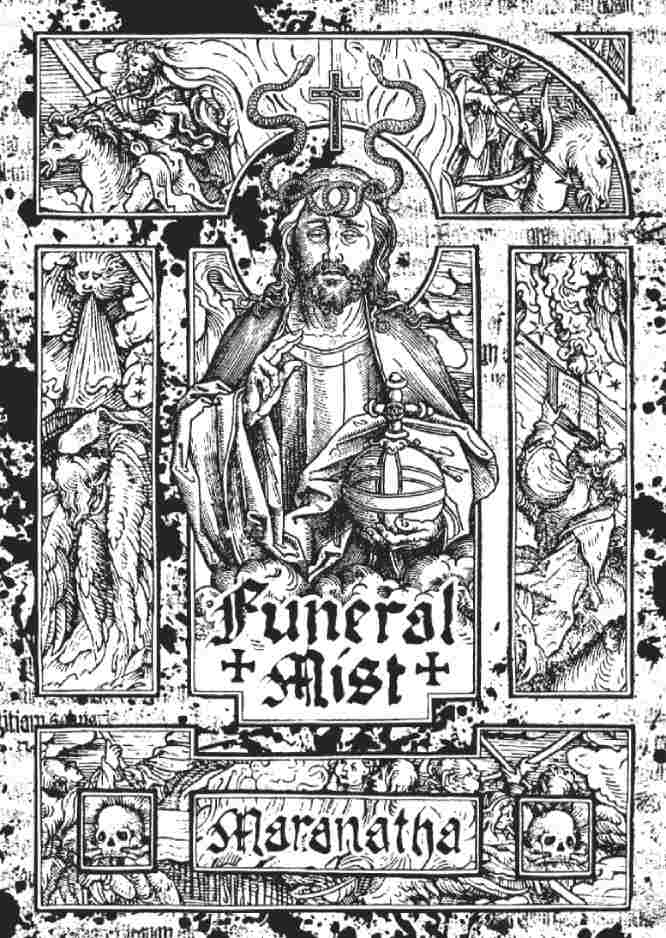
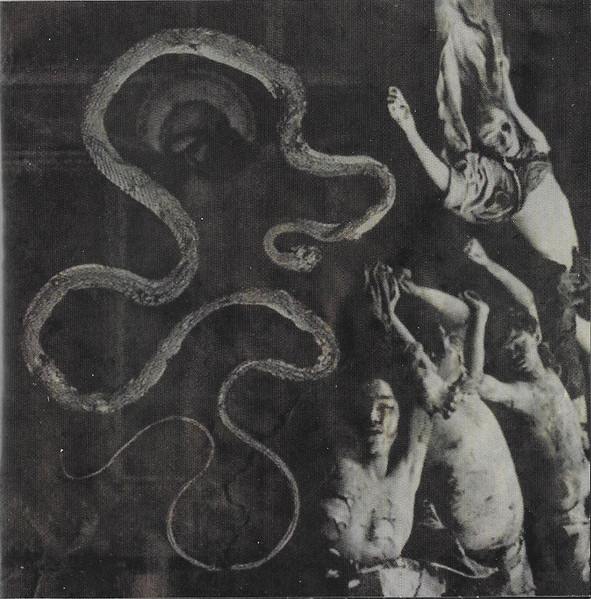
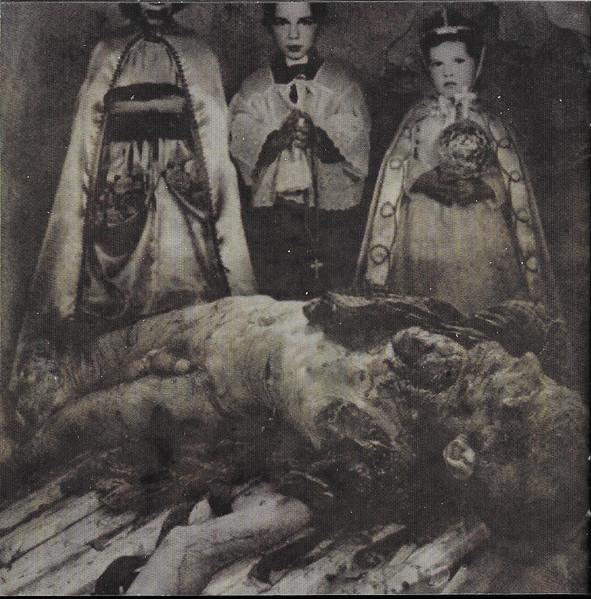
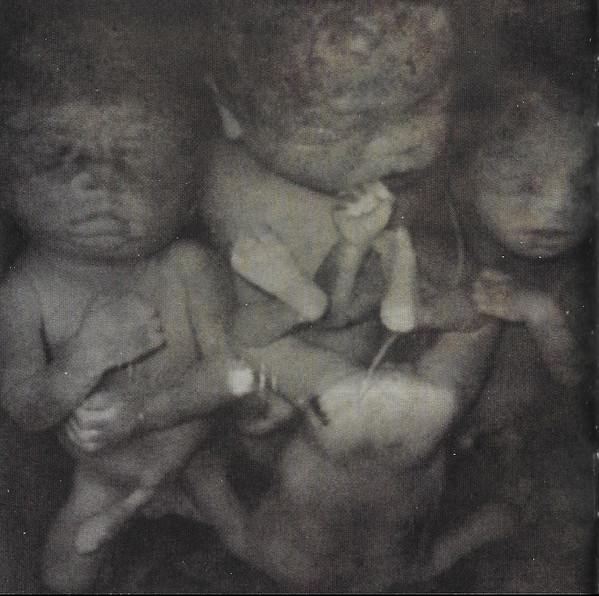
Across “Devilry”, “Salvation”, and now “Maranatha”, the same template holds: a crudely drawn frame, the FUNERAL MIST logo centred above the motif, and the title spaced along the lower edge. Within that fixed structure, each cover builds its own scene from photographic material.
ROSTÉN: Interestingly enough, I remember seeing the first couple of BATHORY records as a youngster and thinking, ‘How plain and boring, putting the logo in the same place on every cover like that’ – only to find myself, many years later, even more obsessive about the matter. The irony.
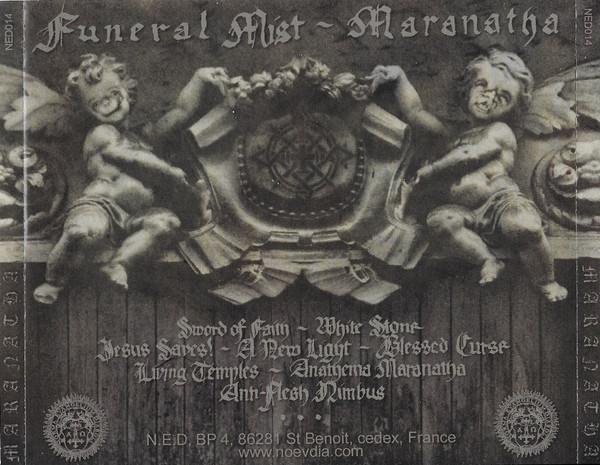
The back cover likewise follows the pattern established on “Salvation”: hand-lettered Gothic at the top, angels to either side, and the NoEvDia sigil at the foot. Most elements, however, were reconstructed from new source material; where the debut featured engraved cherubs, for instance, “Maranatha” uses photographed sculptural reliefs.
ROSTÉN: This was just a case of tightening the overall aesthetic of the layout, making the whole thing more cohesive. No deeper meaning behind it.

As 2006 drew to a close, Timo announced that the book project which had occupied him throughout the autumn – Qabalah, Qliphoth and Goetic Magic – was complete. He could now turn his full attention to “Maranatha”.
Timo outlined a workflow for the handwritten lyrics, aiming for delivery in late January or early February 2007. Mid-sentence, he caught himself: ‘Hmm, those months sound eerily familiar.’ Five years earlier, before leaving for Portugal, he had offered the same estimate for “Salvation” – only for the work to continue into April.
ROSTÉN: I’m sure the possibility of delays crossed my mind once or twice – but for a multitude of reasons, entrusting this particular task to anyone else was unthinkable. Besides, Timo had helped me so much of his own accord, and without payment, during those early years that I’d never dream of giving him a hard time about it.
Discussing the booklet, Timo made his personal ambition clear: it should preserve the FUNERAL MIST identity established on “Salvation” without merely repeating its compositional methods. He therefore welcomed Rostén’s plan to use a series of works by 19th-century Austrian painter Joseph von Führich as a way to impose order.
ROSTÉN: We abandoned the Führich theme fairly early on. The initial idea, just as Timo said, was to weave a common thread through the booklet chaos – but it didn’t sit well with the remaining imagery, so I had to rethink the whole thing.
A few months later, Timo invited Rostén to contribute guest vocals to TEITANBLOOD’s forthcoming debut album. ‘Yes, yes – I know you won’t do it, but I promised my friend I would ask.’ He added that the material was ‘really fucking great’, describing the Spaniards as one of the rare contemporary bands to excite him.
The simultaneous correspondence surrounding “Seven Chalices” and “Maranatha” reveals two very different working relationships. Nasko met Timo’s rapid-fire onslaught in kind – sometimes exchanging as many as thirty emails per day – whereas Rostén replied selectively, often with little more than the essential facts.
ROSTÉN: What can I say? I prefer discussing such matters over the phone or in person. Emails and text messages have always been reserved for the bare essentials.
Nowhere is the contrast clearer than when technical refinements enter the discussion. Rostén, who admitted to being ‘bored to tears’ by graphical minutiae, is very concise, almost curt. Timo, meanwhile, writes gigantic emails about colour calibration with what appears to be genuine enthusiasm.
In a 2007 dispatch, Timo spends almost eight hundred words walking Rostén through ink-coverage management: convert the image from greyscale to CMYK, mix a less saturated black for the background, use the Magic Wand with Tolerance set to zero and Contiguous disabled to isolate the over-inked areas, replace them, and perform the correction only at the very end because reversing the process is a nightmare. Then again, he adds, remain in RGB until the last possible moment, since CMYK does strange things to layers – citing the pale square on the “Devilry” cover as a cautionary example.
ROSTÉN: Well, the job had to be done, and this was the information needed to do it. I didn’t really have much choice but to go through every detail as meticulously as possible, to avoid any nasty surprises further down the road.
Rostén wrote “Salvation” largely beyond the glare of expectation, while FUNERAL MIST remained something of a well-kept underground secret. Reflecting on NoEvDia’s development, Christian would later regard the album as ‘no less important than “De Mysteriis Dom Sathanas”’. Such acclaim inevitably raised the stakes for its successor.
ROSTÉN: There’s always immense pressure, but never from the expectations of others. I answer only to myself, and my ambition has remained simple over the years: to improve every aspect of each creation without sacrificing its identity, style, or… spirit. A futile endeavour, of course, since such decisions are rarely made consciously. What comes, comes.
CHRISTIAN: I became aware of the forthcoming FUNERAL MIST album perhaps two years before its release, but Rostén kept what he told me to a minimum. A number of things – the title among them – were still in flux, though the record had been written and was set to be recorded, which meant sorting out practical matters such as the studio budget.
“Salvation” was, in Christian’s own words, his first attempt to handle every aspect of a release ‘in a truly professional manner’ – a gatefold double-LP, multiple formats, and an unprecedented financial commitment. Come 2008, when Rostén prepared to record “Maranatha”, NoEvDia was a very different label, with a substantial catalogue and an established reputation.
CHRISTIAN: By then, the label was indeed far better equipped to handle everything surrounding a release of that magnitude. The stakes were different this time, however: it wasn’t the financial or logistical side of the album causing me trepidation and sleepless nights, but its very essence.
At the time, Christian believed that a great band should never merely repeat or refine an established formula, but force its vision into new territory.
CHRISTIAN: A new FUNERAL MIST album wasn’t going to be merely another release; at the very least, it was expected to be remarkable, perhaps even a second consecutive game-changer. It is therefore almost impossible to put into words how anxious I felt when the master arrived.
CHRISTIAN: I discovered “Maranatha” with a mixture of astonishment and admiration. The opening track, “Sword of Faith”, permits the illusion of familiarity – the first minute or so after the intro is pure FUNERAL MIST: whirlwinds of Rostén’s characteristic razor-like riffing, feral violence, and grandiose yet sinister melodies.
ROSTÉN: Devo once described my riffing as ‘jagande’ – probably best translated as ‘driving’ or ‘chasing’ – which sounds close enough to me. There’s no fixed formula to rely on; every riff is handled in its own particular way, even if the desired result is often similar. Some parts call for violent shifts and structural chaos, others for hypnotic monotony. Intuition decides.
CHRISTIAN: The mirage persists for a little over two minutes before the first warning shot arrives. Almost as if to remind us that FUNERAL MIST is never predictable, the track introduces a sequence of chords which, played differently, would sit perfectly well in a rock song. Yet here it remains black metal as fuck.
ROSTÉN: In my experience, the main advantage of having no formal training is that it kind of forces musicians to develop their own style. Left to evolve organically, rather than being moulded by existing works and the theory behind them, you end up somewhere no one taught you to go.
CHRISTIAN: Track two, “White Stone”, drives the nail through the corpse of illusion once and for all. Consider the boldness of this very simple riff emerging from the amplifier buzz – something most bands would have cleaned up, though here it sustains the tension. And the vocal performance: ‘Huh!’ A song with a personality entirely its own, if ever there was one.
The ‘huh’ in “White Stone” is actually a ‘phew’ – an exhausted exhalation from Rostén after tracking the preceding lines, caught perfectly on the beat.
CHRISTIAN: Further invention erupts throughout the album, in riffing never before heard on a FUNERAL MIST recording – nothing anyone could have anticipated. Take the ending of “Jesus Saves”, which might evoke the musical world of David Eugene Edwards, or certain riffs in “Anathema Maranatha” and “Anti-Flesh Nimbus” that would blend in seamlessly on a folk record.
Do any of the traits you’ve identified in Rostén’s guitar playing carry over to the bass?
CHRISTIAN: Perhaps insofar as it forms part of his musical world and serves a very particular vision. In purely technical terms, taken in isolation, the bass on a song such as “A New Light” is essentially playing the fundamental note – simple enough. Yet it drives an explosion of dynamics, making it a highly distinctive element of the songwriting.
ROSTÉN: I’ve always liked it when the bass does its own thing instead of merely following the guitar. Perhaps a remnant of being introduced to BLACK SABBATH at a very early age.
CHRISTIAN: Although FUNERAL MIST made it entirely their own, comparable bass work can be found in songs by THE SISTERS OF MERCY, FIELDS OF THE NEPHILIM, THE CURE, CHRISTIAN DEATH, KILLING JOKE, and JOY DIVISION. I have no idea whether Rostén drew on any of them, and ultimately it is irrelevant. It was unquestionably a brilliant addition to “Maranatha”.
Unlike on “Salvation”, the bass is now audible, and occasionally even takes the lead – particularly during the calmer, arpeggiated passages.
ROSTÉN: Again, any development, for better or worse, comes down to me evolving as a musician. Quite frankly, when considering the production of a new album, I don’t concern myself too much with comparisons to previous recordings. I focus on the task at hand – right here, right now. What kind of sound fits, and what doesn’t?
CHRISTIAN: For a band like FUNERAL MIST, ‘good’ production is difficult to define. Much of what a professional sound engineer might suggest would likely backfire – not through any incompetence on their part, but because so many conventional principles must be turned upside down to work within such a specific context.
Did you have any concerns about the FUNERAL MIST spirit surviving the change of studio and producer?
CHRISTIAN: Well, there was a great deal of creativity in the production of “Salvation”, which set a high bar. Nevertheless, as you no doubt know, the answer can only be this: wherever Rostén chooses to record, the result will be FUNERAL MIST. I cannot imagine he would ever release anything that fell even slightly short of the full vision.
For “Maranatha”, Rostén left Necromorbus – where every previous FUNERAL MIST release had been recorded – for Endarker Studio, operated by his MARDUK bandmate Devo Andersson.
ROSTÉN: Truth be told, the choice of studio came down to convenience. Of course, I also felt confident that Devo, given sufficiently firm guidance, would have no trouble realising my ideas and visions – which, I’ve been reliably informed, can be a tad unorthodox at times.
The production of “Salvation” has a stark, treble-forward brightness, with the low end almost entirely absent. “Maranatha” moves in the opposite direction, towards something drier, denser, and more suffocating.
CHRISTIAN: As you say, the production on “Maranatha” is hardly a friendly affair – it’s claustrophobic and compressed, despite the music itself being highly dynamic. Yet this sound serves the album’s spirit perfectly; ergo, it is ‘good’.
ROSTÉN: I’m guessing this was mostly a matter of experimental mixing, learning to balance each instrument against the others. I sometimes wonder how many classic albums from the genre’s infancy owe their sound to people who had no idea what they were doing and simply got lucky. Probably more than we think.
On “Salvation”, you sat directly behind Tore throughout the mixing process. Did “Maranatha” see you loosen your grip on any of the technical decisions?
ROSTÉN: There shall be no loosening of the grip. Not now, not ever.
CHRISTIAN: Of course, having admired the drumming on “Salvation”, I was also curious to hear who would shoulder that responsibility.
Christian singled out Tore Stjerna’s performance as one of the reasons “Salvation” felt historic – ‘frantic, and far beyond typical metal drumming’. For “Maranatha”, Rostén recruited MARDUK drummer Lars Broddesson.
CHRISTIAN: My impression is that Lars largely played what Rostén instructed him to play. Several highly accomplished fills stand out, and he delivered the parts with sufficient feeling. Arguably, some of the strangeness of “Salvation” was lost, but you cannot have Tore’s personality without the man himself behind the kit.
ROSTÉN: Unlike MARDUK, FUNERAL MIST doesn’t require a drummer in the traditional sense. What I need is probably best described as a human drum machine. Since most parts are already worked out, the role simply calls for someone capable of executing them. There is, of course, some room to add a personal touch, but in all honesty… not much.
In the wake of “Salvation”, Rostén replaced Legion as MARDUK’s frontman, bringing his vocal delivery and aesthetic sensibility to the November 2004 “Plague Angel”. Timo handled the layout and later ranked it among the best work he produced during those years, while insisting that ‘half the credit goes to Rostén’.
“Plague Angel” was widely regarded as a marked improvement on “World Funeral” – the last album featuring Legion, and the last recorded at The Abyss. Among FUNERAL MIST listeners, however, Rostén’s arrival prompted the opposite concern: influence flowing back the other way. Learning that “Maranatha” was tracked with MARDUK’s drummer at a studio run by MARDUK’s bassist is unlikely to have settled anyone’s nerves.
ROSTÉN: Stylistically, the two bands aren’t all that different, so some overlap is inescapable – but I don’t see it as a problem, or even an issue. No discerning listener will have trouble telling them apart.
CHRISTIAN: Once Rostén began composing for MARDUK, the riffing patterns familiar from FUNERAL MIST came to permeate some of their material – but the reverse? Not musically, though all the years in a band that active may have made him a more experienced musician. We live, learn, and evolve, and such developments cannot really be compartmentalised.
Were you still following MARDUK’s activities by then?
CHRISTIAN: I saw them in Vienna around the time of “Maranatha”, on a bill with VADER. The year escapes me now, but it was the first black metal show I had attended after several years away from concerts. Onstage, MARDUK were the war machine they have always been.
CHRISTIAN: “Maranatha” is an intensely cinematic album. Close your eyes while listening, and you’ll be confronted with a succession of visions summoned by the record itself. The riffs evoke a broad spectrum of moods, the vocals convey a message, and the samples open onto further worlds.
The song “Blessed Curse” is structurally comparable to “Circle of Eyes” – the long, sample-anchored piece placed late in the running order of “Salvation”. Much like the Gregorian chant in the earlier track, the evangelical preacher here is embedded within the composition, forming its spine rather than serving as an ornament.
ROSTÉN: Typically, these ideas begin either with a riff in need of a sample, or a sample around which to build a riff. There are, after all, only so many ways to go about it. Nonetheless, every once in a while, the gods of rock ‘n’ roll smile upon you and reveal a third path: two seemingly unrelated elements that I know belong somewhere, but which have yet to find a home, suddenly click into something novel and unique. If memory serves, “Blessed Curse” was one such occasion.
log in to keep reading
The second half of this article is reserved for subscribers of the Bardo Methodology online archive. To keep reading, sign up or log in below.
Related reading