Liber Ketola XXXIX
2026-10-28
by Niklas Göransson
Per Faxneld’s study of black metal spirituality grew into an exploration of older manifestations of Satanism. Timo Ketola gave Mörkrets apostlar its printed form, beginning a collaboration shaped by shared esoteric interests and a love of books.
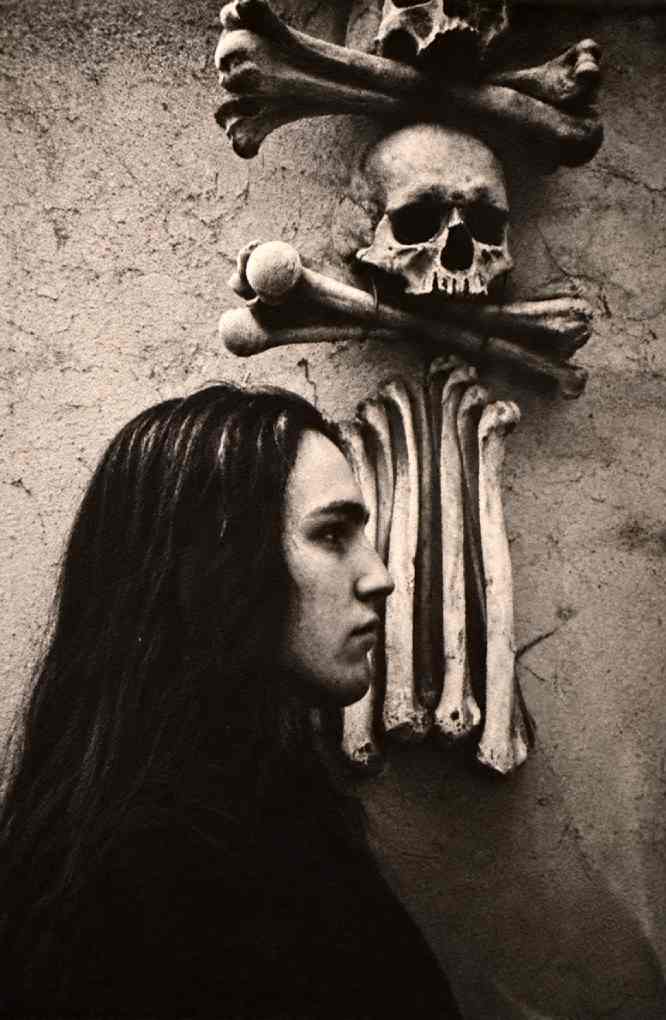
PER FAXNELD: My upbringing probably opened doors not every child gets to walk through. For instance, my mother had specialised in cinema studies at university and often invited her old classmates round to ours. I’d overhear them discussing strange silent films like Nosferatu, and that certainly left its mark.
Per grew up in Vasastan, central Stockholm, the son of an artist and writer with a keen interest in film and surrealism. The vampire mythos got its hooks into him on the page as well as the screen: reading Dracula at eight left what he calls an ‘indelible impression’.
FAXNELD: It might not be obvious to every reader, but that book has strong religious undertones; even as a child, I could sense it was more than just a ghost story. Dracula had a metaphysical charge, as though the powers of darkness were manifesting themselves. I found this fascinating and alluring.
Unusual influences came from both sides of the family. Per’s paternal grandmother, an esotericist and member of a Rosicrucian Order, gave him a tarot deck for his tenth birthday.
FAXNELD: My grandmother never said much about what it all involved, but she took me to something called the Liberal Catholic Church – which I assumed was just some odd strain of Catholicism. I only realised as an adult that, in many ways, it’s an offshoot of Theosophy.
The liturgy, vestments, and incense of the Liberal Catholic Church are borrowed from Rome, but the underlying theology draws on Theosophy – Helena Blavatsky’s 19th-century fusion of Western occultism and Eastern religion, complete with reincarnation, karma, and hidden spiritual Masters.
FAXNELD: Back then, I mostly just thought she was a bit airy-fairy. As a teenager, I developed my own interest in darker forms of magic, but her talk of Madame Blavatsky’s writings, kundalini energy, and so on still struck me as a lightweight kind of esotericism – and not a particularly compelling one.
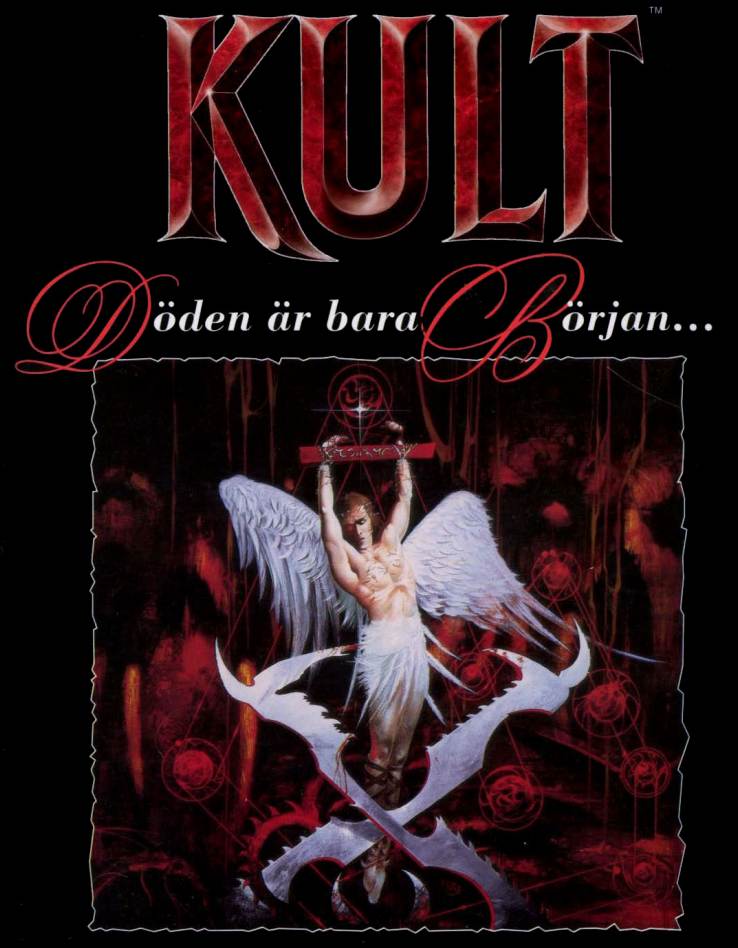
FAXNELD: When Kult came out in 1991, it strongly influenced the esoteric development of many young Swedes. It differed from other tabletop role-playing games in that its magical system was a fairly authentic depiction of Western occultism, rather than some made-up, Tolkien-style wizardry.
The Kult cosmology was built on a Gnostic nightmare: the everyday world is an illusion, a prison constructed by the now-absent Demiurge to keep humanity from reclaiming its lost divinity. The game’s creators and writers, Gunilla Jonsson and Michael Petersén, paired this setting with sex magic, ritual sacrifice and graphic violence.
FAXNELD: In 1992, I interviewed both of them for my RPG fanzine and discovered they’d copied much of their account of magic from existing sources – mainly Aleister Crowley. This revelation came at a time when some of my friends and I had already started seriously considering taking up occult practice rather than just enacting it in role-playing games or reading about it in Lovecraft’s short stories.
The backlash against Kult was predictable. Self-appointed experts warned television audiences that it led Swedish youths straight to Satanism, and the country’s largest toy chain responded by clearing every tabletop role-playing game from its shelves. In hindsight, given how many teenage RPG enthusiasts went on to populate the emerging black metal scene, the alarmists may have had a point.
FAXNELD: Like many of my contemporaries, I first came across descriptions of the kind of ritual magic I was looking for in the Necronomicon – the Simon edition. The themes already felt familiar from MORBID ANGEL, who’d become one of my favourite bands by that point.
A few years earlier in Tampa, Florida, the original MORBID ANGEL line-up had worked closely with the Ancient Ones. According to drummer Mike Browning, the band recited invocations from the Necronomicon before shows – even rehearsals – then channelled whatever answered into the music.
FAXNELD: Our building in Vasastan had this enormous attic stretching across several blocks of flats, with lots of empty wooden storage compartments. My friend Christian and I set up a ritual chamber in one of them – all according to the book’s instructions.
What did it contain?
FAXNELD: We had a tub of sand to thrust a sword into, a long copper rod, and a dagger we’d made and stamped with ‘Inanna’. It felt pretty spooky up there, too. Someone had supposedly hanged themselves from one of the beams – ‘Goodbye’ was written in soot on the wall beneath it. I don’t know whether to believe the story, but it gave the attic a certain charge.
Enough to stir Yog-Sothoth?
FAXNELD: Not quite. After our first fledgling magical experiments, Christian and I began to suspect that this Simon Necronomicon wasn’t a reliable source of authentic arcana, so we had to look further afield.
In his search for more credible sources, Per came across an episode of Fri zon, a youth programme on Swedish state television. First broadcast in 1991, it featured Dragon Rouge’s media debut, two years after the order was founded.
FAXNELD: As I remember it, it was a fairly short documentary piece, with some very atmospheric footage of a ritual in a harbour warehouse – chains swaying in the wind, that sort of thing. It certainly made me curious about what they were up to, and I wanted to find out more.
Per’s musical education followed a time-honoured route. By 1992, at fourteen, he and Christian were already well versed in the death metal of MORBID ANGEL, BOLT THROWER, and DISMEMBER when a friend’s older brother introduced them to BATHORY.
FAXNELD: BATHORY became the most important band for both of us – in every respect. When Scandinavian black metal exploded soon afterwards, that caught our attention too. From there, it was a short step to picking up your first DARKTHRONE record.
Many of those records came from House of Kicks in central Stockholm – soon to be renamed Sound Pollution – where Per also made good use of the extensive fanzine selection.
FAXNELD: Anyone who wanted to connect with the underground had to read fanzines, our internet of the time. There were no search engines, obviously, so you absorbed as much as possible and tried to piece everything together. Whatever gaps remained had to be filled by actually talking to people – virtually unheard of today.
Around the same time, Timo was discovering the international metal underground through that very shop. Per, too, scoured the fanzines’ contact sections for addresses and began writing to bands and tape-traders.
FAXNELD: After corresponding with a variety of interesting characters, I realised I could share these conversations in a meaningful way. I’d been editing publications of one kind or another since I was little – first a He-Man magazine, then Batman, and later that role-playing ‘zine. When extreme metal became such a big part of my life, writing about it seemed like the obvious choice.
In 1994, Per began work on the first issue of Änglablod, joining a thriving scene of Swedish-language black and death metal fanzines.
Like a growing number of editors, he laid out his pages using desktop publishing software. As digital design came within reach of any teenager with access to a PC, the era of typewriters, scissors, glue, and photocopiers was drawing to a close – though not quite yet.
FAXNELD: Those were great years for underground fanzines, but I felt many of them looked a bit slapdash, so I aimed for something tighter. Still, it was pretty primitive layout work. I didn’t scan anything – I set the text in two columns on a computer, printed it out on the school’s laser printer, and glued the logos on by hand.
Published in 1995, Änglablod #1 runs to twenty-eight A5 pages, devoted mostly to up-and-coming Swedish bands such as SETHERIAL, DARK FUNERAL, THRONE OF AHAZ, NAGLFAR, THORNIUM, and NÅSTROND. Excavating my copy from the archives, I was struck by how much more polished it looked than most ‘zines of the day.
FAXNELD: I went to a local print shop and looked at different kinds of paper – I’d already become quite particular about those things. We settled on a matt-coated stock: I didn’t want it too glossy, but it couldn’t be so matt that the blacks in the photos came out dull.
In the editorial, Per acknowledges that black metal dominates the issue and promises a better balance in future. The planned demo reviews are absent, victims of unspecified ‘unfortunate circumstances’, while the comparatively steep price is attributed to the small print run and expensive paper.
FAXNELD: A few details annoyed me when I held the finished issue in my hands. Some of the photos came out a little smaller than intended and didn’t match the column widths. I think it was due to the print shop mounting the images and converting them into halftones, combined with my own cutting and pasting.
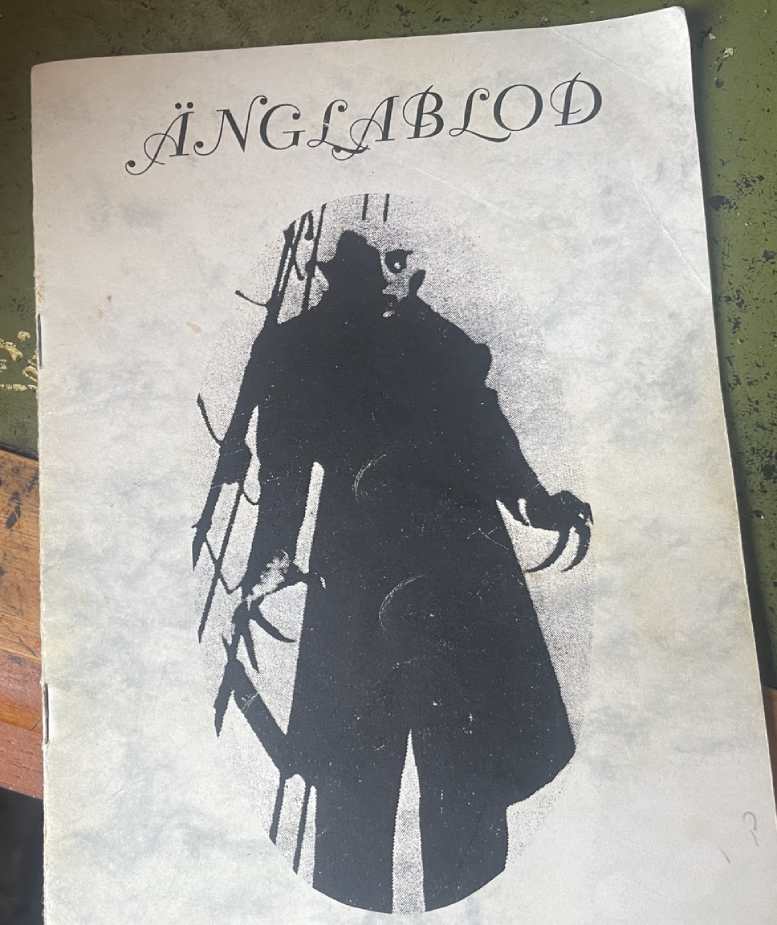
The cover of Änglablod #1 features Max Schreck as Count Orlok in Nosferatu – the film that left its mark on Per as a boy – and the thanks list duly salutes him as the ‘greatest vampire ever’. The editorial invites readers to submit illustrations, poetry, and prose on the same theme, promising to give the subject more room in the next issue.
FAXNELD: In fact, that second issue is more or less finished – it’s been sitting in a binder, fully laid out, since… early 1996, or thereabouts. Among other things, it contains a long and rather amusing BATHORY interview I was fortunate enough to land. I’d sent a copy of the first Änglablod to Black Mark and asked whether I could talk to Quorthon.
Was this in person or over the phone?
FAXNELD: Phone – supposedly from ‘Black Mark’s Berlin office’. You could never be quite sure with Quorthon; he might just as well have been sitting a few blocks away in Stockholm.
Quite the leap, though – from interviewing demo and debut bands by post to a phone call with your favourite black metal musician.
FAXNELD: Yeah, I was completely awestruck at the mere notion of talking to Quorthon – but as a ‘cool’ teenager, I didn’t want to come across as fawning. You can actually hear me yawning a little at the start of the tape <laughs>, trying to sound uninterested and nonchalant.
Are you ever going to publish any of it?
FAXNELD: I’d planned to release the whole of #2 in 2025, exactly three decades after the first issue came out. But I had a few too many irons in the fire, so it didn’t happen. Now I’m aiming for 2028 instead – the thirty-third anniversary, which is good numerology, I think.
FAXNELD: I also did a MALIGN interview which turned out quite interesting, but afterwards Ynas asked me to cut what I thought were the juiciest parts. Unfortunately – though no doubt much to his relief – I no longer have that tape, so it won’t appear in Änglablod #2.
Do you remember Ynas and Timo’s fanzine feud?
FAXNELD: Yes, absolutely: wimpy manors! You don’t forget something like that. Actually, the very first time Ynas and I met, we almost came to blows. He was picking a fight with my short-haired friend who wore a BATHORY shirt – an inexcusable combination, apparently.
Sounds familiar. My first memory of Ynas is from a DARK FUNERAL show in January ‘95, when he ripped an inverted crucifix off the neck of a friend he’d deemed similarly unworthy of black metal apparel.
FAXNELD: That’s what gigs were like back then – people fought over those sorts of things. So, it wasn’t a particularly positive first impression, and I doubt he found me very pleasant either. But at some point, our mutual friend Sonya Ivarsdotter reintroduced us, and we got to know each other.
Had you met Timo by then?
FAXNELD: No, we never met in person back in the ‘90s, but we knew of each other at a distance, through our fanzines. I discovered Dauthus around the time of the first issue… 1996, right? I’m trying to remember who I borrowed it from; it might have been Sonya.
I noticed that Sonya – who wrote lyrics for a song on MALIGN’s demo – is the first name in your acknowledgements to Änglablod #1.
FAXNELD: We were in the same class at upper secondary school, seeing each other pretty much every day for three years. We also spent an enormous amount of our free time together – right up until her death in 1999.
That woman certainly left an impression. The last time I saw her, she said something along the lines of, ‘Fighting is so much more enjoyable than fucking.’
FAXNELD: That sounds very much like Sonya. Quite a few cocky guys got taken down a peg or two when they mouthed off to her. She was a unique person in every respect.

FAXNELD: Sweden didn’t offer much in the way of active magical practice. The O.T.O. existed, but it seemed a bit stuffy and old-fashioned to me. Perhaps it wasn’t quite my flavour of magic either. Judging by that documentary, Dragon Rouge felt closer to what I was looking for.
Some time later, one of Per’s death metal pen-pals slipped a flyer for the order into a letter.
FAXNELD: It had Thomas Karlsson’s dragon sigil – which D.R. used before Timo designed a new one – and a few lines about how they explored different forms of dark magic and the unconscious side of the human psyche. ‘Write to this PO box for more information.’
Per ordered some of their reading material, but it was Änglablod that brought about his first personal contact with Dragon Rouge.
FAXNELD: In early ’96, after “Dream of Lilith” came out, I met up with Tommie Eriksson and Thomas Karlsson to talk about their new project SHADOWSEEDS for Änglablod #2. Interviewing them was my direct route into Dragon Rouge.
Alongside personal tuition, new members received a reading list. Tommie Eriksson recalls Carlos Castaneda among the recommended authors.
FAXNELD: I started with chaos magic – Peter Carroll and so on. Then came Kenneth Grant, of course. How much you could actually put into practice from his books, I don’t know, but they set a certain tone for my magical interests. I still find Grant’s work the most confusing and the most enjoyable occult literature I’ve read.
Tommie and Kosta mentioned the D.R. meetings in the basement of Blå tornet in Stockholm – were you there too?
FAXNELD: Yes, quite often. There was a real power to that place. Whitewashed cellar vaults – and with Strindberg’s flat overhead, you could feel the breath of history. He remained deeply involved in the occult right up until his death.
The playwright August Strindberg’s esoteric period is usually associated with Paris in the mid-1890s, when he abandoned literature for alchemy – even attempting to make gold in his hotel room – wrote for the Hermetic journal L’Initiation, and became convinced that unseen forces were steering his life.
By the time Strindberg moved into Blå tornet, alchemy had given way to the teachings of Emanuel Swedenborg – the 18th-century Swedish scientist who claimed to have toured heaven and hell in the company of angels. Few cellars in Sweden came with a better pedigree.
FAXNELD: The whole thing says a lot about the period: that a group like Dragon Rouge could even get hold of such incredible premises right in central Stockholm – and for several years, too. It was always buzzing, with people coming and going, many of them musicians.
Is that where you first met Timo?
FAXNELD: Yes, at some D.R. meeting around the turn of the millennium. Initially, I found him quite reserved and hard to draw into conversation – we never made much headway. Our discussions only really deepened a few years later, when we started working on the design of my first book, Mörkrets apostlar.
In 1999, Per chose Shintō as the subject of his final research project for a BA in History of Religions. That meant learning Japanese, but after half a term of wrestling with kanji, he returned to esotericism.
FAXNELD: My first paper, back in ’97, dealt with occultism in the Third Reich – mainly the esoteric interests of leading SS members. Since I was studying occult organisations, it made sense to take an academic look at black metal too. And, naturally, I already knew a fair bit about Satanism from my teens.
The thesis initially set out to examine the role of Satan in black metal, a subject for which Per was unusually well placed to gather primary sources.
FAXNELD: I conducted a number of interviews with people like Mist (OPHTHALAMIA, MALIGN), Blackmoon (DARK FUNERAL), Ynas, and Erik of WATAIN, before their big breakthrough. I gathered a mountain of material, too – photocopied thousands of fanzine pages, filed them in binders, and organised it all systematically.
The study also needed a historical introduction: how had this particular strain of Satanism come about, and what preceded it?
FAXNELD: Satanism was often presented as beginning with Anton LaVey’s founding of the Church of Satan in 1960s California. I’d begun to suspect that wasn’t the whole story. Surely, there must have been something much older, but the scholarly literature didn’t offer a clear account.
Per began exploring several neglected strands of occult history, among them the Luciferian elements in Theosophy.
FAXNELD: I kept coming across all sorts of strange figures. One of them was the Polish writer Stanisław Przybyszewski – a good friend of Strindberg and Edvard Munch, actually. It dawned on me that he might have been the first to develop a coherent system of Satanism.
A novelist and essayist of the Decadent movement, Przybyszewski set out the philosophy of Satanism in his 1897 book The Synagogue of Satan, celebrating the Devil as a symbol of evolution, sexual desire, and destructive revolt.
FAXNELD: The background section just kept growing until I had seventy-five pages of historical context. I realised this could be the thesis itself, so I dropped the whole contemporary black metal angle. Not many people were working on that kind of material, though Thomas Karlsson was studying history of religions at the same time.
log in to keep reading
The second half of this article is reserved for subscribers of the Bardo Methodology online archive. To keep reading, sign up or log in below.
Related reading