Liber Ketola XXXXI
2026-11-11
by Niklas Göransson
With Paracletus, Deathspell Omega closed a theological trilogy that Timo Ketola had accompanied from the first cover drawing to the final painting. Drought was its postscript, bringing the enquiry back to earth in six short pieces.
CHRISTIAN BOUCHÉ: Completing the trilogy, achieving what we’d set out to do almost a decade earlier, felt a little surreal. First came the sensation of years’ worth of apnoea drawing to an end – a massive weight being lifted from my shoulders. But I soon discovered that, however rewarding in the moment, artistic satisfaction is a fleeting emotion.
In November 2010, “Paracletus” closed the cycle opened six years earlier by “Si Monvmentvm Reqvires, Circvmspice” and continued in 2007 with “Fas – Ite, Maledicti, in Ignem Aeternum”. Across the three albums, DEATHSPELL OMEGA examined the relationship between God, Satan, and man; Timo drew the first two covers and painted the third.
CHRISTIAN: A project of this magnitude – an undertaking occupying every waking hour, regularly rousing you from sleep because an idea must be written down or a riff tried out – will inevitably leave a gaping hole in your very being. But it would be foolish to expect anything of lesser importance to fill that void.
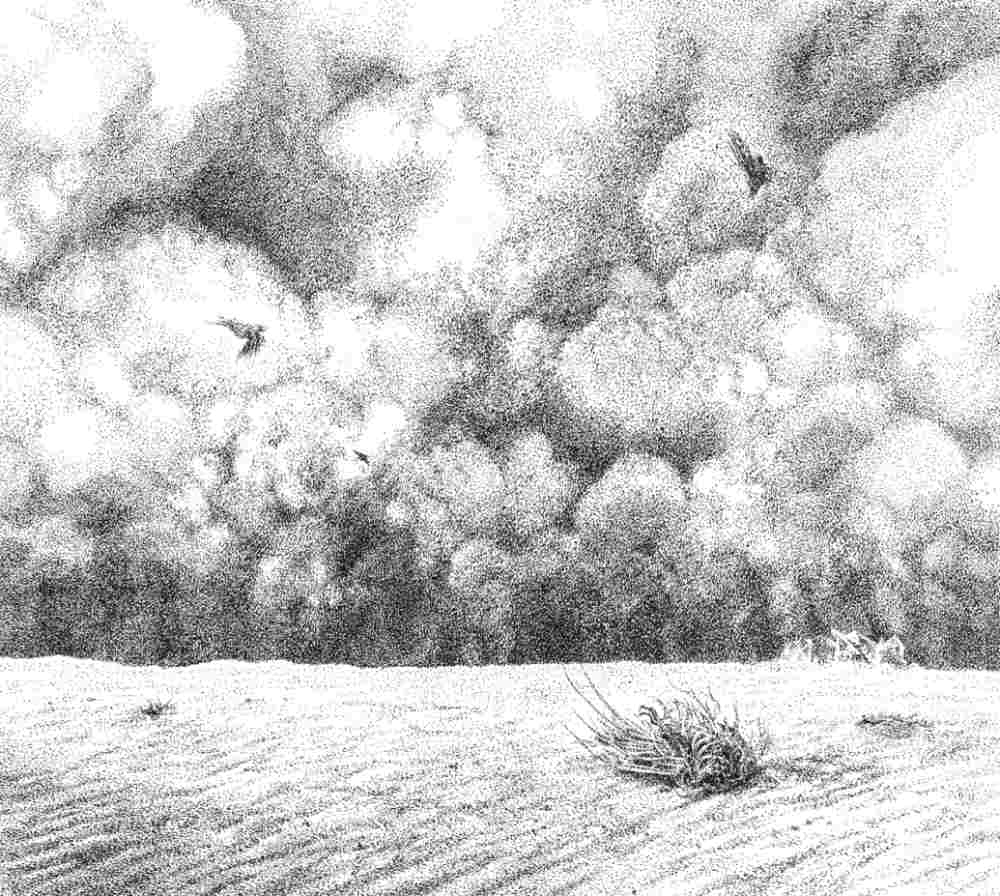
“Paracletus” did not have the last word, however. Conceived – in the band’s own description to Imhotep – as ‘a post-scriptum’, what became the “Drought” EP turned from the theological confrontation presided over by the Holy Ghost back to ‘man on the earthly plane’.
CHRISTIAN: The essence of “Drought” – the gist it was meant to convey – had existed in my mind and as a few handwritten notes for several years. And that’s where I always start; otherwise, I’d miss the entire point of writing music. There must be an enquiry, a curiosity, an exploration outlined through themes.
Building on a loosely defined conceptual framework, Christian began composing in early 2011.
CHRISTIAN: Our drummer was in the process of relocating to British Columbia, where he’d spend the following year. At some point, the three of us sat down to discuss whether to go ahead or leave this last concept unrealised. Ultimately, we decided that we had just enough time to finish the recording itself – but not the mixing – before his departure.
Discussing the band’s 2008 EP, “Chaining the Katechon”, Christian said that the longer the song, the more room there is for unexpected combinations. “Drought” took the opposite approach: six short pieces, none much over four minutes, played without a break.
CHRISTIAN: I’m sure you have noticed a pattern over the years: we tend to explore opposites. Here, we set out to make the most of concision, which implies allocating the limited time available as efficiently as possible. Constraints are a major driving force behind creativity.

CHRISTIAN: In the wake of “Paracletus”, my thoughts were elsewhere, so I wasn’t paying much attention to press coverage. After the tremendous reception for “Fas…”, I wouldn’t be surprised if journalists had tempered their reviews, ratings, and ‘album of the year’ accolades somewhat. For the simple reason that these outlets constantly need something new to feed the hype machine on which they depend.
Is that to say “Fas…” fared better than “Paracletus”?
CHRISTIAN: No. I’d never mistake commercial prowess for artistic relevance, but sales will reliably tell you whether a certain record found an audience. In that regard, sixteen years on, “Paracletus” – the label’s best-selling album – has been a spectacular success, and even helped fund some low-profile releases along the way.
By 2011, Norma Evangelium Diaboli had been running for nearly eight years and grown into an international operation. With DEATHSPELL OMEGA now moving quantities beyond anything the underground was designed to absorb, Christian stripped the label back to essentials – closing the mail-order to concentrate on wholesale distribution.
CHRISTIAN: I don’t believe I’d heard the term yet, but I had instinctively arrived at my own variant of the Pareto principle, which teaches that twenty percent of the time invested can produce eighty percent of the result. Completing the rest may require four times the effort, so the real question is how much of it is crucial.
Named after Italian economist Vilfredo Pareto, the principle was later popularised in management and quality control as the ‘80/20 rule’.
CHRISTIAN: Examining how most people spend their working day makes one thing abundantly clear: being busy and being productive are two vastly different things. Those who constantly harp on about having too much to do aren’t necessarily overworked; they may simply organise themselves inefficiently. In my experience, not everyone considers the possibility of ruthlessly optimising their time. You, for example, have done precisely that.
That logic sits oddly with much of what you’ve told me about DEATHSPELL OMEGA: every second of music exhaustively rehearsed, month-long mixes, and extraordinary effort lavished on barely audible nuances.
CHRISTIAN: Oh, the triage was strictly confined to the workflow underpinning the label – precisely so the music could remain exempt and immaculate. The creative process is, by necessity, based on trial and error and obsessive attention to details that no one else may ever notice.
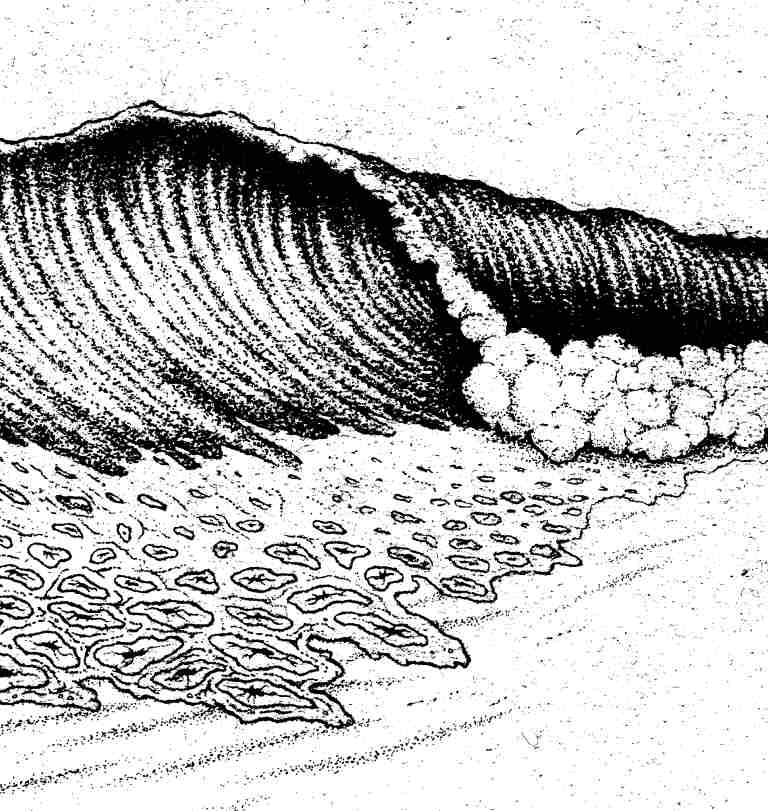

CHRISTIAN: Veteran musicians accustomed to working together as a team provide a solid foundation; this time around, the recording session went by with surprising ease. The sound is quite natural and dry, and getting it right didn’t take long – not by our standards, anyway.
In studio terms, ‘dry’ means stripped of reverb, of air and space – was that meant to reflect the title?
CHRISTIAN: Correct, that is precisely the notion we were trying to impress upon the listener: a recording deliberately deprived of moisture.
By this point, the band’s longtime producer, Franck Hueso, had founded a synthwave project and begun work on its debut EP.
CHRISTIAN: Carpenter Brut, logically, started out on a rather modest scale, but I do remember Franck having immense ambitions from early on. I knew that if there was even a semblance of a possibility to turn them into reality, he’d be the one to pull it off. So, when he spoke of a light show on a par with NINE INCH NAILS, I took him at his word!
Given how intimately you’d worked together by then, do you think any aspects of DEATHSPELL OMEGA influenced Carpenter Brut?
CHRISTIAN: Yes, Franck has mentioned it to me several times. For instance, the way he concealed his identity on record and, by extension, onstage. Older fans will remember that the musicians initially performed as shadows behind a projection screen – something we had discussed at the time.
Hueso would later establish No Quarter Prod – a counterpart of sorts to NoEvDia, handling Carpenter Brut’s production, record releases, and official merchandise.
CHRISTIAN: Then, of course, the idea of making a conceptual trilogy is as explicit as it gets. Franck brought a great deal to DEATHSPELL OMEGA through his exquisite skills, so it would only be fair if those years played some part, however small, in the spark that gave shape to Carpenter Brut.
Did any of your compositional thinking carry over into his songwriting?
CHRISTIAN: It’s hard for me to say, but probably not. In terms of cultural affinities, Franck and I are polar opposites. He tends to favour pop culture, be it music or film – much to the benefit of Carpenter Brut, which draws heavily on such references. I, on the other hand, gravitate towards what people might call more elitist spheres: radical countercultures, literature, contemporary classical composers, et cetera.
Ever since the End All Life days, Christian had maintained sources of income independent of the labels so that neither could be forced into ‘curatorial compromise’. Admirable in principle, but running an operation of NoEvDia’s scale alongside his other commitments meant sixteen-hour workdays, sometimes for weeks on end.
CHRISTIAN: I had the occasional help of close comrades, but otherwise I managed on my own. I’ve never been particularly fond of delegating responsibilities, and the people I’d be willing to deal with on a daily basis are few and far between; I need to respect them, and recognise their capabilities and work ethic.
Did a need to keep everything in your own hands play a part?
CHRISTIAN: Sure, there’s absolutely an element of control – and I’m aware this necessarily comes at a cost. Needless to say, I had precious few moments to devote to anything else, and weeks could go by without a single human interaction outside work and my girlfriend at the time.
What about your bandmates? Were rehearsals sacrificed too?
CHRISTIAN: Work, in this case, also included my musical activities, as everything was intimately connected. It would be wrong to describe any of it as a sacrifice, though; I did precisely what I felt compelled to do, even if it wasn’t always pleasant, mentally or physically.
In a life organised around work, what room was left for recreation, or just meeting up with friends at the pub?
CHRISTIAN: During those years, there was very, very little enjoyment for its own sake. I’m not saying I never watched a movie without some higher purpose in mind, but I simply had no interest in matters unrelated to what we were doing, such as getting drunk.
Were you ever much of a drinker?
CHRISTIAN: I probably drank most heavily around the age of fifteen. Growing up in the countryside, largely in charge of my own after-school hours, I’d reliably get intoxicated every Wednesday afternoon and again on both weekend evenings. Sex was part of the picture as well, of course. That’s the charm of rural France of yore for you, in case you were wondering.
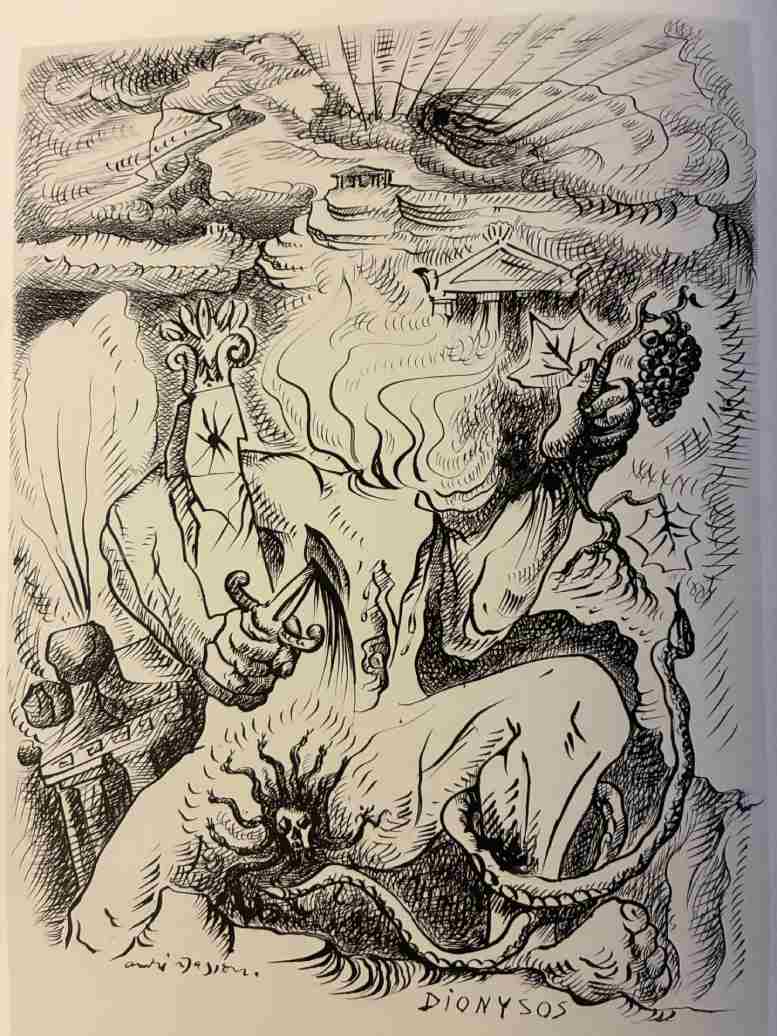
Dionysos by André Masson, 1936
CHRISTIAN: Experiencing such excesses so young had one immense virtue: the appeal of alcohol diminished very quickly. A few years later, at underground metal gatherings where everyone else indulged heavily, I often drank the least. My beverage of choice was black coffee, no sugar.
When we discussed this period, you argued that there is ‘no Charles Bukowski without the alcohol’ – excess as inseparable from creation.
CHRISTIAN: Excess takes many forms and is most meaningful when it pushes you to your very limits, physically, mentally, and spiritually. I once attempted, over three increasingly feverish days during which I barely ate or slept, to recreate in real life the essence of Georges Bataille’s Madame Edwarda.
The novella follows its narrator through a night of debauchery that spills out of a Parisian brothel and into the streets, where erotic abandon becomes an encounter with the sacred, as terrifying as it is ecstatic.
CHRISTIAN: I dare say that what I lived through then – born from the limitless power of the Word and made concrete – changed me profoundly. Some might call it a libertine moment, but in truth it was a liminal one, spiritual above all else. A genuine expérience-limite, perhaps, in the Bataillean sense of the term, and an instance of what he also called inner experience. It is impossible to convey such a state in ordinary language to anyone who has not undergone something similar, as its very nature defies any objective or material description: what matters most cannot be seen with the eyes. When I later looked for parallels, accounts of ritual suspension or the ceremonial consumption of ayahuasca seemed to come close. The divine, with all its scent of sulphur, was present – that much I can say.
Bataille’s sulphur reached the studio, too: Madame Edwarda gave “Diabolus Absconditus” its conceptual basis, and DEATHSPELL OMEGA used samples and effects to evoke the narrator’s vertigo.
CHRISTIAN: I also count physical challenges among forms of excess, as they can affect body, mind, and spirit alike, and those are part of my regular routine. And if you’ll allow me a digression: my fondness for Bukowski owes something to his ability to portray the lives of people who might as well belong to a different species from my own.
There seems to be very little middle ground in your preferences, whether in art or vices.
CHRISTIAN: In a sense, my current relationship with wine reflects how I approach most things: seek out the best, discard the rest. And a single exceptional glass can give you something to ponder for weeks, if not months! So, while I’ve never been addicted to alcohol, cigarettes, or drugs, I concede that they serve some transient purpose.
The list conspicuously omits the obsession that, by your own account, consumed sixteen hours a day for the better part of several years.
CHRISTIAN: It’s different in essence: work, in the field we’re discussing, is vocational – a calling born of an inner necessity. If you want to leave the religious undertones aside, or rather reframe them, the Romantics were already speaking of the sacralisation of art, and of how everything in one’s personal life could be subordinated to that undertaking.
What did that subordination mean for you in material terms?
CHRISTIAN: I was living a very frugal life at the time. I mean, when your only occupations are work, hiking in the woods, listening to music, reading, and the occasional solitary trip to a museum in Paris, you can get by on remarkably little.
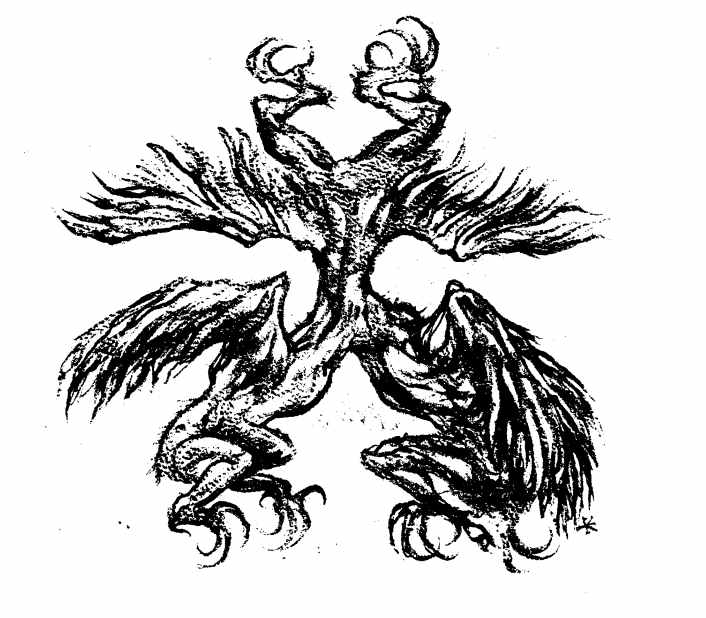
Ἱερὸς Γάμος by Timo Ketola
CHRISTIAN: As a young man, I’d adopted a mental model of comparing the price of virtually everything – especially food and drink consumed outside the home – with a demo, CD, vinyl, or book. By this logic, a night at the pub was indefensible when you could procure several items that would last a lifetime for the same cost.
The arithmetic stayed with him, though the scale grew considerably. During the trilogy period – on top of the label, the band, and everything else – Christian spent a year taking courses on the history of modern finance.
CHRISTIAN: The world had just been shaken by the subprime crisis, and while reading the newspaper over breakfast, I stumbled upon Warren Buffett’s warning, issued a few years earlier, that derivatives were ‘financial weapons of mass destruction’.
log in to keep reading
The second half of this article is reserved for subscribers of the Bardo Methodology online archive. To keep reading, sign up or log in below.
Related reading