Liber Ketola XXXX
2026-11-04
by Niklas Göransson
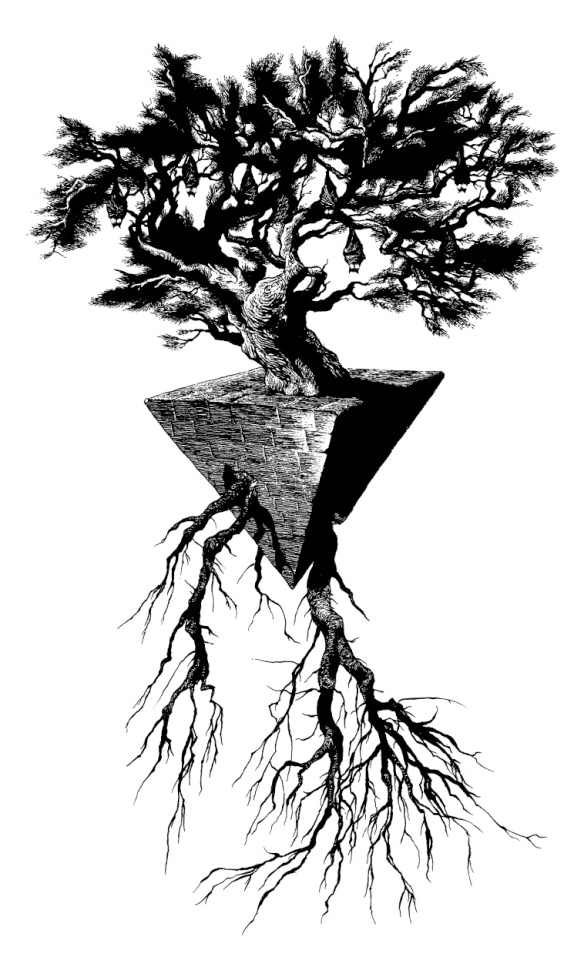
For Arktau Eos’ Unworeldes, Timo Ketola drew a tree that flowered in the northern sky, its branches hung with creatures of his own devising. Meanwhile, Malört’s edition of Varulven sent him looking for the werewolves of rural folklore.
ANTTI LITMANEN: Our earliest workings set in motion a force that’s carried ARKTAU EOS through all these albums to this day. At the time, it truly felt as if something was responding from the depths – whatever Anti and I decided just came together with vast intensity.
As BABYLON WHORES tapered off in 2003, Antti met Oulu-based musician Anti Haapapuro. The two found common ground in esoteric practice, and Antti began making regular trips north. On the summer solstice of 2006, following seven months of musico-magical activity, Haapapuro’s Aural Hypnox released ARKTAU EOS’ debut, “Mirrorion”.
ANTTI: “Mirrorion” documents the earliest stirrings of this project; a lot of what you hear comes straight from the inaugural ARKTAU EOS ritual. All kinds of sounds ended up woven into the fabric – there’s even a track with acoustic guitar, almost a ballad. That was the last remnant of the traditional musical world to creep in.
Released the same day, “Scorpion Milk” was its spontaneous offshoot: a single, extended piece of ritual ambient, recorded live to analogue tape.
ANTTI: Where “Mirrorion” is this huge arena of energies, its companion album is musically far more deliberate – focused and direct. “Scorpion Milk” is like someone sitting alone in a room with a candle, staring into the flame, drawing all that energy to a single point before it boils over.
In 2007, building on the momentum of the first ARKTAU EOS emissions, Antti relocated from Helsinki to Oulu. By then, Haapapuro’s Katajan Kaiku had grown into a fully equipped analogue studio, allowing recording, mixing, and mastering to be handled entirely within their immediate circle.
ANTTI: Having unfettered access to this atmospheric, almost temple-like space, full of coveted vintage equipment, made for amazing working conditions. Mixing everything in one place, through a chain of proper old analogue desks, gave our music a certain edge you just don’t get in a sterile, computerised environment.
Relocating to a fairly remote corner of northern Finland had an unexpected consequence: Antti now saw more of Timo than in all his Helsinki years. Timo’s parents lived in nearby Kalix, on the Swedish side of the border, and Oulu lay conveniently on the route.
ANTTI: He would often stay with me for a couple of days, which gave us plenty of opportunities to talk. We’d catch up, of course, but I also got the impression – and this is mere speculation – that he was kind of making up for lost time. Remember, Timo didn’t spend much of his childhood in Finland.
Timo was only three years old when his family moved to Sweden and settled in the Stockholm suburb of Brandbergen.
ANTTI: Timo worked diligently at mastering his mother tongue. He already spoke excellent Finnish, but wanted to learn more about the roots of our language and delve into poetry and literature – the Kalevala and so on – to deepen that knowledge and perhaps recover something he’d partly forgotten.
Two years earlier, OFERMOD’s Mika Hakola – born in Sweden to Finnish parents – had glimpsed the same impulse. Although they mostly spoke Swedish in person, Timo insisted that all written correspondence be in their shared native language.
ANTTI: One legacy of that early uprooting is the persistence of old and quaint expressions in the idiom. I hardly count myself among the most pedantic language purists, but as our literary landscape is awash with unchecked Anglicisms, encountering such a rare register has its undoubted charm.
What do you think drew Timo back towards his heritage in later life?
ANTTI: Part of it probably came down to maturity and growing more interested in questions like, ‘How did my mind take shape? Where do I come from?’ – and not only geographically. I firmly believe Timo was a mystery even to himself, so he made a concentrated effort to understand what it meant to be Ketola.
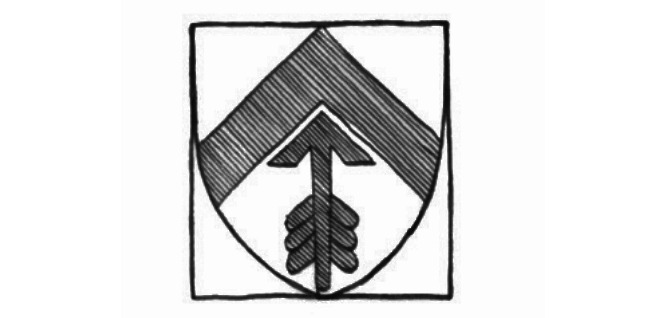
ANTTI: Timo had a profound inner drive to connect with his forebears. At some point, he designed a family crest – which goes a bit deeper than a casual interest in your grandfather’s Winter War exploits or whatever. I can’t remember half of what he got up to, but he’d even fixate on things like sketching the ground plan of their ancestral home in a notebook.
Timo’s research had traced the family to Hailuoto, an island off Oulu inhabited since the 12th century. In the island’s church village, the Ketola–Prokko farmstead occupies a site marked on a local map as early as 1766.
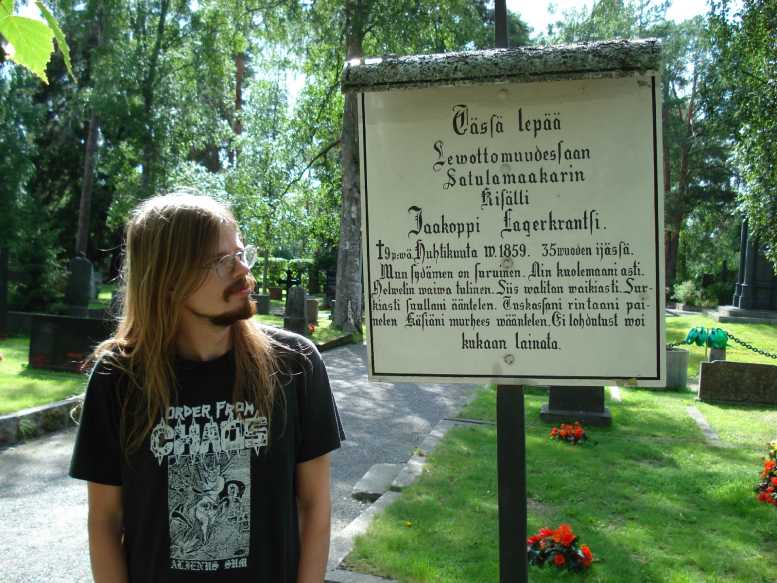
ANTTI: At least once, he went out to the island to meet an uncle or cousin or somebody. I stayed behind – this was another of Timo’s special missions, a pilgrimage to undertake alone. That relative gave him rough directions to a graveyard where one of their ancestors lay buried, and we actually managed to find the Ketola in question.
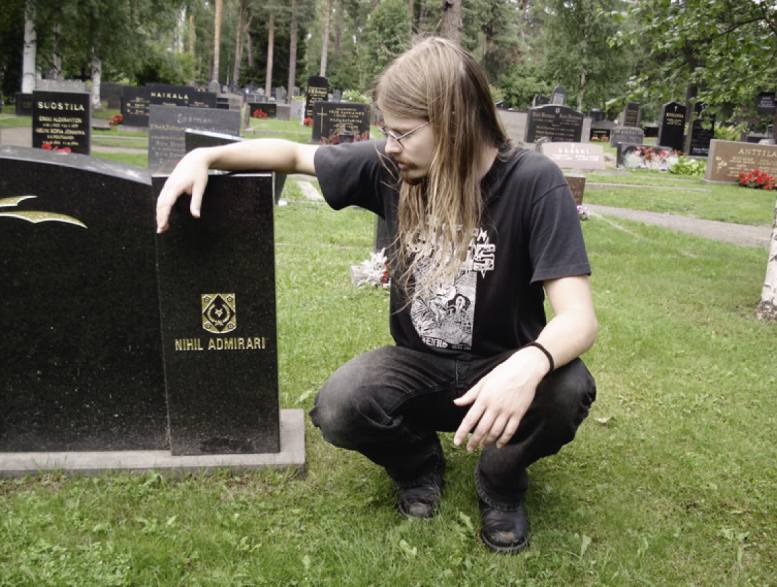
The crest and several field sketches appear in Liber Ketola, including a drawing headed Hailuodon Ketolat – ‘The Ketolas of Hailuoto’. The monograph also features a photograph from the Oulu Cemetery visit, showing Timo on his haunches beside a headstone engraved Nihil admirari – ‘marvel at nothing’.
ANTTI: I can’t recall the grave’s occupant now, but watching him stop and go, ‘Okay, Nihil admirari; photo, please’, was such a classic Timo moment. I’m sure you’ll agree that he had a sort of casual morbidity about his interests – the mystery of death especially. No gloating, no posing.
ANTTI: On a related note, I also remember the first time Timo met my girlfriend in Oulu. While rummaging through his wallet, he produced a razor. ‘Oh, a blade’, he said, almost absentmindedly. Then, looking up at us with complete nonchalance, he added, ‘I always carry one in case I come across any dead birds.’
Avian remains had featured in Timo’s work since the cover of Dauthus #1. By the third issue, he was creating entire collages from severed bird feet.
ANTTI: My girlfriend gave me a somewhat bemused look. Before long, however, she grew accustomed to Timo’s oracular one-liners, and the following year we visited him in Sansepolcro. Around the same time, I introduced Timo to Anti, who ran a print shop, so they could discuss printing techniques – how inks react on particular papers and so on.
In the early Dauthus days, Timo haunted Haninge Tryckeri until the staff objected to his skulking around their printing press. Finding a professional keen to talk shop must have had him levitating with delight.
ANTTI: <laughs> Yeah. Anti deserves credit for a long-term investment in learning both studio work and printing, honing his craft daily. Production-wise, only the actual pressing of vinyl or CDs remained out of our hands: custom labels, covers, et cetera were already achievable in-house.
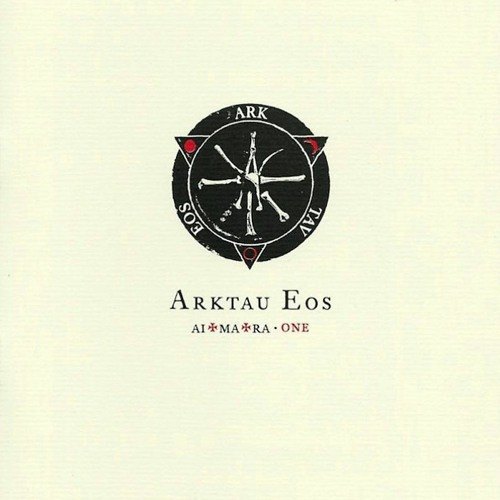
“Mirrorion” came as a six-panel A5 insert: ivory pages, black-and-red ink, and little more on the cover than the bön-eye and a title that partly reverses itself.
ANTTI: The reversed element in the title wasn’t premeditated, but if one wants to see a reference to a black mirror, the connection isn’t entirely unwarranted. We’ve always paid close attention to presentation. The paper, the typeface – everything should be part of the whole. Having all those resources within our circle really helped us shape the ARKTAU EOS aesthetic.
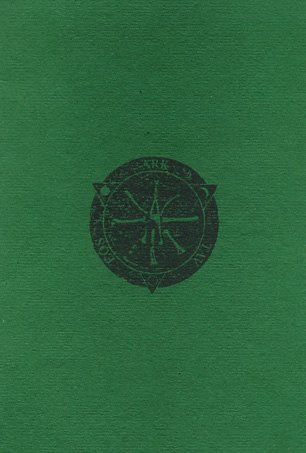
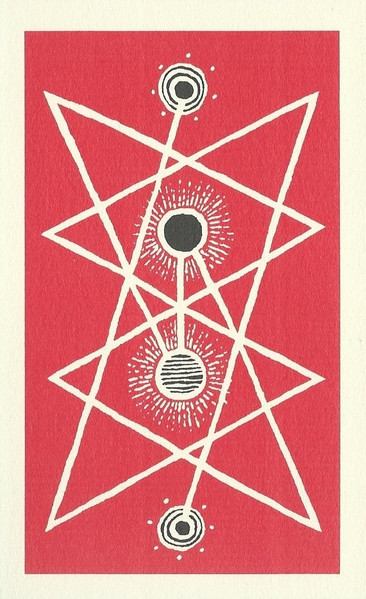
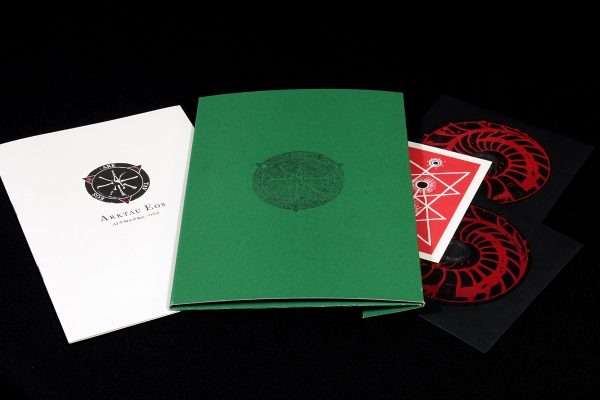
Three years later, “Ai Ma Ra” arrived in a deep-green box stamped with the ARKTAU EOS seal, containing both discs, a talismanic print, and a booklet bound tête-bêche – two front covers, each inverted relative to the other.
ANTTI: We envisioned “Ai Ma Ra” in terms of all the dualities at work at the time. The tête-bêche format probably owes something to Fulgur’s original 1992 edition of Austin Osman Spare’s The Witches Sabbath and Axiomata. Together with A. D. Chumbley’s The Azoëtia, that book helped launch the grimoiric revival, whose ripples are still felt today – major landmarks, both. I also did a degree in typography and design and was extremely inspired by Bringhurst.
Robert Bringhurst’s The Elements of Typographic Style, first published in 1992, remains a standard reference on its subject. Tilmann Benninghaus introduced Timo to it in the late ‘90s, though neither man ever made read the entire tome.
ANTTI: Bringhurst is important because he’s a poet at heart. The Elements would be readable even if you had no interest in typesetting whatsoever. Obviously, the book is packed with information on classical typography – but more than anything, it really is a meditation on loving your craft.
With Peter Smith’s bön-eye, the bone seal, and the talismanic prints, ARKTAU EOS built their visual representation around elemental forms – circles, crosses, triangles – to leave room for the observer’s own associations.
ANTTI: I think the enthusiastic reception of our early works came down to us doing something both unique and communicable. The great dark ambient boom that followed quickly became a bit tiresome, though: a torrent of albums covered in syncretic symbology drawn from all sorts of sources.
The expansion is reflected in Discogs’ catalogue, which has around four hundred dark ambient releases dated 2000, compared with nearly five thousand for 2015 – more than half of them digital.
ANTTI: I hope we inspired a few people to do something more original – not by being deliberately weird, but by reaching towards the roots of things instead of getting stuck in the imagery of a particular cult or order. Of course, anyone familiar with us can probably recognise the influences behind certain elements. But the point has never been to drown the listener in an information soup from different traditions.

PER FAXNELD: Socially, I’d drifted from the black metal scene to some extent, but I still listened to the music and attended the occasional special gig – the first DISSECTION show after Jon Nödtveidt got out of prison, for instance, or OFERMOD’s live debut in Sweden.
Few academic articles open with someone being kicked unconscious. Per’s 2015 essay on black metal as a form of new religiosity, published in the Norwegian journal DIN, recalls the OFERMOD show five years earlier: a muggy early-summer evening, thunder in the air, and Mika Hakola planting a boot heel in the face of a young heckler.
FAXNELD: I’ve never met or spoken to Mika, but I’d admired his musical output for years. There was something unmistakably ‘real’ behind OFERMOD, if I may put it that way – you could sense it in the interviews and in the music itself, which had a completely unique character.
Your article describes several audience members greeting the violence with enthusiasm – this, they said, was exactly how black metal should be. What did you make of that?
FAXNELD: Given the context, it seemed fairly reasonable. That sort of thing was commonplace in the ‘90s but had faded by then, so perhaps it could be seen as a flame being rekindled.
That same year, Per and a cabal of academics and industrial music veterans founded Malört förlag. Having enjoyed their collaboration on Mörkrets apostlar, he proposed Timo as the publisher’s resident artist and designer.
FAXNELD: From the outset, as fellow bibliophiles, we agreed on two priorities of equal weight. First, the content: every book that was a translation or reissue of older writings needed interesting supplementary material, and the text itself had to be meticulously edited and proofread.
The second concerned the physical object – and here, Timo was uniquely qualified. Besides his eye for layout, he had trained in traditional crafts such as bookbinding and restoration.
FAXNELD: These weren’t meant to be disposable books; we wanted to create bibliophile monuments to last for generations. Visually, too, everything had to be of the highest possible standard, with a character of its own. Without Timo, we’d never have achieved the quality that became Malört’s hallmark.
The imprint’s debut title appeared in early 2011: Den förälskade djävulen, the first Swedish translation of Cazotte’s 1772 novel Le Diable amoureux. Timo created Malört’s wormwood-flower logo but used existing illustrations inside the book.
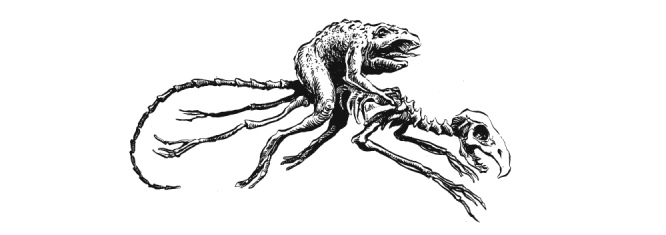
FAXNELD: I’d found a 19th-century French edition full of strange little vignettes, including this drawing of a frog riding a skeletal creature. We used it on the last page, and for the next Malört project, we decided to come up with a variation. That’s how Timo came to draw his first tailpiece – for the werewolf book.
FAXNELD: Back in the ‘90s, my studies followed three main strands. One was history of religions, another film – for a while, I even considered becoming a horror cinema scholar, the genre being a great passion of mine. The third grew out of my fascination with older folk beliefs, which led me to ethnology.
In Sweden, the discipline grew out of efforts to study and systematically record peasant customs, beliefs, and lore before modernity swept them away. Its Stockholm department was housed in Wicanderska villan, a turn-of-the-century merchant’s mansion on the royal park island of Djurgården, a stone’s throw from the country’s largest museum of cultural history.
FAXNELD: An incredibly atmospheric place – the actual teaching, alas, rather less so. Unbeknownst to me, Swedish ethnology had veered off towards matters such as postmen’s uniforms, sailing blogs, multicultural suburbs, and the various challenges of modern society.
Not quite what you’d signed up for, I presume.
FAXNELD: Not at all. I wanted to study the mysterious beings of folklore – trolls, werewolves, fairies, household spirits – and there was precious little of that. I dropped out after the first term, but the older research never lost its hold on me. Ella Odstedt, for instance, one of the most important figures in the field.
Born in 1892, Odstedt grew up on her grandmother’s tales of the vittra, the hidden people said to dwell underground. Decades of fieldwork across Sweden followed, recording traditions and preserving thousands of memories of 19th-century peasant society. What secured her lasting reputation, though, was Varulven i svensk folktradition, a 1943 study of werewolf lore.
FAXNELD: Varulven was sought-after and hard to find second-hand, so making it available again felt logical. The book has also aged well, research-wise: rather than leaning too heavily on the fashionable theories of the day, Odstedt assembled her material very methodically, and her interpretations have stood the test of time. And everyone likes werewolves, of course.
How did you decide which additional material to include?
FAXNELD: The whole Malört team discussed how to make our edition worth buying even for someone who already owned the original. We soon realised it needed a text about the author – the more familiar we became with her work, the more interested we grew in Ella Odstedt as a person.
For the biographical essay, Malört turned to ethnologist Agneta Lilja. To place the werewolf material in a broader historical context, Per approached Tommy Kuusela, a fellow doctoral student at Stockholm University specialising in Old Norse religion.
FAXNELD: I asked whether he could write something about Old Norse wolf cults, berserkers, ulfhednar, and so on, and he jumped at it – Tommy likes werewolves beyond his research. Funnily enough, he’s also a former fanzine editor: he once ran a death metal ‘zine called Nazgul Mag.
Malört also obtained a 1950s photograph of Odstedt from the archives of Åbo Akademi, the Swedish-language university in Turku, Finland.
FAXNELD: Such an amazing photo: Odstedt stands outdoors in her fieldwork clothes, holding what appears to be a bear or a wolf mask. We don’t know the story behind it, but the image is very evocative; you immediately start imagining secret lycanthropic cults in the Swedish countryside.
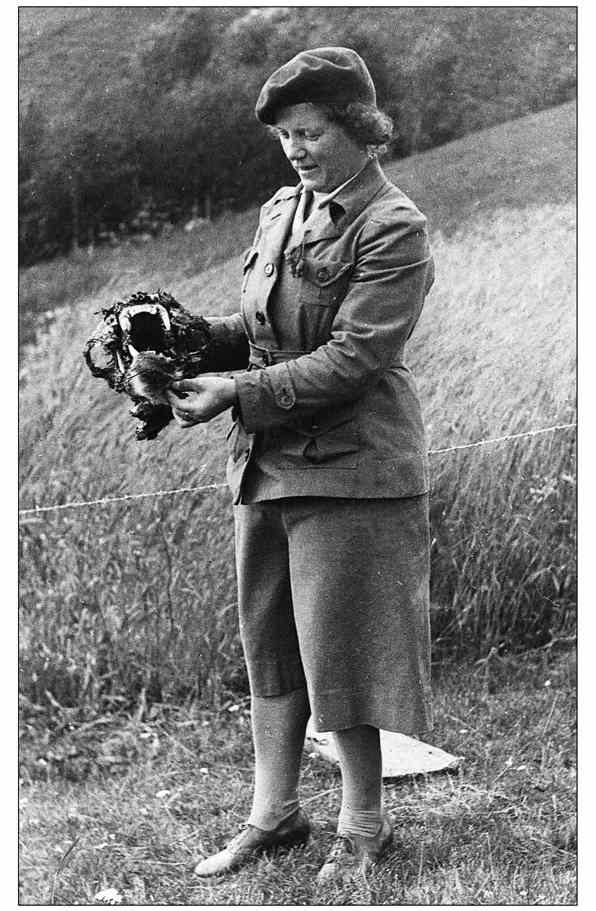
Ella Odstedt (1892-1967)
ANTTI: Over the years, I came to recognise a rare quality in Timo: he was a curator who could engage musicians in a kind of Socratic dialogue, putting forward his own ideas while also pushing the band to take their work more seriously. I really admire what he did for TEITANBLOOD, for example.
While the Spaniard’s debut was still in the making, Timo put Antti in touch with Nasko. In May 2009, shortly after its release, the two met face to face in Berlin – both staying with Tilmann to catch the brief reanimation of KAAMOS.
ANTTI: “Seven Chalices” is monumental, born of years of gruelling work. But I imagine Timo sometimes enjoyed a more spontaneous approach, too. I mean, he was always doodling – maybe some of the pieces falling off the edge of the table were just as worthwhile in their own way.
Did you ever discuss a collaboration during your first decade of friendship?
ANTTI: Not really. Back in the BABYLON WHORES days, it didn’t appeal to Timo at all, so my music remained a peripheral topic. As you know, his metal preferences were… somewhat particular. I’d often struggled to grasp what he found so noteworthy about a given demo.
In Timo’s eyes, BABYLON WHORES had two strikes against them: audible evidence of a professional studio recording and song structures one could easily follow. For a man who rated a two-song instrumental TEITANBLOOD rehearsal tape above almost anything in twenty years of death metal, a deathrock band touring with KING DIAMOND never stood a chance.
ANTTI: Once Anti and I started ARKTAU EOS, Timo seemed far more receptive. We never spoke formally about bringing him into our circle – it all developed very organically. In 2011, he came through Oulu on one of his trips north, and we’d just finished recording “Unworeldes”.
As with “Mirrorion” and “Scorpion Milk”, ARKTAU EOS had prepared two albums in parallel – both destined for a late 2012 release through Svart Records.
The CD-only “Ioh-Maera”, a five-phase cycle about seeding dreams and dissolving the border between sleep and waking, centred on gongs, drums, and whispered voices. Its vinyl counterpart, “Unworeldes”, offers four long, slow-moving pieces of drone and bowed-string minimalism, laced with distorted feedback.
ANTTI: I was explaining the album’s structure and concept – how we envisioned it – when Timo had one of his lightning-flash ideas. He looked at me with a blank face and said, ‘Oh, so why don’t we just go to the shop, get ourselves a few beers, and start drawing straight away?’
log in to keep reading
The second half of this article is reserved for subscribers of the Bardo Methodology online archive. To keep reading, sign up or log in below.
Related reading