Liber Ketola XXII
2026-07-01
by Niklas Göransson
Recorded in a single night, Teitanblood’s Seven Chalices then sat the better part of a year, held back by its unfinished visuals. Timo Ketola sank deep into the artwork, each detail resolved only to open another beneath it.
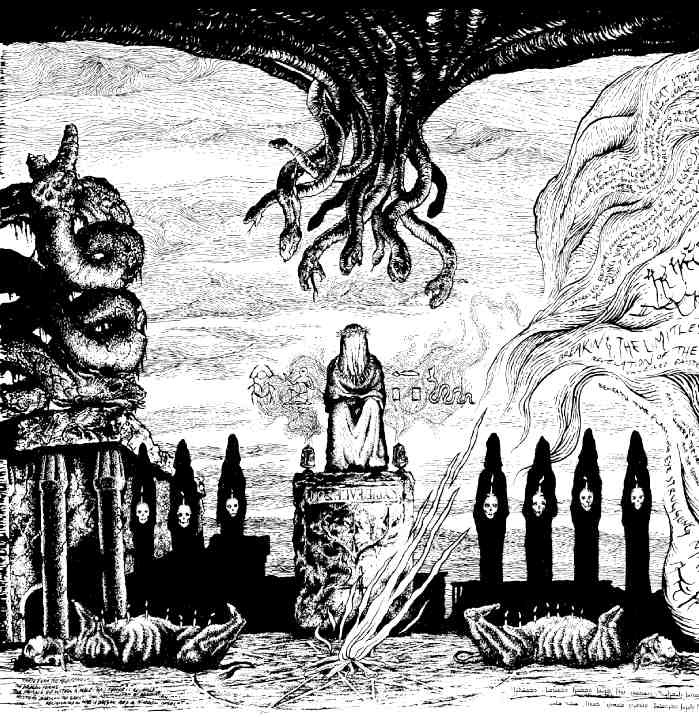
NASKO: The final stretch of “Seven Chalices” was very challenging and exhausting. I don’t know exactly how Timo felt, but we were both clearly burnt out and just wanted it finished, to move on to other things. So, that reflects our state of mind towards the end.
By early 2009, TEITANBLOOD’s “Seven Chalices” – an album recorded in one night – had been delayed for almost a year by the gruelling process of its visual presentation.
NASKO: When Timo and I got started, neither of us spared a thought for logistics – timetables, planning, any of it – which perfectly explains why everything spiralled out of control. I knew we stood on the cusp of something great, but not seeing the light at the end of the tunnel brought a lot of pressure.
The lack of planning might have been survivable had the task remained a single cover. Instead, each song developed into its own visual world – symbolic and intricate enough to rival what most bands put on an entire album sleeve.
NASKO: Remember the three-headed goat Timo made for DEAD CONGREGATION – the one based on an illustration in Dauthus #3? That is the kind of artwork I expected from him. Now, I don’t know where we got lost in translation, but I suspect this reorientation was largely due to “Reinkaos”.
When Nasko first approached Timo about a TEITANBLOOD cover in late 2005, the answer came back no. Deep in the final stages of DISSECTION’s “Reinkaos”, Timo explained plainly that the project had worn him out, to the point of considering a break from album covers altogether.
“Reinkaos” was the most ambitious commission of his career: detailed illustrations for nearly every song, roughly a year of meetings with Jon Nödtveidt and Erik Danielsson, each motif weighed for symbolic accuracy down to the arrangement of the moon’s phases.
NASKO: He turned our simple, crude concepts into these massively ambitious pieces of art without either of us realising it. We were just exchanging ideas like crazy, and eventually landed in this strange mixture of grandiose motifs with writings in different languages woven through them. So, there was no control or common sense applied, nor even the simplest basics of proper project management.
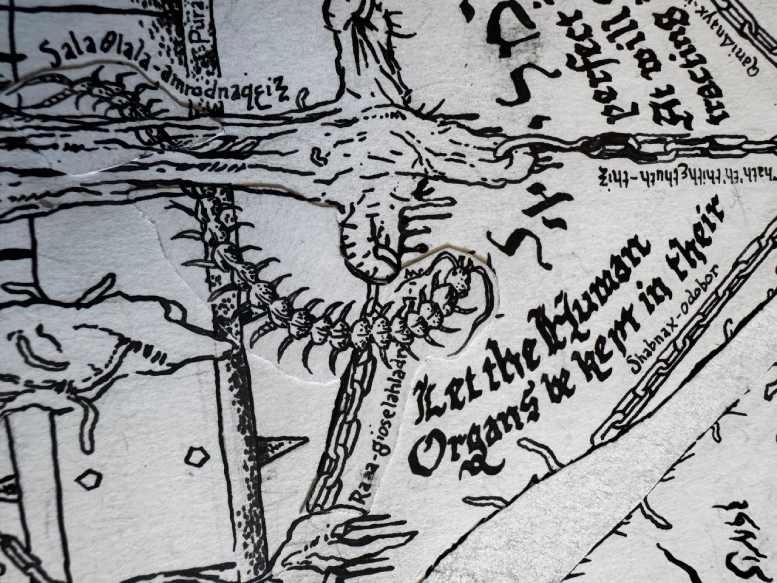
The designs grew absurdly intricate – motifs layered with text in multiple scripts and alphabets, several demanding actual research and, in some cases, the eye of a trained linguist. And none of it held still; every piece underwent constant reworking, expansion, and amendment, each pass adding another layer that then had to be reconciled with everything else.
NASKO: If you look in my Ketola archives, you’ll see one sketch placed over another, all pasted together on a blank sheet using some sort of sticky paper. He would also print out excerpts from the emails I sent and set them next to his collage, kind of engaging with my thoughts while working.
In a brief aside from January 2009, around the completion of DEATHSPELL OMEGA’s “Chaining the Katechon” and FUNERAL MIST’s “Maranatha”, Timo alludes to the physical and psychological toll “Seven Chalices” had exacted: ‘I just noticed a white strand in my beard. It certainly wasn’t there yesterday.’
NASKO: <laughs> Actually, another reason for the delay – and part of the frustration too – was that he kept taking on other commissions at the same time. At some point, I said, ‘Come on, before you start on something else, try to finish at least one of the TEITANBLOOD pieces.’
In a separate email, Timo acknowledged the mounting delays and pressure to finish. He grudgingly refers to a certain ‘French prediction’ regarding his optimistic timeline estimates, which now appears to be coming true. I assume Christian arrived at this foretelling not through oracular powers but from hard experience with DEATHSPELL OMEGA commissions.
CHRISTIAN BOUCHÉ: The prediction certainly amounted to warning him that, even under drastic discipline, it’d be humanly impossible to finish everything the way he’d laid it out. Since “Seven Chalices” was foremost a Dauthus 1899 release, the responsibility for seeing it through eventually rested on Mr Ketola’s shoulders. After the initial extension of the timetable, I reverted to a wait-and-see mode. Nasko dealt directly with Timo; I merely kept an eye on the relevant updates.
Having been through this before, did you at any point warn Nasko what to expect?
CHRISTIAN: Probably not in excruciating detail. I likely kept any warnings gentle in tone, so as to avoid causing him unnecessary anguish. I simply tried to stay grounded, assuming that concrete plans would be made once there was substantial progress.
NSK
‘Yes, this time it’s for real’ – on Friday, February 6, in a message to Nasko, Christian, and Tyler Davis of The Ajna Offensive, Timo announced that “Seven Chalices” was finally ready to move towards production, with the files scheduled for upload to the G.Z. and Icon servers on Monday morning. He stressed the deadline’s gravity in a postscript, almost as if to pre-empt disbelief: ‘PS. I mean it!’
Even at this late stage, however, parts of the layout remained unfinished. Much of the artwork still existed on paper rather than as completed scans, undergoing what Timo called ‘infinite final minor fixes’.
NASKO: Niklas, you wouldn’t believe how many times I looked at a sketch and said, ‘Great! Done.’ – ‘Not at all, there’s a line I want to make a fraction of a millimetre thicker in one of the corners.’ At some point, Timo told me, ‘I always perform better under pressure, so give me a deadline.’ But that didn’t work either, because he’d find a detail he disliked, scratch it, and rework it into something different… which, in turn, would spark a fresh set of ideas.
TYLER DAVIS: I’m just trying to imagine how many hours Timo and Nasko must’ve spent firing emails back and forth, month after month, with everything scrutinised in minute detail. I mean, didn’t Nasko work a job during all this?
NASKO: Yeah, I was employed full-time as an engineer, often working ten-hour shifts. But other than this, everything revolved around TEITANBLOOD.
Thirty-six minutes after Timo’s announcement that “Seven Chalices” would finally go to print the following Monday, Christian replied with dry amusement: ‘Interesting. I’ll believe it when I see the files uploaded on the FTP.’ In addition, he confirmed the master was already at the plant, meaning production could begin the moment the artwork arrived.
At 4 am on February 9, Timo solemnly declared the promised Monday-morning upload unattainable. With only three and a half hours until his self-imposed deadline, he admitted defeat. Stimulants – ‘tea, coffee, dark chocolate’ – and “Maranatha” on repeat had failed to get him there: the ‘minor fixes’ resisted being forced without risking serious mistakes.
Rather than push sleeplessly into the morning, Timo decided to stop. His reasoning was practical: exhaustion at this stage could lead to pagination errors, missing files, or other print-stage disasters. He recalled an earlier mishap with DEATHSPELL OMEGA’s “Kénôse” booklet, where a page had been left out.
CHRISTIAN: Working under pressure is a double-edged sword. Tunnel vision sets in – and ‘foam at the mouth’, as Timo sometimes put it – but even a genius like him could stumble in the rush. So yes, urgency can be a tool, though one with its own limits and risks.
The delay, then, wasn’t quite an abandonment of Timo’s target date so much as a controlled retreat – production pushed back a single day to avoid compromising the final files. The revised plan was unambiguous: ‘TEITANBLOOD goes to print on Tuesday morning.’ The message ends with no attempt at justification beyond the bare fact of it: ‘I have no comments. Merde.’
J
Two days later – Wednesday morning, February 11 – the “Seven Chalices” layout had still not been uploaded. Timo shared a detailed incident report: the ‘Lesser Gods’ were attempting to obstruct completion by severing his internet connection, a power outage having knocked the antenna out of configuration.
TYLER: Timo’s essay-length explanations for being late were a constant source of amazement to me. I was like, ‘You could have finished the damn artwork in the time it took to type all this!’
Timo then listed his remaining tasks with almost production-manager precision. Symbols of phosphorus, mercury, lead, and sulphur had yet to be drawn for the vinyl labels. The cuneiform phrase ‘inum sa bibbim’ awaited insertion at the foot of “Morbid Devil of Pestilence”. And several drawings, naturally, needed final touch-ups. Notably, every item on the list was Timo’s alone to execute.
NASKO: Re-reading these rambling 3 am emails now, you can see Timo essentially thinking out loud – holding long, active conversations with himself, which is something I used to do a lot as well. In the end, “Seven Chalices” grew beyond a simple collaboration between songwriter and artist. There were many voices talking, pushing against each other all at once; it sometimes feels like a collective effort rather than just the two of us.
The schedule, however, remained precarious. Timo conceded that his earlier estimates had become almost absurd, attributing the latest slip to what he called ‘afternoon syndrome’: submitting files to G.Z. at four or five, after the Italian siesta, would be pointless. He planned instead to use the night for final adjustments and upload everything the next morning at 10:15, when the internet point opened.
NASKO: Timo would perform a kind of mental planning, sharing these focused, disciplined schedules: ‘Right, I will take care of this now, start that at 6 pm., and keep going until noon. After a three-hour nap, I’ll drink two cups of black tea and resume work fresh and energised. Let’s go!’ It was like an email diary, chronicling his experiences. Then he’d get distracted and reschedule everything all over again.
‘I don’t expect you to believe me when I say that all will be uploaded to G.Z./Icon tomorrow, Thursday morning’, he continues, assuring everyone he means it this time. The pressure was no longer purely artistic; Timo notes how each additional day now costs him money, since he cannot take on new work until “Seven Chalices” has gone to print.
NASKO: At that point, Christian and NoEvDia handled the “Seven Chalices” budget, so I had no clue about the agreed compensation. Nor was I aware of Timo’s overall financial situation, or even what kind of lifestyle he kept. He would often mention tea, bread, and cheese – but I always assumed, ‘Oh, he is having a snack’, not realising it meant dinner.
CHRISTIAN: I am revealing no secret in saying Timo never enjoyed financial comfort. I always tried to pay him as much as we could afford, and by underground criteria, from 2006 or 2007 onward, his rates were not cheap. Occasionally, a well-paid commission would come along – I’m thinking of one for Century Media in particular – and right his finances for a couple of months. But the trouble was that he poured insane amounts of time into most projects, which made it mechanically impossible to earn a decent living.
NASKO: It didn’t occur to me that Timo had a really low income, or sometimes even struggled to afford proper food. He never brought it up either, so I just thought, ‘Okay, we have a label taking care of payments.’
CHRISTIAN: Part of the problem was a chaotic work process and, yes, a certain bohemian distraction, simply an element of his nature. But ultimately he meant to deliver real value to people who trusted him – and tunnel vision or not, quality takes time. “Seven Chalices” stood apart entirely. Everyone reading this will see how much of himself Timo put into that artwork.
On the morning of February 12, Nasko emailed Tyler and Christian, relaying an SMS he had received from Timo: the “Seven Chalices” files would now go up on Sunday rather than Thursday. Nasko’s only comment: ‘Oh well, at least I’m not in SADISTIC INTENT.’
At 8 am the next day, Timo’s internet connection had returned, allowing him to share joyous tidings. After ten hours of focused work, he’d cleared one of the remaining major layout obstacles: the back cover. Minor issues lingered – mainly tracklisting typos – but the substantial artwork was, at long last, done. Again.
TYLER: Do you know more about the back cover obstacles? I must have seen five different versions of that design – all very similar, but each just as obsessive and detailed – meaning he redrew the damn thing at least five times.
NASKO: The back ended up almost as maddening as the front. I remember an email saying, ‘Here’s an update on the cover’, and I could see it was finished. Man, imagine a whole year of building expectations, and at last, I have this piece sitting before me. But no, Timo insisted he still had a lot of stippling left to do, to get the proper texture along the outer edges.
Stippling is the gradual accumulation of tone and texture through countless individual dots – the denser the cluster, the darker the area – and it is as punishingly slow as it sounds.
NASKO: I was like, ‘What the fuck are you talking about? Are you delusional? Listen to me: the cover is a hundred percent finished.’ But Timo goes, ‘Just a couple more details here and there.’ At that point, I told him, ‘Please, hold off on the emails until it’s done. I don’t need to see your dot-by-dot progress.’
Worth noting is that this exchange took place a full month before the cover was deemed finished.
NASKO: In retrospect, if you compare the sketch from a month earlier to the final version, you’ll notice a difference. But day to day, everything blurred together into a pixelated photo taken with a low-res webcam… ‘Man, I see the same fucking picture as the last three times. I can’t even tell where the new dots are anymore.’
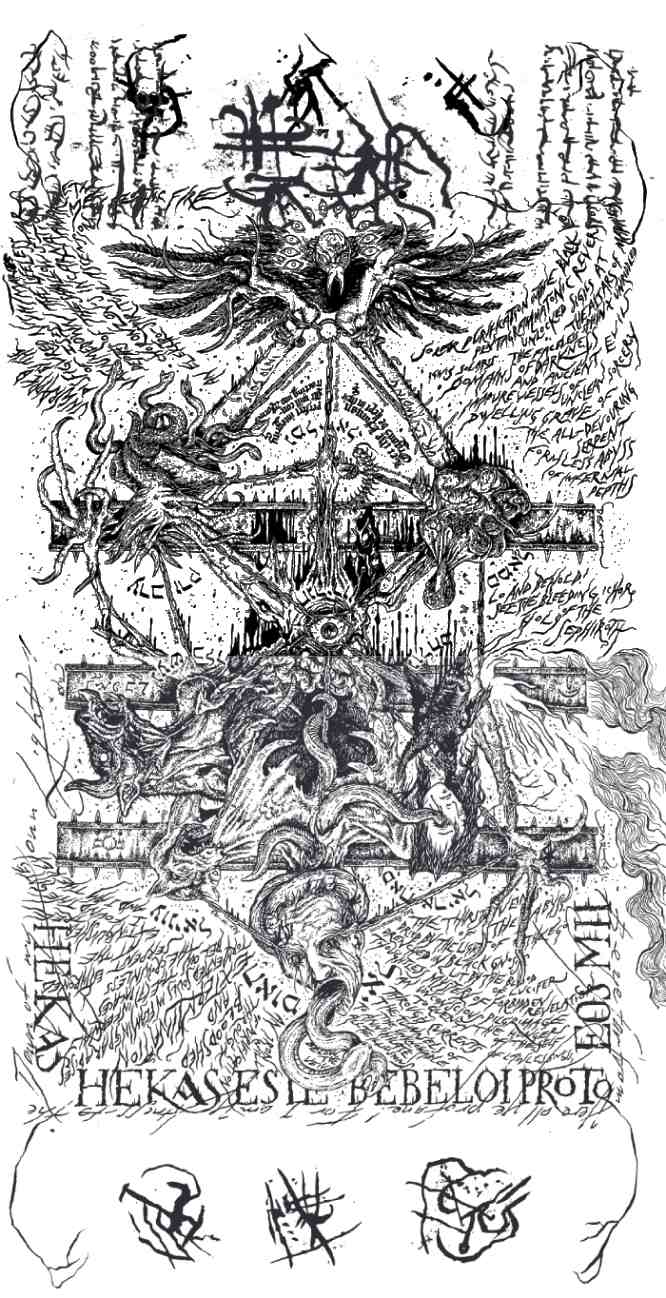
As usual, the update also lists Timo’s current workload. With the back cover complete, his remaining tasks had been reduced to a handful of final corrections: the Marquis de Sade quote and clothing details on a corpse in “Whore Mass”, additional demon faces in “Domains of Darkness and Ancient Evil”, more work on the serpents in the sky in “The Abomination of Desolation”, and one stubborn issue concerning the “Morbid Devil of Pestilence” lettering.
NASKO: I’d look at the previews, thinking, ‘Seriously, come on. It already looks fantastic.’ But there were undoubtedly nuances I couldn’t grasp at the time; I now realise I was unable to see the subtleties Timo could. I mean, if you took him to a museum, he’d spend hours staring at a single painting and still not be finished, going into that level of depth.
Are you speaking from experience now?
NASKO: Yes. When Timo visited me in Madrid, we went to El Prado. I remember seeing him stop, staring obsessively at a single canvas. I kept walking, looking at other things, and twenty minutes later he was still standing there, admiring the same piece. That museum has the Garden of Earthly Delights triptych, Goya’s Black Paintings, and – I think – the original The Triumph of Death.
Bosch’s Garden of Earthly Delights moves across its three panels from Eden to a nightmarish Hell, Goya’s Black Paintings – made directly on the walls of his house late in life – are among the bleakest images in Western art, and Bruegel’s Triumph of Death depicts an army of skeletons laying waste to the living.
NASKO: Timo told me, ‘I’m going to spend the whole day here tomorrow’, then added, almost apologetically, ‘I’d prefer to go alone; this way, I don’t feel bad making you wait.’ He went in the morning and came back when it closed, still not having seen even half. I think he returned to El Prado two or three more times, just to contemplate art.
Writing to Nasko, Tyler, and Christian on the afternoon of February 15, Timo announced, ‘Breakfast now, then doing last things.’ The message ends on a firm target: he expects everything to be uploaded to both the US and European servers by around 7 pm.
At 9:38 pm., Timo confirms: G.Z. and Icon should now have access to the vinyl covers and labels. He added, though, that he would likely keep updating the files through the night, ‘adding details and so on’. Fourteen minutes later, Tyler – clearly overcome by the finality of the moment – replied with a single exclamation: ‘Hallelujah!’
TYLER: Now that sounds about right.
Closing in on midnight, “Seven Chalices” sat in a strange, liminal state: the vinyl covers and labels were delivered already, but the LP booklet still needed work and had yet to enter the manufacturing chain.
Two hours later came another short update: a new iteration of the CD label had been made available for inspection on Timo’s preview server. The design, he noted, was essentially identical to the previous one, with a single crucial adjustment: it now looked ‘dirtier’.
NASKO: Honestly, I never cared about the CD format. Of course, the layout had to be adapted, and Timo expressed all kinds of demands – no transparent trays, a metallic-looking disc, and so on. But there were no discussions, not even opinions, from my side, because for me it’s like… well, I only own TEITANBLOOD releases on vinyl myself.
Half an hour after uploading the final CD label preview, Timo delivered a far more dramatic update: he had pulled the LP layout back off the server. The reason was blunt and absolute: ‘IT HAS TO BE RIGHT.’ He promised everything would be finished by Tuesday, adding, ‘you don’t have to believe me, but that’s it.’
Only minutes later, at 2:31 am, Timo sent a follow-up email that escalated his promise into a formal vow: if the files were not ready to print by the morning of February 17, Nasko would become the owner of one of Timo’s prized possessions – SADISTIK EXEKUTION’s “Sadistically Executed” EP.
CHRISTIAN: That’s right. I had entirely forgotten about the sacrificial seven-inch.
TYLER: Oh, that was the best part of all.
In the early hours of February 17, Timo dispatched another update. He mused over the wager from the night before, noting that someone had since offered to bet a badger skull against his chances of hitting the deadline. ‘One more cup of tea’, he wrote, undeterred by doubters, ‘and we move on.’

At 5:25 am, barely two and a half hours before the deadline, Timo reached out to Kosta Papavassilou – the custodian of his record collection back in Stockholm. ‘Can you dig up my SADISTIK seven-inch when you’ve got the time?’ He went on to outline possible methods of delivery: ‘either by mail or to Nasko in person at the coming KAAMOS gig in Berlin’.
KOSTA PAPAVASSILOU: Actually, on a later occasion, Timo also asked me to set aside an original copy of ROTTING CHRIST’s “Passage to Arcturo” for the same reason – though I don’t think that one was for TEITANBLOOD.
log in to keep reading
The second half of this article is reserved for subscribers of the Bardo Methodology online archive. To keep reading, sign up or log in below.
Related reading