Liber Ketola XXXXII
2026-11-18
by Niklas Göransson
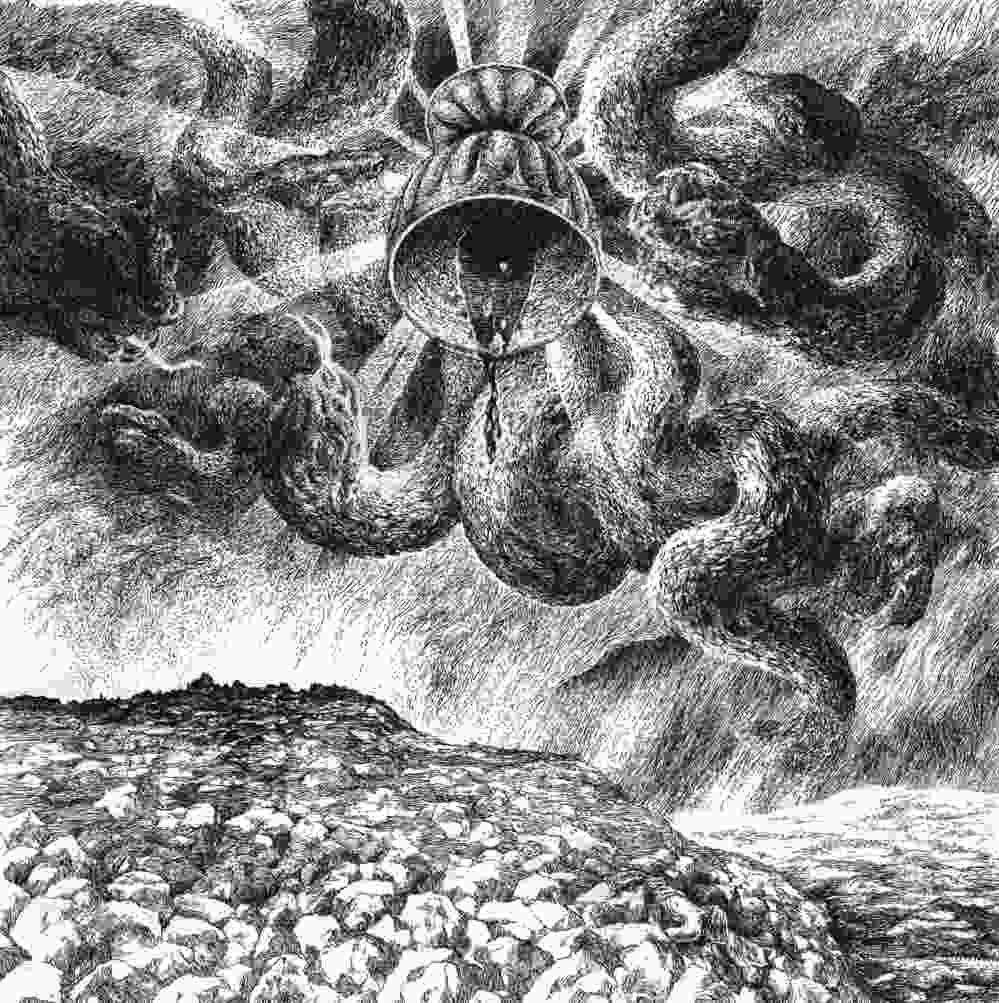
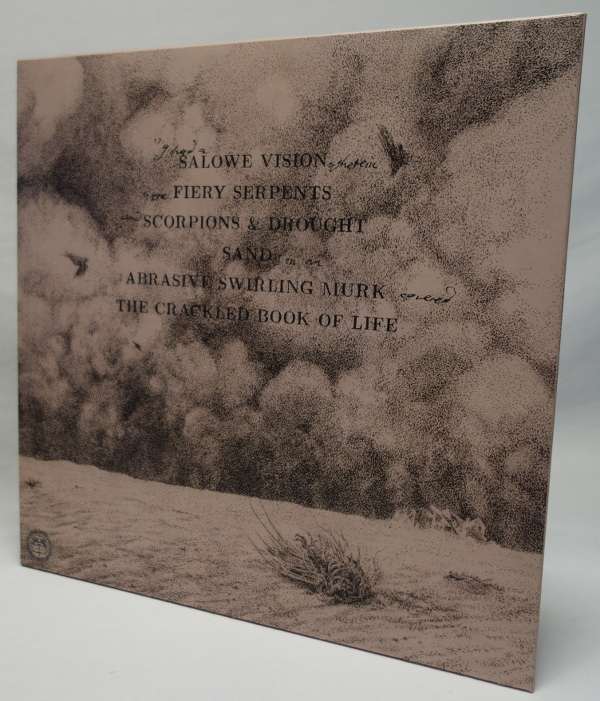
For Deathspell Omega’s trilogy box set, Timo Ketola overturned the chalice from Si Monvmentvm…, letting a thin black trickle fall onto a barren plain. On the back of Drought, another empty landscape lay beneath a sky thick with dust.
CHRISTIAN BOUCHÉ: With Timo, planning remained something of a work in progress until his untimely demise. When it became clear that, despite meticulous preparations, the “Paracletus” booklet piece would not be finished in time, he suggested bringing in Manuel Tinnemans. For “Drought”, Timo initially intended to handle only the layout.
Was this simply a matter of scheduling?
CHRISTIAN: Time constraints certainly played a part – and perhaps he was somewhat burnt out, reluctant to commit to yet another project likely to demand a great deal of energy. But I could sense he wasn’t entirely comfortable with this arrangement.
DEATHSPELL OMEGA recorded “Drought” during 2011: a ‘post-scriptum’ to the theological trilogy closed by “Paracletus” the previous November. As the year drew to a close, the studio work was done, the research complete – and the EP still had no cover.
CHRISTIAN: I wanted to get lost, alone, in a foreign country with a language entirely alien to me. I had no destination in mind, so I looked at a map, and my eyes wandered between the easternmost and westernmost confines of Europe, eventually settling on the Portuguese coastline.
The city Christian chose was Porto, which he visited in February 2012. Under the Romans, the town at the mouth of the Douro became known as Portus Cale – in time, the root of the country’s name.
CHRISTIAN: It had struck me that Portugal was as far west as one could go before facing the depths of the Atlantic Ocean. I found the idea appealing, as it reminded me of a basilica near my childhood home: Our Lady of the End of the Lands, a name I’d always thought very poetic. My interest in Pessoa may also have played a minor role.
Earlier in the series, Christian mentioned Fernando Pessoa as one of the writers Timo had introduced him to. Lisbon’s foremost modernist poet was also a practising astrologer, and in September 1930, he famously helped Aleister Crowley stage his own suicide.
CHRISTIAN: I arrived without any plans, knowing very little about Porto. Communicating with the locals proved difficult – ironically, the most fluent English-speaker I encountered was a junkie asking for cash sometime past midnight. I simply walked the streets, eyes wide open, and soon noticed a poster advertising an exhibition in a former prison.
Habitar a Escuridão – ‘Inhabiting Darkness’ – ran from January to March 2012 at the Centro Português de Fotografia, housed in the city’s old jail and court of appeal. Across fifty black-and-white photographs taken over more than a quarter of a century, Mexican photojournalist Marco Antonio Cruz documented the daily lives of blind people in his home country.
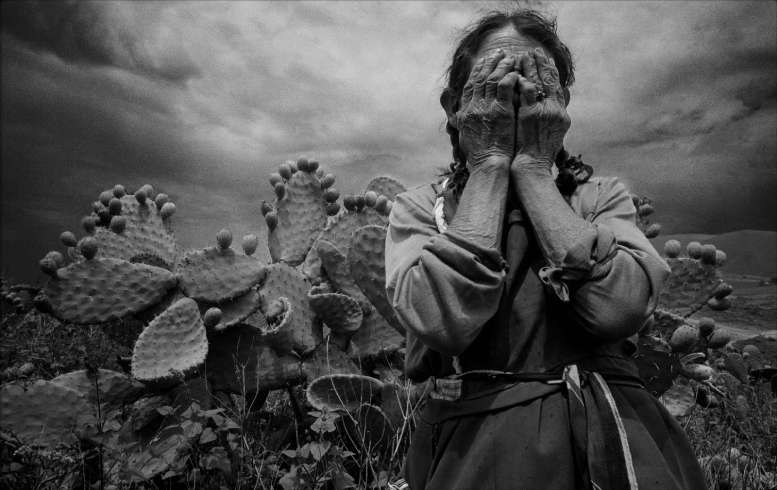
CHRISTIAN: Once inside, I found myself staring at this photo of an elderly lady. With blindness one of the keywords in my research, and notions of a dry, desert-like setting another, it seemed to me a most potent incarnation of the ideas behind “Drought”. In a moment of inexplicable magic, everything fell into place – although I was already making some mental additions to the picture.
Seven years earlier, a similarly unplanned encounter in Paris had given “Kénôse” its entire visual direction – and, as Christian kept finding correspondences between his lyrics and the art long after the fact, its structure too. On that occasion, he’d wandered into an exhibition, stormed out, and promptly bought several of the artist’s monographs.
CHRISTIAN: My reaction was more measured this time around. I spent a few days exploring the city – absorbing its cultural offerings and taking in the nicer and less pleasant sides of Porto by night – and only looked up the artist when I returned home. Ultimately, I recognised undeniable talent, but not themes I felt compelled to explore further.
Twice now, a solitary trip has led you to an exhibition you weren’t looking for – and to the visual key to a DEATHSPELL OMEGA release. How does a mind as rational as yours process that?
CHRISTIAN: I file it under a six-sigma event – or a mystery, should I find myself in a poetic mood. Then again, empirical evidence suggests that when you are ready for a particular encounter, it becomes more likely to happen at some point.
As it turns out, Christian found the cover during Portugal’s driest winter since records began in 1931 – by February 29, 2012, the entire mainland was in severe or extreme drought. He had no idea until I brought it up. By his own reckoning, that makes two six-sigma events on a single trip, and the theory of readiness will now have to account for the weather as well as the exhibition.
CHRISTIAN: Well, our entire body of work revolves around the diabolic and engages it in a dialogue – logically, something may speak back. And in this case, I might have to admit it did indeed. But the well-worn trope about God, or the Devil, working in mysterious ways strikes me as paradoxically too convenient; at some point, it diminishes what one considers holy. Let me quote good old Nietzsche, again from his Zarathustra: ‘Of gaps was the spirit of these redeemers made up; but into every gap they put their delusion, their stopgap, which they called God’.
In the chapter On the Priests, the prophet Zarathustra passes a group of clergymen and pities them as prisoners of their own Saviour – a charge theologians would later dub the ‘God of the gaps’.
CHRISTIAN: For my part, I’ll exhaust every logical explanation until none remains. Only as a very last resort will I entertain the notion of omens. Consider it a mark of rigour and respect rather than of militant disbelief.
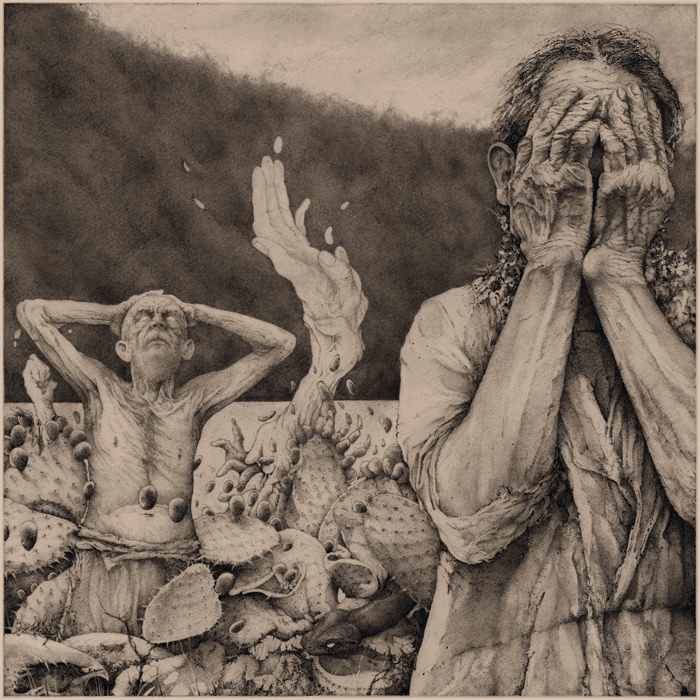
CHRISTIAN: The photograph was extraordinary, but a few conceptual elements were missing. I came up with a list of changes I wanted made, Manuel suggested a couple of additional ideas, and then he worked freely; any interference on my part would’ve been counterproductive.
In Tinnemans’ reworked image, the crone is joined by an emaciated, sightless old man – Adam and Eve at the end of times – as well as a serpent.
Of the cover’s several references, the most prominent is the Dust Bowl of the 1930s, when drought stripped the over-ploughed North American prairies of topsoil: a catastrophe largely caused by humankind and, as DEATHSPELL OMEGA told Imhotep, ‘a straightforward metaphor for things to come’.
CHRISTIAN: The suffocating summer of 2026 should have surprised no one paying attention. As for the artwork, after seeing Manuel’s very first draft and receiving an advance copy of the recording, Timo suddenly decided he wanted to contribute a drawing for the back. Much to my delight, as you can imagine: more Ketola was always welcome.
Compared to the front, Timo’s back cover looks almost like the next frame of the same film. The couple and serpent have vanished; the storm now fills the sky above an emptied landscape.
CHRISTIAN: I’d sent him the lyrics for feedback, as always, and we’d already discussed the concept behind “Drought”. I also provided numerous photographs from the period, some showing houses buried in dust. Timo was free to conceive the piece as he wished – but to me, it’s a distillation of all those elements, filtered through his own lens.
Timo’s illustration is rendered entirely in stippling – the very technique that drew him back to pen and paper after seeing Manuel’s PENTACLE cover in 1998. Homage, rivalry, or simply the right method for depicting dust?
CHRISTIAN: A bit of everything at once, possibly? Rivalry would probably be too strong a term. I assume that when Timo worked on the layout, he realised there was an obvious opportunity to establish a dialogue between two artworks. From this premise, one can imagine various motivations.
By 2012, Timo had been asked about DEATHSPELL OMEGA countless times and never once publicly confirmed or denied his involvement. That year, Tinnemans gave an interview to Heathen Harvest in which he took credit for the “Drought” front cover – and captioned the “Paracletus” illustration as a collaboration with ‘T. Ketola’.
CHRISTIAN: With the trilogy project complete, I may have relaxed my demands somewhat – but I can’t say for certain. Such credits matter to artists in our scene, who are rarely paid generously for their work: the economics of the underground simply don’t allow it. So, this sort of symbolic recognition can help compensate by bringing in further commissions and allowing them to command higher fees.
On a related note, Timo told me he dropped his laptop while finishing the “Drought” design – but an advance from NoEvDia got him a new one within forty-eight hours.
CHRISTIAN: Yes, it was one of those episodes where Timo needed some financial help and we stepped in. That’s what you do for friends, I think.
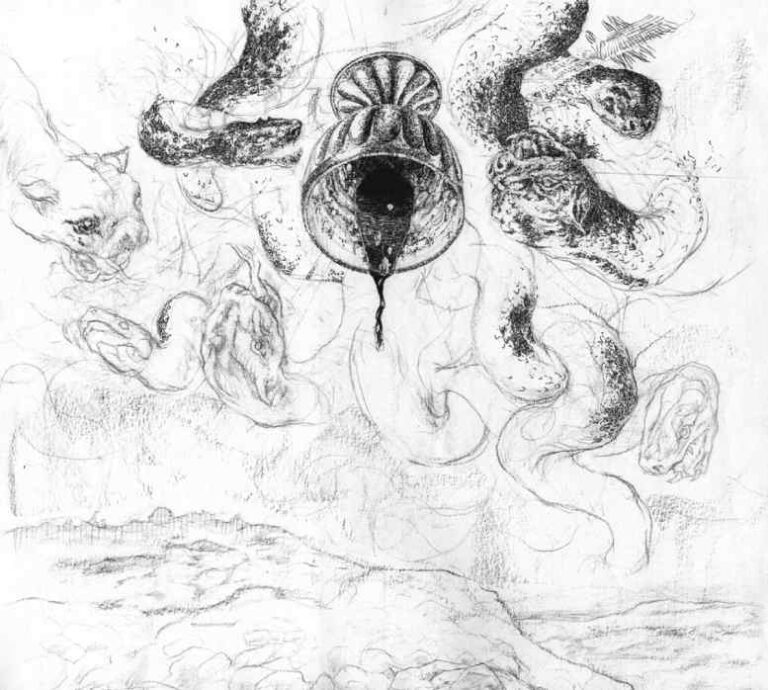
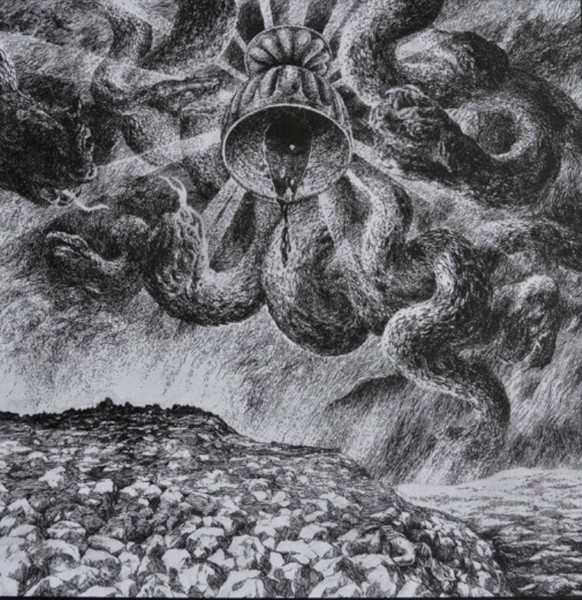
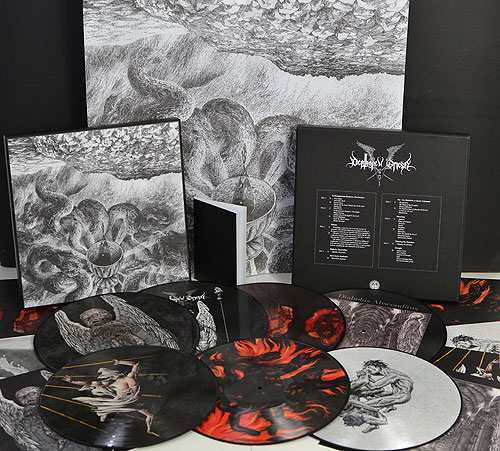

Alongside “Drought”, Timo was designing DEATHSPELL OMEGA’s 2012 box set, gathering the theological trilogy. For its 2009 predecessor, which compiled the band’s first era, the hourglass on the reworked “Inquisitors of Satan” artwork had been shattered – to make the image, as Christian put it, ‘even more definitive’.
This time, the same logic was applied to the chalice from “Si Monvmentvm Reqvires, Circvmspice”, inverted and spilling a thin black trickle onto a barren plain.
CHRISTIAN: The idea behind such a box is to materialise the unity and continuity of all its recordings, so I wanted the cover to be a visual metaphor for the entire trilogy. I believe the upturned chalice was part of my requests, which also included the descending figure from “Fas…” having hit the ground. But as usual, following intense discussion, Timo had a lot of creative input.
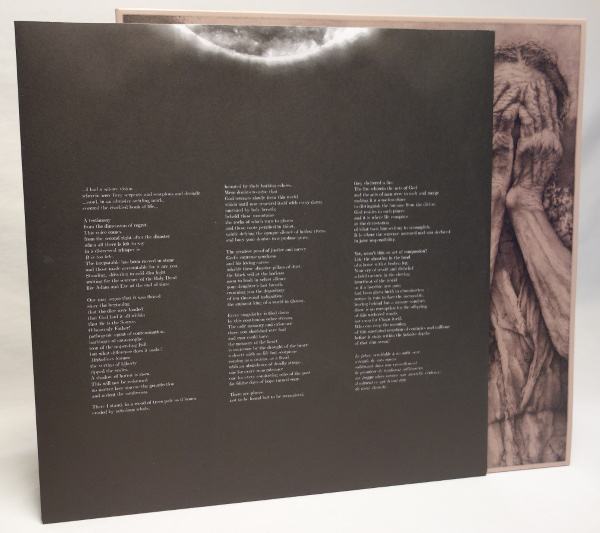
In 2012, Norma Evangelium Diaboli issued the set as seven picture discs, with seven art prints, a sixty-page psalter, and a poster. Buyers praise Timo’s packaging almost unanimously, but many complain about the sound quality. One maintains that the ambient passages of “Fas – Ite, Maledicti, in Ignem Aeternum” – the very dynamics Christian spent a month fighting to preserve in the mix – are nigh-on inaudible.
CHRISTIAN: Picture discs are indeed the worst format for preserving fidelity. I would, however, argue that it’s not as bad as this person implied. The physical medium is one aspect, sure – but having a proper turntable, a stylus in reasonable condition, a decent amplification system, and good speakers is equally important. Anyway, we wanted to create an artefact in which sound quality was ultimately, if only slightly, subordinated to considerations such as visual impact. A conscious trade-off.
The NoEvDia album archaeology continued. In 2011, “Diabolus Absconditus” returned under a Manuel Tinnemans cover, both on its own and paired with “Mass Grave Aesthetics” on vinyl, while MALIGN’s “Divine Facing / Fireborn” followed on LP. The next year brought the trilogy box and Season of Mist CD editions of “Fas…” and FUNERAL MIST’s “Devilry”.
Beyond these archival releases, NoEvDia’s new extreme metal output came from just two bands: DEATHSPELL OMEGA, with “Drought”, and TEITANBLOOD – whose place on the roster Timo had championed. The Spaniards’ fifteen-minute “Purging Tongues” appeared on a single-sided LP in 2011, followed the next year by a CD edition featuring the previously unheard “Sanctified Dysecdysis”.
Meanwhile, a new generation was emerging.
CHRISTIAN: These younger bands contrasted somewhat with our original circle, both as individuals and in their art. Some returned to familiar black metal themes, such as a certain take on Romanticism – by then devitalised, and often the least demanding point of entry – whereas others approached the Devil’s work from a different angle. Yet we, the artists around NoEvDia and End All Life, had clearly left a mark.
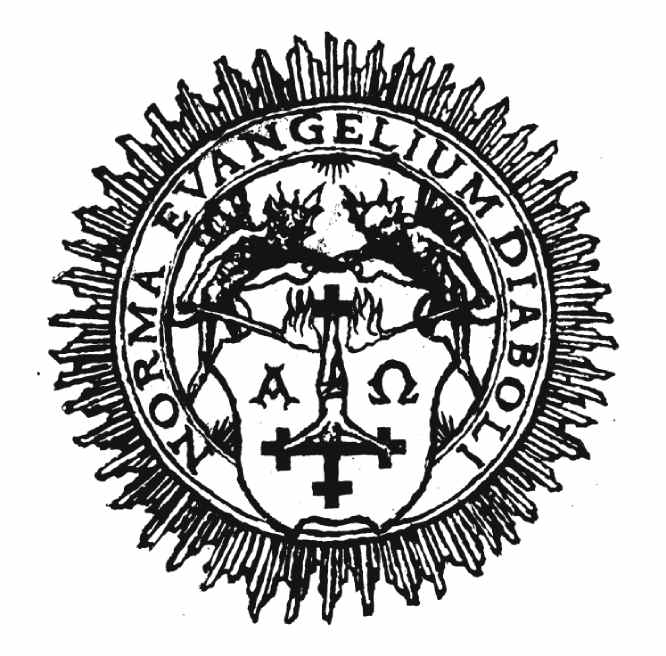
NoEvDia sigil by Timo Ketola and Erik Danielsson
That current first stirred, largely unnoticed, in late-’90s Sweden, among the bands orbiting Shadow Records – OFERMOD, FUNERAL MIST, and MALIGN – before announcing itself emphatically a few years later with “Salvation”, “Casus Luciferi”, “Kruzifixxion”, and “Si Monvmentvm…”.
Within a decade, revelation had become routine. What began as letters and conversations between a handful of people settled into a subgenre, ‘orthodox black metal’, with a fixed catechism: inverted theology, liturgical imagery, and an aesthetic Timo did much to define, increasingly accompanied by choirs and dissonance.
CHRISTIAN: I tend to tune out anything beyond my control, as dwelling on it would waste energy better spent on matters I can actually influence. Ynas (MALIGN), on the other hand, was acutely aware of the scene from early on, keeping a constant eye on everything wrong with it. At the end of the day, each of us took what we saw as the most coherent course: some faded into silence, others focused on their inner circle of friends, and a few carried on unfazed.
Where did you fit in?
CHRISTIAN: In almost everything, I follow my inner compass. If anything, I’d call myself a spectator, looking on as though none of it concerned me in the slightest. But that sentiment was, of course, at odds with my work on the label.
NoEvDia must have been the first port of call for every aspiring ‘orthodox’ band with a demo. How did you judge submissions that took your own releases as a blueprint?
CHRISTIAN: Critically. Even some records I would now sincerely recommend as respectable works of that period found no favour in my eyes at the time. You have to understand my reasoning: is this musically and conceptually better than, or at least fully on par with, FUNERAL MIST or KATHARSIS, for example?
Hardly a fair criterion – few records of any era would clear that bar.
CHRISTIAN: Agreed. It stemmed from my desire to uphold the vision on which NoEvDia was founded. Now, to be fair, all of us had our own influences – musical, as well as in terms of worldviews and general behaviour. But I also know, having lived through it, that the originators of what later became a formula for others to replicate underwent a great many extreme experiences to forge the template.
In a 2016 Bardo Methodology interview, MALIGN co-founder Ynas made much the same case: the Great Work, he argued, has aspects that cannot be grasped ‘from fancy books or arcane accessories alone’, and gaining certain insights ‘requires both the administering and reception of violence’.
CHRISTIAN: There was a lot of madness, countless sleepless nights spent staring into the abyss – all at great cost. “Salvation” sprang from far more than a casual fondness for black metal, as you can well attest, and this held true for every foundational album of the movement. So, when a record by a younger band displayed obvious musical qualities but, I sensed, not quite the same degree of personal sacrifice, I assume you’ll understand why I initially kept my distance. But, as Heraclitus taught, no man ever steps into the same river twice, for it is not the same river and he is not the same man.
Which changed more – the music arriving at NoEvDia, or you?
CHRISTIAN: The river changed faster than I did. I often felt I was, if not the last, then one of the last to cling to fading values and mindsets. My judgments move at a glacial pace, so it took me many years to warm to the new generation. They were perhaps less immersed in the conceptual dimension than we’d been, but very sincere in their approach. And sincerity has a value of its own. There are some brilliant musicians among them, who deserve my full admiration.
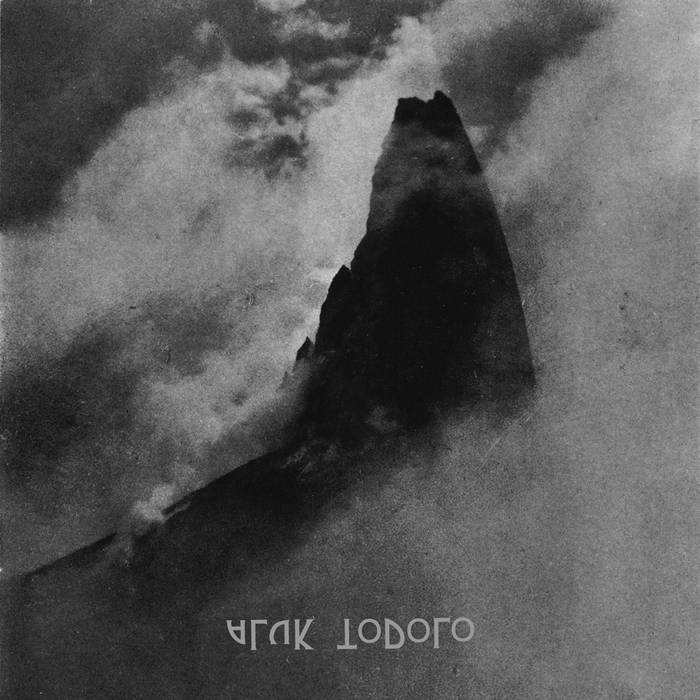
And yet in 2012, with the glacier barely moving, NoEvDia signed ALUK TODOLO – an instrumental trio operating well outside black metal.
CHRISTIAN: I already knew of the members through their previous projects, and, if memory serves, I hadn’t reviewed those particularly favourably in my fanzine back in the 1990s. But ALUK TODOLO captivated me, and my enthusiasm was not only genuine but downright overwhelming. Such conceptual depth, despite the absence of lyrics!
log in to keep reading
The second half of this article is reserved for subscribers of the Bardo Methodology online archive. To keep reading, sign up or log in below.
Related reading